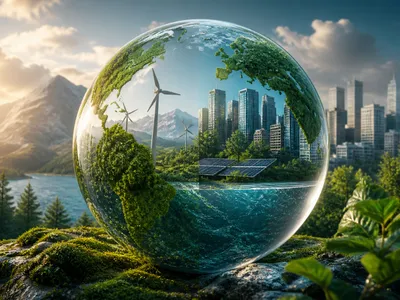
The Inherited Earth
Our present actions constitute a moral and practical blueprint for the world our descendants will inhabit. This concept, known as intergenerational equity, frames the environment not as a commodity but as a fiduciary trust passed between epochs.
Current economic models often discount future costs, creating a perilous temporal externality where deferred consequences accumulate unseen.
The geological community has proposed the term "Anthropocene" to mark our current epoch, defined by humanity's dominant influence on Earth's systems. This dominance carries an implicit responsibility for stewardship, necessitating a shift from exploitative to regenerative systems thinking to ensure the planet's fundamental life-support systems—climate, biodiversity, and biogeochemical cycles—remain intact and functional for future human civilization.
Averting the Resource Collapse Scenario
A critical dimension of sustainability is the responsible management of finite material and energy resources to prevent systemic collapse. The Limits to Growth thesis, while debated, underscores a non-negotiable reality: infinite growth within a finite biosphere is a physical impossibility.
Strategic pivots toward a circular economic model are essential to decouple prosperity from resource extraction. This model prioritizes design for longevity, reuse, remanufacturing, and recycling, fundamentally altering material flows.
This transition mitigates geopolitical risks associated with resource scarcity and fosters resilience. It represents a direct investment in future economic stability, ensuring that coming generations have access to the materials necessary for innovation and development without resorting to conflict or facing severe scarcity-driven inflation.
The energy transition's success hinges on a just and equitable approach, avoiding the replication of extractive paradigms under a "green" guise. Future generations will judge us not merely on our technological breakthroughs but on the ethical framework within which we deployed them. The pursuit of resource security must be coupled with ecological integrity and social equity to be truly sustainable.
Climate Stability as a Prerequisite for Progress
The Anthropogenic climate crisis represents the most profound and systemic threat to the developmental potential of future generations. It is not merely an environmental issue but a force multiplier for poverty, conflict, and instability.
A stable climate system is the non-negotiable foundation upon which all long-term human progress—agricultural, economic, and social—is constructed. Its disruption directly imperils food and water security.
Scientific consensus, as articulated by the IPCC, demonstrates that exceeding 1.5°C of warming will trigger non-linear tipping points with irreversible consequences, such as ice sheet collapse and major biome shifts. These changes would fundamentally alter the planet's habitability and capacity to support advanced civilizations.
Investing in climate mitigation and adaptation is therefore a direct investment in future socio-economic stability. The costs of inaction, quantified through tools like the social cost of carbon, dwarf the investments required for a rapid transition to a low-carbon economy. This transition, centered on renewable energy, electrification, and sustainable land use, must be viewed as the greatest infrastructure project in human history, one that will define the competitive and resilient landscape of the 22nd century. Failure to act constitutes a catastrophic transfer of risk and degraded living conditions to those who bear no responsibility for creating the crisis, violating core principles of justice and fiduciary responsibility.
Creating Lasting Value Through Sustainable Action
Sustainability is about active legacy-building, moving beyond mere preservation to actively enhance the capacity of future generations to thrive. This requires embedding anticipatory governance and adaptive learning into our institutions.
The challenges ahead are complex and nonlinear, demanding systems thinking and the ability to pivot in response to new information. Investing in sustainability today is an investment in societal antifragility and options value for the unborn.
This proactive approach manifests in several key areas: fostering open-source innovation for sustainable technologies to ensure equitable access, redesigning educational curricula to integrate ecological literacy and complex problem-solving, and establishing legal frameworks that recognize the rights of future generations. Such measures ensure that our descendants inherit not just a stable planet, but also the cognitive tools, institutional structures, and technological toolkit necessary to navigate their own challenges. The legacy we cultivate must therefore be dynamic—a foundation that enabls future innovation rather than constraining it. By prioritizing long-term resilience over short-term efficiency gains in isolated sectors, we build systems that can absorb shocks and evolve.
Consequently, the narrative shifts from one of sacrifice to one of generational opportunity. The sustainability transition presents the most significant driver for scientific discovery, economic modernization, and ethical renewal in the coming century. By embracing this imperative, we bequeath a world where the potential for human flourishing is not diminished but amplified—a world characterized by robust ecosystems, circular economies, and just societies. This is the profound, active bequest that true sustainability promises, making our present actions the most meaningful gift of possibility to those who will follow.