The Physical Backbone of a Virtual World
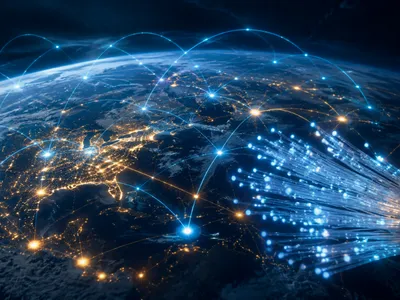
The seamless experience of digital life is underpinned by a vast, often invisible, physical architecture. This infrastructure transcends the abstract concept of “the cloud,” materializing as a complex global network of tangible components.
Undersea cables form the transcontinental arteries of the internet, carrying over ninety-nine percent of international data traffic. These fiber-optic lines, no thicker than a garden hose, are engineered to withstand immense oceanic pressures and are the critical latency factor in global communications.
Landing stations connect these submarine systems to terrestrial networks. From these coastal points, data travels through a hierarchy of cables, including long-haul fiber backbones and metropolitan area networks, to reach its destination region.
At the core of content delivery and cloud computing are data centers, the centralized repositories of computational power and storage. Their design prioritizes redundant power supplies, advanced cooling systems, and physical security, ensuring continuous operational integrity. The geographical clustering of these facilities creates availability zones critical for service resilience.
The interconnection between these physical elements—cables, networks, and data centers—creates the robust framework upon which all higher-layer digital services depend. Without this extensive physical plant, the instantaneity of modern digital iinteraction would be impossible. The table below illustrates key components of the global undersea cable infrastructure, a foundational element of this backbone.
| Cable System | Primary Landing Points | Approx. Length (km) | Design Capacity (Tbps) |
|---|---|---|---|
| MAREA | United States, Spain | 6,600 | 200+ |
| FASTER | Japan, United States | 11,629 | 60 |
| 2Africa | Multiple across Africa, Europe, Middle East | 45,000 | 180+ |
Complementing the cabling, the physical nodes of the network have evolved into sophisticated ecosystems. Modern hyperscale data centers often exceed one million square feet and consume electrical power on a scale comparable to small cities.
The key functional components within a typical Tier III+ data center facility include several critical subsystems that work in concert to maintain uptime and performance.
- ⚡ Power Infrastructure: Dual independent feeds, uninterruptible power supplies (UPS), and distributed backup generators.
- ❄️ Cooling Systems: Chilled water plants, computer room air handlers (CRAHs), and innovative designs using outside air or liquid immersion.
- 🌐 Network Connectivity: Carrier-neutral meet-me rooms with dense fiber cross-connects to multiple internet service providers.
- 🔐 Security & Monitoring: Multi-factor access control, biometric scanners, and pervasive sensor networks for environmental conditions.
How Does Data Navigate the Global Network?
Data traversal across the internet’s physical fabric is governed by a logical framework of protocols and addressing schemes. The journey of a data packet from source to destination is a complex orchestration of multiple independent systems. This process relies on a decentralized and interoperable suite of protocols that ensure reliability without centralized control.
At its core, the Internet Protocol (IP) provides the fundamental addressing mechanism. Every connected device is assigned a unique IP address, which functions as a logical locator within the global network topology. The transition from IPv4 to IPv6 is actively expanding the available address space to accommodate the proliferation of Internet of Things devices.
Packet routing is managed by Border Gateway Protocol (BGP), which is often described as the postal service of the internet. BGP allows autonomous systems—large networks operated by ISPs and major corporations—to announce which IP address ranges they control and to learn paths to reach all other networks.
The dynamic and policy-based nature of BGP path selection can lead to inefficiencies or vulnerabilities, such as route hijacking, where traffic is misdirected. Despite its critical role, BGP’s foundational design assumes a trusted environment, a premise that modern security practices must actively compensate for through initiatives like the Resource Public Key Infrastructure (RPKI).
Within individual networks, protocols like Open Shortest Path First (OSPF) manage internal routing. These interior gateway protocols calculate the most efficient local paths based on configurable metrics like link speed or latency, ensuring optimal traffic flow before handing off to BGP for inter-domain routing.
Different routing protocols are optimized for specific operational contexts within the broader network hierarchy, from internal data center routing to global path selection.
| Protocol | Operational Scope | Primary Function | Key Characteristic |
|---|---|---|---|
| BGP (Border Gateway Protocol) | Inter-Domain (Between AS) | Path Vector Routing | Policy-based, decentralized |
| OSPF (Open Shortest Path First) | Intra-Domain (Within an AS) | Link-State Routing | Fast convergence, hierarchical |
| EIGRP (Enhanced Interior Gateway Routing Protocol) | Enterprise Networks | Advanced Distance Vector | Cisco proprietary, efficient |
Enablers of Speed and Capacity
The user expectation for instantaneous data delivery is met by a suite of advanced technologies that optimize the flow of information. These solutions address the inherent limitations of physics and geography that govern data transmission over distance.
Content Delivery Networks (CDNs) are a primary architectural response to the latency problem. By caching static and dynamic content in geographically distributed edge servers, CDNs bring data closer to the end-user.
This process bypasses long-haul network routes for frequently requested content, dramatically reducing load times for web pages, videos, and software downloads. The strategic placement of these nodes is a critical factor in their performance efficacy.
Advancements in optical networking technology directly amplify the backbone's capacity. Dense Wavelength Division Multiplexing (DWDM) allows a single strand of fiber to carry multiple data signals simultaneously as different wavelengths of light, effectively multiplying capacity without new physical cable installations. Coherent optics, using advanced modulation techniques, enable these signals to travel transcontinental distances with high fidelity, pushing single-channel speeds beyond the terabit-per-second threshold. These innovations transform existing infrastructure, making it exponentially more powerful and cost-effective.
The evolution of network architecture toward edge computing further decentralizes processing. By performing computation and data storage at the network periphery, near data sources, this paradigm reduces the latency and bandwidth needed for journeys to centralized cloud data centers. This is essential for real-time applications like autonomous vehicles and industrial IoT.
Several key technologies work in concert to overcome the traditional bottlenecks of speed and latency, forming a multi-layered approach to performance optimization.
- 🗺️ Anycast Routing: A network addressing method where a single destination IP address is announced from multiple locations, automatically routing users to the topologically nearest server.
- 🚀 TCP Optimizations: Protocol enhancements like TCP Fast Open and BBR congestion control that reduce connection establishment overhead and improve throughput on modern networks.
- ⚡ HTTP/3 and QUIC: The latest application-layer protocols built on UDP, designed to reduce connection latency and improve performance over lossy networks, especially for mobile users.
- 🔗 Peering Agreements: Private interconnections between networks that allow data to flow directly between them, avoiding transit fees and potential bottlenecks on public internet paths.
How Internet Exchange Points Localize Traffic?
The internet is not a single monolithic network but a network of networks. Its resilience and efficiency depend fundamentally on how these disparate autonomous systems connect and exchange traffic.
Internet Exchange Points (IXPs) are the pivotal physical hubs where this exchange occurs. They provide neutral, shared fabric for multiple networks to peer, exchanging vast amounts of domestic and regional traffic locally.
This localization of traffic flow, known as traffic localization, prevents unnecessary international transit, lowering latency, reducing costs, and enhancing network performance for end-users within a region.
The economic and technical benefits of IXPs are substantial. By keeping local traffic local, they save participating networks considerable sums in transit fees paid to upstream providers. The reduced path length also minimizes potential points of failure and attack surfaces, contributing to a more robust national or regional internet infrastructure. A thriving IXP can stimulate a local digital ecosystem, attracting content providers, cloud on-ramps, and other services that seek low-latency access to the aggregated networks present at the exchange.
Beyond public IXPs, private interconnection has become the backbone of the cloud and SaaS economy. Hyperscale cloud providers like AWS, Google Cloud, and Microsoft Azure establish direct, high-capacity links within carrier-neutral data centers. This allows enterprise customers to access cloud services without their data ever traversing the public internet, providing superior security, predictable performance, and often lower costs. The colocation data center facility itself thus transforms from a mere hosting site into a dynamic interconnection nexus, where strategic business rlationships are physically embedded into the network fabric. This layer of private connectivity is essential for the performance of modern hybrid and multi-cloud architectures.
The global landscape of interconnection is not evenly distributed, with major hubs concentrating in key economic and geographic centers. The following table contrasts several major global Internet Exchange Points, highlighting their scale and pivotal role in regional connectivity.
| Comparative Overview of Major Global Internet Exchange Points | |||
|---|---|---|---|
| IXP Name | Location (Primary) | Peak Traffic (Tbps) | Key Role |
| DE-CIX Frankfurt | Germany | 12+ | World's largest by data throughput, central European hub |
| AMS-IX | Netherlands | 11+ | Major European interconnection point, known for efficiency |
| LINX (LONAP & MAN) | United Kingdom | Multiple Sites | Critical UK traffic exchange, enhancing national resilience |
| Equinix IX | Global (Distributed) | Varies by Metro | Largest global distributed exchange across 50+ metros |
The operational models of interconnection have evolved to meet diverse needs. Public peering at an IXP is typically open and facilitated through a shared switch, ideal for exchanging traffic with many networks. Private peering involves a direct, dedicated physical or virtual circuit between two networks, offering greater capacity, security, and control, which is why it dominates cloud and content provider connectivity. The choice between models is a strategic decision based on traffic volume, performance requirements, and cost.
This interconnected mesh of public and private links creates a fault-tolerant web. If one path becomes congested or fails, routing protocols can dynamically re-route traffic through alternative interconnections, ensuring the overall stability of the digital ecosystem. The health and openness of these exchange points are therefore critical indicators of a mature and competitive digital economy.