Defining HRC
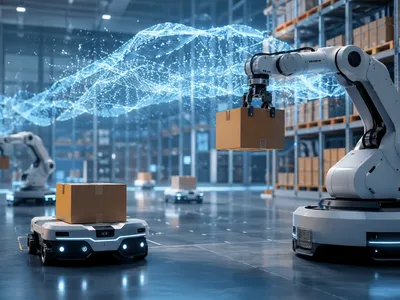
Human-Robot Collaboration (HRC) enables humans and robots to share workspaces and tasks, unlike isolated robotic cells. Robots operate alongside people without physical barriers, requiring new design philosophies. HRC is classified into four levels, ranging from simple coexistence to synchronized actions, shared control, and mutual adaptation between agents.
Effective collaboration depends on establishing common ground through a bidirectional communication loop, allowing each agent to anticipate the other's actions. Robots interpret human gestures, gaze, and speech, while humans understand robot intent via visual or auditory cues like LED signals. Without this shared understanding, collaboration deteriorates into mere coordination, making transparent robot behavior a design priority.
The foundational elements of HRC can be summarized as follows:
- 🤝 Physical co-existence without barriers
- 🔄 Task interdependence and role negotiation
- ⚡ Real-time feedback and adaptation
- 👀 Mutual performance monitoring
Key Enablers
Several technologies enable safe and efficient HRC. Sensor fusion and lightweight robot arms form the hardware backbone, while advanced grippers improve dexterity.
Artificial intelligence plays a crucial role in real-time intent prediction. Machine learning algorithms allow robots to recognize human actions and adjust their trajectories accordingly. This reduces cognitive load on human workers and prevents unnecessary stoppages.
ISO/TS 15066 defines safety requirements for collaborative robot applications, including power and force limiting. Speed and separation monitoring allows robots to slow down or stop when humans approach. Additionally, lightweight materials and rounded edges reduce injury risks during accidental contact. These enablers transform industrial robotics from dangerous machines into safe co-workers. Without such integrated safety systems, true and trusted collaboration remains impossible in practice.
Safety Systems
Safety systems in HRC prevent injuries during accidental contact, with power and force limiting reducing impact energy. Dynamic speed adjustments and speed and separation monitoring maintain safe distances near human operators, while hand guiding allows controlled physical interaction with the robot arm, highlighting how robotics is changing industrial workflows with a focus on shop-floor safety.
Holistic collaborative workspace safety combines hardware, software, and training. Protective zones monitored by safety-rated software trigger a safety-rated monitored stop if breached. Light curtains, area scanners, and torque-limiting sensors enhance protection, and functional safety certification per ISO 13849 ensures correct responses to faults. Ongoing risk assessments address evolving tasks and human behaviors to prevent unpredictable failures.
Negotiating Roles in Shared Workspaces
Humans and robots must continuously negotiate who does what in shared workspaces. This dynamic role allocation improves efficiency and trust.
| Pattern | Human Responsibility | Robot Responsibility | Example Task |
|---|---|---|---|
| Leader-Follower | High-level planning | Precise execution | Assembly line |
| Peer-to-Peer | Shared control | Adaptive assistance | Collaborative lifting |
| Supervisor-Subordinate | Quality inspection | Repetitive motion | Packaging |
Role negotiation often relies on shared mental models and communication protocols. When task complexity increases, robots may request assistance or cede control. Effective negotiation reduces idle time and prevents conflicts over shared resources, mirroring the underlying mechanisms of what is autonomous decision systems in dynamic environments.
Implementing adaptive role negotiation requires real-time intent recognition and flexible task planning. Robots must interpret subtle human cues such as hesitation or workload indicators. Proactive role switching occurs when the system predicts a bottleneck. Training both human operators and robot algorithms on negotiation strategies enhances overall system resilience. Longitudinal studies show that teams with explicit role negotiation outperform those with fixed assignments.
Measuring Success in Collaborative Tasks
Traditional productivity metrics often overlook HRC quality, whereas collaborative efficiency evaluates task completion alongside idle times and handover delays. Trust and user acceptance serve as key non-technical indicators, with fluency metrics measuring seamless coordination and subjective workload assessments like NASA-TLX uncovering hidden strain on human operators.
A comprehensive evaluation framework for HRC includes:
- ⏱️ Cycle time reduction relative to solo work
- 🛑 Number of safety interventions or emergency stops
- 🤔 Human perceived safety and trust scores
- 💤 Robot idle time due to unclear intent
Overcoming Technical and Social Barriers
Technical challenges in HRC include sensor noise, latency, and unpredictable human motion, requiring robust perception algorithms to manage occlusions and lighting variations. Social barriers, such as worker fear of job loss or distrust of autonomous systems, can be addressed through participatory design sessions early in deployment.
Interoperability with different robot brands and legacy systems demands standardized communication protocols like OPC UA and ROS 2 to create modular HRC setups. Successful implementation also depends on organizational change management, including supervisor training, clear role definitions, and financial planning that considers retraining and maintenance. Neglecting social factors often leads to abandonment of otherwise functional systems within the first year.