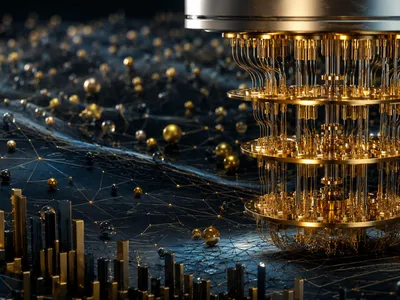
Entanglement Empowers Quantum Links
The foundational architecture of a quantum network diverges profoundly from its classical counterpart by leveraging the unique principles of quantum mechanics. This framework is built upon the transmission and manipulation of quantum information, encoded in physical systems known as qubits. Unlike binary bits, qubits can exist in a superposition of states, enabling a form of parallel information processing that is fundamentally more powerful for specific tasks.
A quantum network’s operational backbone relies on the generation and distribution of quantum entanglement. This phenomenon describes a powerful correlation between particles where the quantum state of one cannot be described independently of the other, regardless of the physical distance separating them. Entanglement is a non-classical resource that enables protocols impossible on today's internet, forming the core of quantum networking applications.
Key hardware components include stable qubit platforms like trapped ions or nitrogen-vacancy centers in diamond, which act as network nodes. Photons serve as the flying qubits for transmitting quantum states through optical fibers or free-space links. The integrity of these transmissions is challenged by decoherence and photon loss, necessitating advanced error correction and signal amplification strategies to maintain the fragile quantum information across distances.
The following table categorizes the primary physical systems explored for implementing the core components of a quantum network, highlighting their respective advantages and current challenges.
| Qubit Platform | Role | Key Advantage | Primary Challenge |
|---|---|---|---|
| Trapped Ions | Network Node / Memory | High fidelity operations and long coherence times | Complex scaling and system integration |
| NV Centers in Diamond | Node / Interface | Room-temperature operation and optical addressability | Limited qubit connectivity and spectral stability |
| Photons | Communication Channel | Low-loss propagation in existing fiber infrastructure | Probabilistic entanglement generation and loss |
| Superconducting Circuits | Processing Node | Rapid gate operations and potential for on-chip integration | Requires cryogenic environments, not ideal for transmission |
The interplay between these components defines the network's capability. A critical function of the stationary matter qubits is to serve as a quantum memory, allowing for the storage and on-demand retrieval of quantum states. This capability is indispensable for synchronizing operations across the network and for building quantum repeaters. The performance metrics for these memories, including storage time, efficiency, and fidelity, are active frontiers in applied quantum physics research.
Current experimental demonstrations have successfully linked small-scale nodes, validating core principles. These pioneering implementations rely on a stack of protocols governing entanglement distribution, purification, and teleportation. The technical progression from these proof-of-concept demonstrations to scalable architectures represents the central engineering challenge in the field today.
- 🔀 Quantum Superposition: The ability of a qubit to exist in multiple computational states simultaneously, expanding data representation.
- 🔗 Quantum Entanglement: A persistent, non-local correlation between qubits that is the primary resource for networked quantum protocols.
- 📡 Quantum Teleportation: A protocol using entanglement and classical communication to transfer an unknown quantum state between locations, without physical transfer of the particle.
- ⚠️ Decoherence: The process by which a quantum system loses its quantum properties due to interaction with the environment, imposing strict timing constraints on operations.
How Unhackable Photons Safeguard Communications?
Quantum Key Distribution is the most technologically mature application of quantum networking, offering a provably secure method for establishing cryptographic keys between remote parties. Its security foundation rests not on computational hardness, but on the fundamental laws of quantum mechanics. Any attempt by an eavesdropper to measure the quantum states being transmitted inevitably disturbs them, a consequence of the no-cloning theorem and the observer effect, leaving detectable anomalies in the communication.
The BB84 protocol, introduced by Bennett and Brassard, remains a canonical example. It uses two non-orthogonal bases for encoding bits onto photon polarizations. Legitimate users, traditionally named Alice and Bob, subsequently use a public channel to sift and compare a subset of their measurements, revealing any discrepancy caused by interception. This process allows them to distill a pperfectly secret shared key known only to them, with security that is information-theoretically secure.
Modern QKD systems have moved beyond simple point-to-point links. Networked QKD architectures, such as trusted-node networks, are already operational in several metropolitan areas. These networks allow key distribution between users not directly connected by a quantum channel by routing keys through intermediate, trusted nodes. While this architecture enhances reach, it requires trust in the network operator at the intermediate points, representing a security compromise compared to end-to-end quantum links.
Continuous-variable QKD and measurement-device-independent protocols represent significant advances addressing practical limitations. MDI-QKD, in particular, removes all security vulnerabilities from the detection units, which are often the most complex and attack-prone components. This approach dramatically enhances the practicality and security of real-world deployments, pushing QKD closer to widespread commercial adoption for critical infrastructure protection.
- 🔐 Information-Theoretic Security: Security derived from information theory, guaranteed against an adversary with unlimited computational power, unlike classical public-key cryptography.
- 🕵️ Eavesdropping Detection: The inherent capability of QKD protocols to reveal the presence of an interceptor through increased quantum bit error rates.
- 🌐 Trusted-Node Network: A pragmatic QKD network topology where security is guaranteed only if intermediate nodes are not compromised, enabling wider geographical coverage.
The integration of QKD with existing cyber-infrastructure poses non-trivial challenges, including key management integration, high-speed classical post-processing, and cost-effective deployment. Satellite-based QKD experiments have demonstrated the feasibility of establishing global-scale quantum-secure links, overcoming the distance limitations imposed by terrestrial fiber attenuation. These achievements mark a pivotal step toward a future quantum-secured global communications grid.
Despite its strengths, QKD is not a panacea for all cybersecurity ills. It specifically addresses the key exchange problem and does not provide authentication by itself, which must be handled by classical means. Furthermore, its security claims depend on rigorous adherence to the underlying physical models and proper implementation, highlighting the need for robust certification standards. The evolution of QKD from a laboratory curiosity to a component of national security architectures underscores its transformative potential.
The long-term vision extends beyond QKD to a full quantum internet, but QKD serves as the critical first use case. It drives the development of essential hardware like single-photon sources and detectors, while simultaneously creating an ecosystem for quantum network services. This technological maturation pathway ensures that early investments in quantum secure communications yield tangible benefits, even as more advanced networked quantum computing applications remain on the horizon.
Can Quantum Repeaters Bridge Global Distances?
The vision of a global quantum internet is predicated on overcoming the fundamental limit of signal attenuation in quantum channels. Direct transmission of photonic qubits over optical fiber is constrained to a few hundred kilometers before losses become insurmountable. To bridge continental distances, the architecture must incorporate quantum repeaters, which are sophisticated nodes designed to extend entanglement through intermediary segments without directly measuring the quantum state.
Unlike classical signal amplifiers, a quantum repeater cannot copy an unknown quantum state due to the no-cloning theorem. Instead, it operates by establishing entanglement independently across shorter, manageable links. These local entanglement bonds are then swapped and purified through a series of quantum operations to create a single, high-fidelity entangled pair across the entire distance. This process is iterative and requires each repeater node to possess both processing capability and a reliable quantum memory.
Quantum memories are essential for storing entangled states while waiting for successful entanglement generation in adjacent segments and for performing the necessary purification routines. Their performance is quantified by storage lifetime, retrieval efficiency, and operational bandwidth. Solid-state systems like rare-earth-doped crystals and atomic ensembles are leading candidates, offering promising coherence times and integrability with telecom-wavelength photons. The development of a multiplexed, broadband quantum memory is considered a critical path technology for scalable networks.
The functional hierarchy of a quantum repeater can be broken down into distinct stages, each with specific technical requirements and challenges that must be solved in concert.
- ⭐ Entanglement Generation: Creating entangled pairs between a repeater node and its immediate neighbors using probabilistic photon emission and detection.
- ⭐ Entanglement Storage: Holding the fragile quantum state in a memory with high fidelity, awaiting the success of parallel attempts on other links.
- ⭐ Entanglement Swapping: A Bell-state measurement that connects two shorter entangled links to create entanglement across a longer distance, effectively moving the entanglement connection point.
- ⭐ Entanglement Purification: A non-deterministic protocol that consumes several low-fidelity entangled pairs to distill a smaller number of pairs with higher fidelity, counteracting operational noise and imperfections.
Current research is focused on moving from proof-of-concept, single-repeater-link demonstrations to multi-node, field-deployable systems. This necessitates not only hardware advances but also the creation of robust network stack protocols for quantum communications. These protocols must manage entanglement scheduling, handle purification decisions, and route quantum information efficiently, introducing a layer of complexity absent in classical networking.
Integrating quantum repeaters into existing telecommunication infrastructure presents significant engineering hurdles. They require cryogenic or ultra-stable environmental conditions, precise optical alignment, and low-latency classical communication for coordination. The roadmap to a quantum internet is therefore incremental, progressing from trusted-node networks to entanglement-distribution networks, and finally to a fully functional quantum repeater internet capable of distributed quantum computation.
The ultimate utility of this infrastructure extends far beyond secure communication. A fully realized quantum internet, enabled by repeaters and memories, would serve as the backbone for connecting remote quantum computers, dramatically increasing their collective computational power through blind quantum computing and distributed algorithm execution. It would also enable ultra-precise networked quantum sensing, creating a web of synchronized atomic clocks or telescopes with unprecedented resolution.
Can Entanglement Enable a Global Quantum Web?
The prospect of a globe-spanning quantum web hinges on the feasibility of generating and distributing entanglement on a planetary scale. Entanglement is not a signal that propagates but a correlation that is established, making its "distribution" a non-trivial procedural achievement. The primary obstacle is the exponential decay of photon probability with distance in optical fibers, which makes direct transmission of entanglement-generating photons over intercontinental distances practically impossible with current technology.
Two divergent yet potentially complementary pathways are being pursued to overcome this distance barrier. The first is a terrestrial approach based on a global network of quantum repeaters, as previously described. The second, more radical approach leverages satellite-based nodes to estblish entanglement through free-space optical links. The vacuum of space offers a lower-loss channel for photons, and satellites can establish connections between distant ground stations, effectively acting as entanglement sources or repeaters in low-Earth orbit.
Pioneering experiments have demonstrated satellite-to-ground quantum key distribution and even entanglement distribution over distances exceeding 1,200 kilometers. These missions validate the critical technologies, such as high-precision pointing and acquisition systems, ultra-bright entangled photon sources, and detectors capable of operating in daylight noise conditions. The success of these experiments provides a compelling argument that a hybrid space-terrestrial network is the most plausible architecture for achieving a global quantum web in the coming decades.
The comparative analysis of different platform strategies for long-range entanglement distribution highlights distinct trade-offs between technological maturity, scalability, and operational complexity, guiding strategic research investments.
| Platform Strategy | Maximum Link Distance | Key Technical Challenge | Scalability Potential |
|---|---|---|---|
| Terrestrial Fiber with Repeaters | Unlimited (theoretical) | Quantum memory coherence and high-speed optical switching at many nodes | High, but requires massive infrastructure deployment at dedicated facilities |
| Direct Satellite-to-Ground | ~10,000 km (satellite visibility) | Atmospheric turbulence, narrow transmission windows, and satellite payload constraints | Moderate, limited by satellite constellation size and ground station density |
| Satellite-Based Repeater Constellation | Global | Placing and maintaining quantum processors (memories) in space with intersatellite links | Very High, but represents a long-term, monumental engineering endeavor |
Beyond the formidable hardware challenges, the creation of a global quantum web introduces profound questions in quantum network theory. Researchers are developing new graph-theoretic models to describe entanglement flow and resource states across complex, heterogeneous networks. The concept of an entanglement routing protocol must account for the probabilistic nature of entanglement generation, the finite lifetime of stored entanglement, and the need for purification, making it fundamentally different from classical packet routing.
The functional applications of such a web would be transformative. A planetary-scale entanglement distribution network would enable cryptographic tasks like position-based quantum cryptography and multi-party secure computation with guarantees unavailable classically. Furthermore, it would facilitate truly global quantum sensor networks for geodesy and fundamental physics tests, probing the intersection of quantum mechanics and general relativity with unprecedented sensitivity. The answer to whether entanglement can enable a global web is shifting from a theoretical 'if' to a practical 'how' and 'when,' driven by rapid experimental progress.