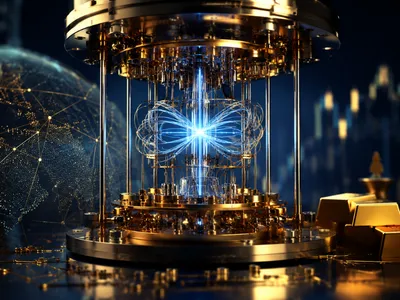
How Does Quantum Entanglement Enable Parallelism?
The foundational principles of quantum computing extend far beyond the basic concept of superposition. While a classical bit exists as a definitive 0 or 1, a qubit leverages superposition to occupy a probabilistic blend of both states simultaneously.
This fundamental capability is exponentially amplified through quantum entanglement, a phenomenon where qubits become intricately linked, with the state of one instantly influencing another regardless of distance. Entanglement creates powerful non-classical correlations that are the true engine for quantum parallelism, enabling a quantum processor to manipulate a vast landscape of possibilities in a single computational step.
Engineering Qubits for the Real World
Translating quantum theory into functional hardware requires meticulous physical engineering of qubits. Multiple modalities are being pursued, each with distinct trade-offs between coherence time, gate fidelity, and scalability. The dominant platforms include superconducting circuits, trapped ions, and photonic qubits.
Superconducting qubits, particularly the transmon design, are currently the workhorse for many tech giants due to their compatibility with solid-state fabrication techniques. These artificial atoms are manipulated using microwave pulses within cryogenic environments near absolute zero to minimize environmental noise.
Trapped-ion qubits offer exceptional coherence times and high-fidelity gate operations, as they use naturally occurring atomic states isolated in ultra-high vacuum chambers. However, their sequential gate execution and complex apparatus present significant challenges for scaling to millions of qubits, a necessity for fault-tolerant computing.
Can Quantum Computers Deliver Practical Scientific Value?
The landmark demonstration of quantum supremacy marked a pivotal transition from theoretical promise to engineered reality. This term denotes the moment a quantum computer executes a specific, albeit often esoteric, task intractable for any classical supercomputer within a reasonable timeframe.
The focus is now decisively shifting toward quantum utility, where quantum processors are used to solve problems of practical scientific value, even before full error correction is achieved. This era is defined by extracting actionable insights from imperfect, noisy quantum devices.
Demonstrations have relied on sampling problems, such as boson sampling or random circuit sampling, designed to be hard for classical simulation but not directly applicable. The rapid classical algorithmic counter-advancs following these experiments highlight the dynamic competition in the field. Current experiments aim for utility in quantum chemistry and materials science, where even approximate results from quantum devices can provide new knowledge.
How Does Quantum Error Correction Protect Qubits?
The fragility of quantum information presents the central obstacle to building large-scale, reliable quantum computers. Quantum error correction (QEC) is the sophisticated framework designed to protect logical qubits by encoding their information across many physical qubits.
QEC operates on a principle profoundly different from classical redundancy. Measuring a quantum state directly destroys it, so errors are inferred indirectly through syndrome measurements on entangled ancilla qubits. The threshold theorem proves that if physical error rates are below a certain threshold, logical error rates can be suppressed arbitrarily through larger codes. Topological codes, like the surface code, are favored for their relatively high threshold and nearest-neighbor interaction requirements, making them suitable for planar chip architectures. The ongoing experimental challenge is to maintain the integrity of logical information for longer than the constituent physical qubits can store it.
What Can NISQ Quantum Computers Achieve Today?
Current quantum computing exists firmly within the NISQ paradigm, defined by processors containing from 50 to several hundred qubits that lack comprehensive error correction. The "noisy" designation is critical, as operations are prone to errors from decoherence, imperfect gate calibration, and readout mistakes. In this regime, the depth of executable quantum circuits is severely limited before information is lost to noise.
The primary research objective in the NISQ era is to identify and demonstrate quantum utility—solving a practical problem more efficiently or accurately than classical methods, despite the noise. This requires co-designing algorithms, error mitigation strategies, and hardware to extract the maximum computational value from fragile quantum states. Error mitigation techniques, such as zero-noise extrapolation and probabilistic error cancellation, are essential tools. They do not prevent errors but instead characterize the noise and use classical post-processing to infer what the result of a lower-noise computation would have been, at the cost of increased sampling overhead.
The technological landscape of the NISQ era is characterized by rapid progress and diverse hardware approaches, each with distinct performance profiles. The following table summarizes the current capabilities and focus of leading qubit modalities in the NISQ context.
| Qubit Modality | NISQ Qubit Count Range | Key NISQ Advantage | Primary NISQ Limitation |
|---|---|---|---|
| Superconducting | 50 - 1000+ | Fast gate operations, scalable fabrication | High gate error rates, qubit crosstalk |
| Trapped Ion | 10 - 100+ | High-fidelity gates, long coherence | Slow gate speeds, scaling complexity |
| Neutral Atom | 100 - 1000+ | High qubit count, long coherence | Mid-circuit readout challenges |
| Photonic | 10 - 100+ (mode count) | Room temperature operation, low noise | Probabilistic entangling gates |
The trajectory of the NISQ era is toward increasingly complex and meaningful benchmarks, moving from random circuit sampling to simulations of quantum dynamics and quantum chemistry that can provide verifiable, scientifically relevant results not easily obtainable through classical approximation methods alone.