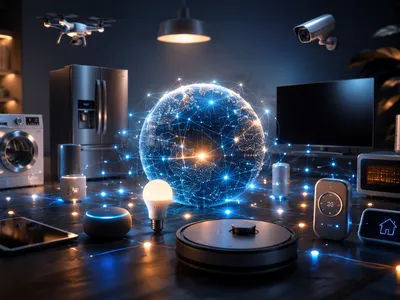
Predictive Analytics in Smart Home Automation
Contemporary smart home evolution is defined by a fundamental shift from reactive command-based systems to anticipatory environments. These advanced ecosystems leverage predictive analytics and machine learning to automate domestic experiences without explicit user input.
The operational core of this paradigm lies in sophisticated behavioral algorithms that analyze historical data from sensor networks, appliance usage, and occupant routines. By identifying subtle patterns and correlations, the system constructs dynamic models of resident behavior, enabling it to pre-emptively adjust lighting, climate, and even entertainment settings. This represents a move towards ambient computing where technology recedes into the background, focusing on outcome-based automation rather than manual device control. The technical architecture required for such proactivity necessitates robust edge computing capabilities to process data locally, thereby mitigating latency and enhancing real-time responsiveness within the living space.
Interoperability The New Imperative
A critical barrier to realizing seamless smart home functionality has been the proliferation of isolated, vendor-specific platforms. The current trend strongly emphasizes interoperability as a non-negotiable feature for next-generation systems.
This drive is fueled by consumer demand for flexible, future-proof solutions that avoid ecosystem lock-in. The industry's previous reliance on closed, proprietary protocols is increasingly seen as a limitation to innovation and scalability.
Emerging open-standard frameworks and universal application programming interfaces (APIs) are becoming central to new product development strategies.
The following table contrasts the key characteristics of the traditional model with the emerging interoperability-driven paradigm, highlighting the shift in design philosophy and user benefit.
| Aspect | Traditional Siloed Model | Interoperable Model |
|---|---|---|
| Communication Protocol | Proprietary, brand-specific | Open-standard (e.g., Matter, Thread) |
| System Integration | Complex, requires custom bridges | Native, seamless connectivity |
| User Flexibility | Limited to single-brand ecosystems | Freedom to mix and match devices |
| Long-Term Viability | High risk of obsolescence | Enhanced future-proofing |
Achieving true interoperability presents significant technical and commercial hurdles for the industry. The primary challenges are not merely technological but also involve aligning business interests across competitive landscapes. Established players with dominant market shares may perceive open standards as a threat to their proprietary ecosystems and recurring revenue streams from dedicated services.
Ambient Intelligence and Invisible Interfaces
The concept of ambient intelligence represents the next evolutionary stage for smart homes, moving beyond discrete devices toward a context-aware environment. This paradigm envisions a living space saturated with interconnected, yet unobtrusive, computing power.
Key to this shift is the development of invisible interfaces that move beyond screens and voice commands. These include advanced sensor arrays for gesture and presence detection, as well as materials and objects with embedded sensing capabilities. The goal is a zero-user interface experience where technology's presence is felt through its effects, not its apparatus.
The technical realization of ambient intelligence depends on several converging innovations. Distributed micro-sensors and low-power wireless mesh networks form the perceptual fabric of the environment, collecting vast amounts of contextual data. Edge AI processors then analyze this data stream in real-time, distinguishing between routine activities and aanomalous events without requiring cloud connectivity. This enables the system to manage resources and trigger automations based on a nuanced understanding of occupant needs, promoting both efficiency and comfort through seamless integration into daily life.
The table below outlines the primary categories of emerging invisible interfaces, highlighting their operational principles and potential applications within the domestic sphere.
| Interface Type | Mechanism | Typical Application |
|---|---|---|
| Context-Aware Sensors | Fusion of data from temperature, humidity, light, and sound sensors to infer activity. | Adjusting ambient lighting and audio volume based on detected mood or activity. |
| Gesture & Spatial Recognition | Millimeter-wave radar or time-of-flight cameras detecting movement and proximity. | Controlling media playback or lighting with hand waves, or activating pre-sets upon room entry. |
| Embedded & Tangible UI | Interactive surfaces and objects where controls are integrated into furniture or walls. | A kitchen countertop that displays recipes or a table that controls whole-home audio. |
How Will AI Reshape Domestic Energy Management?
Artificial intelligence is transitioning from a luxury feature to a core component of sustainable home energy systems. Modern AI-driven platforms extend far beyond simple scheduling, employing deep learning for holistic optimization.
These systems integrate real-time data from smart meters, weather forecasts, local grid demand signals, and household consumption patterns. Machine learning models process this multifaceted data to forecast energy needs with high accuracy, enabling predictive load balancing. This allows the home to automatically shift non-essential consumption to off-peak hours or periods of high renewable generation.
A more profound impact lies in the management of distributed energy resources, such as home battery storage and electric vehicle charging. Advanced algorithms perform continuous cost-benefit analyses, deciding when to store grid energy, consume it directly, or discharge back to the grid based on dynamic tariffs and predicted self-consumption. This transforms the home from a passive energy consumer into an active node in a flexible smart grid. Furthermore, generative AI models are now being piloted to simulate countless energy usage scenarios, identifying unique conservation strategies tailored to a specific household's architecture and behavioral patterns that would be non-intuitive to human planners.
Security and Privacy in the Hyper-Connected Home
The proliferation of connected devices dramatically expands the domestic attack surface, transforming ordinary appliances into potential vectors for cyber intrusion.
Concurrent privacy issues arise from the continuous extraction of behavioral data, creating detailed digital twins of inhabitants without transparent consent mechanisms.
Mitigating these intertwined risks necessitates a fundamental rethinking of smart home security frameworks, particularly through the adoption of zero-trust principles. Effective countermeasures must evolve beyond device-level passwords to encompass systemic approaches.
- 🛡️ Implementation of network segmentation to isolate critical systems from less trusted IoT device networks.
- 🔐 Mandatory use of end-to-end encryption for all data transmissions, both within the local network and to cloud services.
- 🔑 Adoption of hardware-based secure elements for device identity and authentication, moving away from easily compromised software-based keys.
Sustainable solutions depend on robust regulatory frameworks and industry standards that enforce minimum security and privacy baselines. Emerging certification programs mandate practices like regular software updates, transparent vlnerability disclosure, and advanced data anonymization. Concurrently, user-centric privacy interfaces—which visually map data flows and provide intuitive control—are essential for moving beyond opaque consent forms. This dual approach seeks to embed security and privacy by design, transforming them into fundamental system attributes crucial for building long-term user trust in hyper-connected domestic technologies.