How Does Hawking Radiation Work?
At the heart of Hawking radiation lies a profound tension between general relativity and quantum field theory. This conflict becomes most acute at the event horizon, where spacetime curvature reaches extreme values.
The conventional picture of empty space as a featureless void gives way to a seething foam of virtual particle-antiparticle pairs that continually pop in and out of existence. These fluctuations are not mere mathematical artifacts but carry tangible physical consequences.
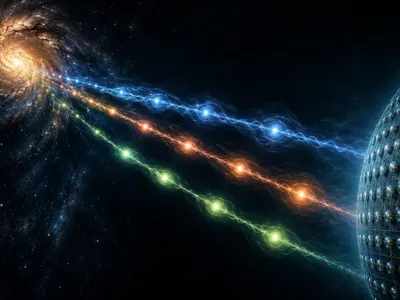
When such a pair materializes exactly at the event horizon, an extraordinary fate awaits. One particle plunges inward, its worldline terminating at the singularity, while its partner escapes to infinity. The infalling particle carries negative energy relative to an observer at rest, thereby reducing the black hole’s mass through a purely quantum process. This mechanism transforms a classically immutable object into a slowly evaporating body.
What makes this process particularly striking is its independence from the black hole’s formation history. The emitted radiation retains no memory of the matter that originally collapsed, exhibiting a nearly perfect thermal spectrum characterized solely by the black hole’s surface gravity. This thermodynamic behavior forced physicists to reconsider the very nature of gravitational entropy, establishing a bridge between the microscopic world of quantum mechanics and the macroscopic arena of spacetime geometry. A conceptual revolution emerged from what initially appeared to be a minor quantum correction.
The Event Horizon’s Hidden Energy
Energy extraction from a black hole occurs not through classical mechanics but through the subtle architecture of curved spacetime. The event horizon acts as a membrane where quantum fields acquire unusual properties.
One can visualize the horizon as a one-way surface that separates trapped regions from the external universe. Virtual photons and gravitons near this boundary undergo amplification due to the gravitational field’s tidal forces.
The energy for Hawking radiation ultimately derives from the black hole’s mass itself, leading to a gradual decrease in its Schwarzschild radius. For a solar-mass black hole, the evaporation time surpasses the current age of the universe by many orders of magnitude, yet for primordial black holes formed in the early cosmos, detectable gamma-ray bursts might still occur today. This timescale sensitivity offers a potential observational window into quantum gravity effects that would otherwise remain hidden.
Several distinct energy regimes characterize the emission process. The table below summarizes how different particle species contribute to the overall spectrum and how the energy scales vary with black hole mass.
| Particle Type | Emission Peak (relative to kT) | Mass Dependence |
|---|---|---|
| Massless bosons (photons, gravitons) | ≈ 2.8 kT | Gray‑body factor ≈ 1 |
| Neutrinos | ≈ 3.2 kT | Suppressed at low energies |
| Electrons & positrons | ≈ 4.5 kT (when T ≫ mₑ) | Exponentially suppressed below threshold |
The thermal nature of Hawking radiation implies that a black hole emits all species of elementary particles whose Compton wavelength is comparable to the horizon size. As the black hole shrinks, its temperature rises, enabling the production of increasingly massive particles. This runaway effect, known as the black hole evaporation final stage, remains one of the most active areas of theoretical inquiry.
Key conceptual shifts introduced by this energy‑extraction mechanism include:
- 🕳️ Thermodynamic unification – Black holes possess entropy proportional to horizon area, linking gravity to statistical mechanics.
- 🕳️ Information loss controversy – If evaporation is purely thermal, the initial state’s information appears destroyed, challenging unitary quantum evolution.
- 🕳️ Holographic principle – The entropy–area relation suggests that the fundamental degrees of freedom of quantum gravity reside on lower‑dimensional surfaces.
Each of these implications forces a reexamination of foundational principles. The apparent contradiction between the predictability of quantum mechanics and the irreversible character of black hole evaporation has driven decades of research, with recent advances in string theory and holography offering tentative resolutions. Emergent spacetime paradigms now suggest that what we perceive as the event horizon might be a coarse‑grained description of a more fundamental, unitary process.
Virtual Particles in a Curved Spacetime
Quantum field theory in curved spacetime provides the rigorous mathematical framework for understanding Hawking radiation. This formalism treats matter fields on a classical gravitational background, revealing how curvature within the what is space-time continuum modifies the vacuum state.
The notion of a particle becomes ambiguous when observers undergo acceleration or reside in regions with event horizons. A quantum state that appears empty to an inertial observer at infinity manifests as a thermal bath when viewed from the perspective of a freely falling observer near the horizon. This observer‑dependent particle concept lies at the core of the effect.
Technically, one constructs Bogoliubov transformations that relate the vacuum defined on past null infinity to the vacuum defined on future null infinity. The mixing between positive and negative frequency modes yields a nonzero expectation value for the number operator, directly giving the Planckian spectrum characteristic of Hawking radiation. Such calculations demonstrate that the radiation emerges not from any localized source but from the global structure of the spacetime itself.
A striking consequence of this analysis is the prediction that the Hawking temperature depends only on the surface gravity of the black hole. For a Schwarzschild black hole, T = ħκ/(2πckB), where κ = c⁴/(4GM). This inverse relationship between mass and temperature implies that smaller black holes radiate far more intensely than their stellar‑mass counterparts. In the final moments of evaporation, the temperature rises without bound, pushing the semiclassical approximation to its limits. Quantum gravity becomes unavoidable as the horizon radius approaches the Planck scale, where the very concepts of spacetime and thermodynamics must be reimagined.
Why Black Holes Are Not Truly Black?
The term “black hole” suggests an object that absorbs everything and emits nothing, yet quantum effects reveal a dim but persistent glow. This emission fundamentally alters the classical picture of these gravitational entities.
From a distance, a black hole appears as a dark sphere against the sky, but the radiation it emits carries away energy, angular momentum, and even charge over astronomical timescales. For astrophysical black holes formed from stellar collapse, the present‑day emission is far too feeble to be detected, consisting primarily of ultra‑low‑energy photons and gravitons with wavelengths comparable to the horizon size. Nevertheless, the principle that no object is eternally stable under quantum mechanics reshapes our understanding of gravitational collapse and final states.
The emission spectrum contains valuable information about the black hole’s properties. While the leading‑order thermal distribution is universal, subleading corrections—so‑called gray‑body factors—depend on the spin of the emitted particle and on the black hole’s rotation. These factors encode the scattering of outgoing modes off the background curvature, effectively acting as frequency‑dependent filters. The overall picture, therefore, is not strictly blackbody but carries subtle imprints of the horizon geometry.
Several qualitative reasons explain why black holes must radiate:
- 🕳️ Unitarity demands: If black holes never radiated, pure states evolving into mixed states would violate quantum mechanical unitarity.
- 🕳️ Thermodynamic consistency: The laws of black hole mechanics mirror the laws of thermodynamics only when Hawking radiation is included.
- 🕳️ Spacetime stability: Without evaporation, small perturbations could lead to runaway instabilities in quantum field theory on curved backgrounds.
The realization that black holes emit radiation transformed them from exotic mathematical solutions into physical objects governed by quantum laws. This shift compelled theorists to treat black holes as thermodynamic systems with well‑defined temperatures and entropies. The information paradox that emerged from this synthesis remains one of the deepest open problems in fundamental physics, highlighting the still‑incomplete marriage of general relativity and quantum theory.
Can Black Holes Destroy Quantum Information?
Hawking’s original calculation suggested that black hole evaporation is entirely thermal, implying that information about the collapsing matter is permanently lost. This conclusion directly conflicts with the unitarity principle that underpins quantum mechanics, leading physicists to explore the limits of what is entanglement in preserving quantum data across horizons.
The resulting information paradox forces theorists to choose between abandoning quantum determinism or modifying our understanding of spacetime structure at the horizon. Recent advances in string theory and the gauge‑gravity duality suggest that information may indeed escape encoded in subtle correlations within the radiation, preserving unitarity without requiring exotic Planck‑scale effects at the horizon itself. Holographic entanglement entropy calculations have provided compelling evidence that the radiation’s entropy follows the Page curve, a hallmark of unitary evolution.
The legacy of this debate extends far beyond black hole physics, touching foundational questions about the nature of reality. If information is preserved, then the event horizon cannot be a true boundary; instead, it must be replaced by a fuzzball or a wormhole structure that allows quantum correlations to escape. Conversely, if information is destroyed, quantum mechanics itself would require revision, potentially signaling a deeper principle where gravity fundamentally alters the flow of time and causality. These competing possibilities drive current research at the frontier of quantum gravity, where laboratory analogues of Hawking radiation in condensed‑matter systems now offer rare experimental glimpses into this profound theoretical landscape.