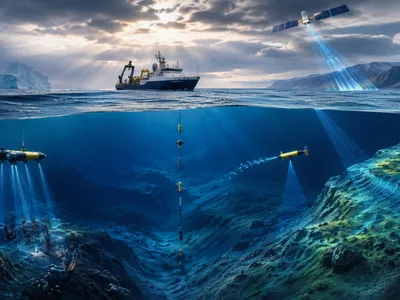
How Does the Deep Ocean Store Heat?
Earth's oceans store more than 90 percent of the excess heat generated by anthropogenic warming. This vast thermal reservoir suppresses the apparent rise in surface temperatures, while the upper ocean layers present a calmer picture than the full system actually reflects.
New high-resolution simulations show that subsurface heat content is increasing faster than earlier projections suggested. Deep convection processes transport energy beneath 2000 meters, outside the reach of standard observation systems, delaying atmospheric balance. The mismatch between observed sea surface temperature trends and Earth's energy imbalance therefore points to an underestimation of deep-ocean heat storage, leaving short-term climate sensitivity projections potentially biased toward lower ranges.
Gaps in Argo's Vision
The Argo profiling float array revolutionized oceanography, yet its reach is far from absolute. Spatial and bathymetric blind spots introduce significant uncertainty into global heat budgets. Coastal shelves and marginal seas remain chronically undersampled.
A critical review of deployment logistics reveals a stark divide. While mid-latitude gyres enjoy dense coverage, high-latitude polar oceans and deep trenches constitute data deserts. The table below outlines the observational asymmetry that biases global mean calculations.
| Ocean Basin | Argo Density (Floats/10⁶ km²) | Sampling Depth Bias | Heat Uptake Certainty |
|---|---|---|---|
| North Atlantic | 42 | Upper 2000m skewed | High |
| South Pacific | 18 | Sub-Antarctic gap | Moderate |
| Arctic Ocean | <5 (seasonal ice limit) | Permanent under-ice void | Very Low |
| Southern Ocean (South of 60°S) | 12 | Severe winter undersampling | Low |
Recent studies combining satellite altimetry with sparse in-situ profiles suggest that the abyssal Southern Ocean is warming at a rate nearly 40 percent higher than previously cataloged. This research highlights how deep sea currents regulate global weather by exporting heat into the abyss, even though standard Argo floats remain unable to descend beyond two kilometers to capture these dynamic shifts.
Where Are the Missing Measurements?
Marginal seas and continental shelves cover only eight percent of the ocean surface yet play a disproportionate influence in global heat exchange. At the same time, the sharp decline of ship-based expendable bathythermograph transects since the Argo transition has reduced high-resolution vertical profiling, limiting the ability to accurately monitor narrow boundary currents in these already undersampled regions.
The following list details critical observational deficiencies that impede accurate closure of the global heat budget. Each gap introduces a systematic cold bias into multi-decadal trend analyses.
-
🌊
Indonesian Throughflow RegionComplex bathymetry and strong tidal mixing; fewer than ten active Argo floats operate in the Banda and Timor Seas.
-
🌀
Western Boundary ExtensionsThe Gulf Stream and Kuroshio regions exhibit high eddy variability. Lagrangian float displacement prevents sustained Eulerian monitoring.
-
⬇️
Deep Overflow PathwaysDenmark Strait and Faroe Bank Channel overflows transport dense water below 2000 meters, invisible to standard profiling floats.
-
🧊
Seasonally Ice-Covered ShelvesThe Laptev and East Siberian Seas experience intense summer heating of surface freshwater lenses, but winter data is nonexistent.
Without targeted deep-diving autonomous vehicles and expanded glider operations, these missing measurements perpetuate a skewed perception of ocean warming. The true rate of heat accumulation in the Indo-Pacific warm pool remains a matter of statistical inference rather than direct observation.
Polar Shadows and Deep Currents
The abyssal overturning circulation acts as a long-term heat sink, sequestering thermal anomalies away from the atmosphere for centuries. Antarctic Bottom Water formation sites are ground zero for this process.
Recent hydrographic sections across the Weddell Sea reveal a significant freshening and warming of the dense shelf waters that feed the global abyss. This process underscores the reality of melting ice and its deep ocean consequences, as the deep limb of the overturning circulation decelerates while absorbing more heat. This deceleration alters the vertical distribution of heat, trapping warmth at intermediate depths where it can later re-emerge to influence ice shelf basal melt rates.
Polar shadows extend beyond the simple absence of sunlight to encompass a data void of immense scale. The perennial ice cover of the Arctic Ocean prevents satellite altimetry from accurately measuring sea level rise contributions from thermal expansion. Meanwhile, the turbulent boundary layers beneath Antarctic ice shelves are completely inaccessible to remote sensing, leaving model parameterizations of ice-ocean heat flux dangerously unconstrained. The potential for rapid, non-linear melt driven by warm circumpolar deep water intrusions underscores the risk of underestimating both ocean heat content and subsequent sea level commitments. When integrated over the vast volume of the Southern Ocean, an error of just a few millidegrees in abyssal temperature translates to an energy discrepancy equivalent to several years of global industrial activity.
Why Historical Baselines Betray Modern Trends?
Climatological normals derived from pre-Argo eras rely heavily on sparse ship tracks and mechanical bathythermographs. These legacy records contain systematic instrumental biases that artificially cool historical baselines.
A reassessment of XBT fall-rate equations and bucket-to-engine-room intake corrections reveals a persistent cold bias in mid-20th century subsurface temperature archives. When modern high-precision floats are compared against these adjusted records, the rate of ocean warming appears significantly steeper than earlier assessment cycles indicated.
- Time-Varying Bias Adjustments: Corrections applied to historical data are not static; evolving methodologies change the baseline slope.
- Mapping Infill Artifacts: Objective analysis techniques smooth gradients in data-void regions, muting extreme warming signals at high latitudes.
- Reference Period Shift: Updating from a 1981–2010 to a 1991–2020 climatology absorbs recent warming into the average, masking the anomaly trend.
- Deep Ocean Initialization: Coupled models initialized with pre-Argo observations often start with an unrealistically cold abyss.
The choice of vertical interpolation scheme also skews perceived heat gain. Isotherm-following analyses capture warming of water masses better than fixed depth-level averages, yet the latter remain standard in many intercomparisons.
Reframing Climate Certainty Without Alarm
The narrative surrounding ocean warming often oscillates between understated confidence and hyperbolic alarm. A more constructive approach involves acknowledging the inherent structural uncertainty in our observing network without dismissing the clear physical signal.
Recent syntheses of in-situ data with grace satellite gravimetry and reanalysis products converge on a singular finding: the ocean is gaining heat at an unprecedented rate. The table below juxtaposes the known limitations against the irreducible certainties derived from independent measurement systems.
| Uncertainty Vector | Impact on Heat Estimate | Robust Constraint |
|---|---|---|
| Argo deep ocean coverage (below 2000m) | Potential underestimate of 10-15% | Satellite altimetry infers total thermosteric expansion |
| Marginal sea & coastal sampling | Regional biases in continental shelf budgets | High-resolution SST records show coastal amplification |
| Historical XBT/MBT fall-rate corrections | Modifies centennial trend by ±0.05 W/m² | Paleoceanographic proxies confirm recent anomaly uniqueness |
| Polar under-ice measurements | Seasonal cycle aliasing in ice-covered regions | Ice mass loss from GRACE confirms net heat import |
A balanced scientific communication strategy must emphasize that the direction of change is unequivocal while the exact magnitude carries a specific uncertainty envelope. This framing encourages adaptive policy responses rather than gridlock induced by perceived data insufficiency.
Acknowledging gaps in the Argo array or deep-ocean coverage does not invalidate the thermodynamic imperative of a warming planet. The energy accumulating in the ocean system—verified through independent sea level budget closures and Earth radiation imbalance measurements at the top of the atmosphere—provides a metric that transcends individual instrumental flaws. While localized sampling biases persist, the planetary-scale integration of these signals yields a consistent story of accelerating thermal absorption. The observed increase in marine heatwave frequency and the stratification-driven decline in primary productivity in subtropical gyres serve as tangible, observable consequences that corroborate the subsurface temperature trends derived from the global fleet of profiling floats.
The path forward lies in expanding the observational network to encompass the full ocean volume. With new technologies revealing hidden ocean cycles, investments in deep Argo technology and autonomous gliders will progressively narrow the uncertainty ranges. Even within the current data landscape, the signal has decisively emerged from the noise. The ocean is not merely a passive receptacle for excess heat; it is the primary memory bank of the Earth system.