The Impenetrable Barrier Myth
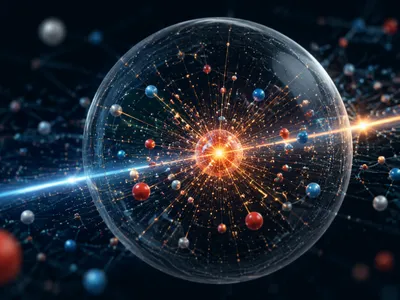
Classical physics assumes that a particle cannot overcome a barrier higher than its energy, viewing potential walls as absolute limits based on everyday intuition and Newtonian mechanics. Quantum mechanics, however, replaces this certainty with the wave function, describing particles as probability clouds that can extend through obstacles rather than as localized objects.
Even when the wave function meets a region of elevated potential energy, it does not drop to zero abruptly. Instead, its amplitude diminishes exponentially across the forbidden region, revealing the crucial mathematical insight that this decay is finite and allows particles to penetrate barriers at the nanoscopic scale, challenging the notion of impenetrable matter.
The table below quantifies the stark contrast between classical expectations and the counterintuitive reality of tunneling behavior. It illustrates how the barrier width fundamentally alters the transmission probability.
| Physical Regime | Barrier Perception | Transmission Probability |
|---|---|---|
| Classical Macro-scale | Absolute Wall | Exactly Zero |
| Quantum Wide Barrier | Strong Suppression | Extremely Small but Finite |
| Quantum Narrow Barrier | Significant Leakage | Appreciable and Measurable |
This finite probability is not a mere mathematical curiosity. It is the engine driving stellar fusion and the bane of the semiconductor industry's relentless pursuit of miniaturization.
Wave-Particle Duality's Role
A classical particle cannot enter a region where its kinetic energy would be negative, but this limitation vanishes when we consider the wave nature of matter. The de Broglie wavelength gives even massive objects a spatial and frequency extent, and this intrinsic positional uncertainty is a fundamental property, not a measurement error.
Since a particle exists as a delocalized wave packet, part of its amplitude can penetrate thin potential barriers. The internal reflection within the barrier is partial, letting some probability density appear on the far side. This behavior mirrors evanescent waves in optics, where a decaying field can cross a narrow gap, making quantum tunneling the matter-wave counterpart of frustrated total internal reflection.
The list below summarizes the essential physical factors that govern the likelihood of observing a tunneling event. These parameters emerge directly from the Schrödinger equation's solution for a rectangular potential step.
- 🧱 Barrier Width — The probability decreases exponentially with increasing thickness; doubling the width squares the attenuation factor.
- ⚡ Energy Deficit — The difference between barrier height and particle energy dictates the decay rate inside the classically forbidden zone.
- ⚖️ Particle Mass — Heavier particles tunnel with exponentially lower probability, explaining why the effect dominates in electron-scale systems.
Recognizing that a particle is a wave not only rescues logical consistency but provides the precise mathematical framework for calculating tunneling currents. Without exploring the wonders of quantum physics in daily life and this dualistic perspective, the behavior of modern transistors and the sun itself would remain utterly inexplicable.
The spatial extent of the wave function guarantees that confinement is never absolute. Even within the most robust potential wells, there exists a finite, albeit sometimes vanishingly small, probability of escape.
How Particles Cheat Classical Physics Rules?
Classical physics mandates that a particle's kinetic energy must remain positive; otherwise, the equations of motion yield imaginary velocity. The very idea of entering a region where potential energy exceeds total energy constitutes a forbidden transaction.
Quantum mechanics circumvents this restriction not by granting the particle extra energy, but by rendering the concept of a well-defined trajectory meaningless. This principle is a cornerstone of what is quantum computing and why it matters, as the Heisenberg uncertainty principle ensures that we cannot simultaneously know a particle's precise location and its exact momentum.
Within the barrier, the wave function does not oscillate as a propagating wave; instead, it enters an evanescent regime characterized by exponential decay. This decay constant is governed by the square root of the mass and the energy deficit. The particle does not travel through the barrier in a classical sense; it simply possesses a non-zero probability amplitude to be found on the far side. The mathematical formalism of the Schrödinger equation seamlessly accommodates these complex wave vectors, which are anathema to Newtonian trajectories.
The temporal aspect of this process remains one of the most subtle and debated facets of tunneling physics. For decades, the question of how long a particle spends inside the classically forbidden region seemed unanswerable. Recent theoretical advances using weak measurements and attosecond laser pulses have begun to probe this tunneling time controversy with unprecedented experimental resolution. Studies suggest that the traversal may be effectively instantaneous or even involve superluminal group velocities that do not violate causality due to the severe reshaping of the transmitted wave packet.
The following table contrasts the distinct mathematical treatments applied to a particle's wave function inside and outside the potential barrier. It highlights the stark difference between propagating solutions and the damped, non-oscillatory behavior within the forbidden gap.
| Spatial Region | Wave Function Nature | Phase Accumulation |
|---|---|---|
| Classically Allowed (E > V) | Propagating Plane Wave | Complex Exponential (Oscillatory) |
| Classically Forbidden (E < V) | Evanescent Wave | Real Exponential (Decay/Growth) |
| Transmitted Region | Reduced Amplitude Wave | Shifted but Oscillatory |
Real-World Quantum Leaps
Wave function penetration is spectacularly evident in stellar cores. Without this counterintuitive tunneling, the universe would remain a cold, dark expanse lacking heavy elements. Quantum seepage allows protons in the Sun to overcome Coulomb repulsion, with the Gamow factor quantifying the tunneling probability that initiates the proton-proton chain reaction. This process produces the light and warmth essential for life on Earth.
On Earth, tunneling has been harnessed in tools like the scanning tunneling microscope. A biased, atomically sharp tip brought nanometers from a conductive surface allows electrons to tunnel, and the exponential sensitivity of the current to distance enables atomic resolution. The topographic images produced by STM are maps of constant tunneling probability, effectively tracing the contours of electron clouds on surfaces.
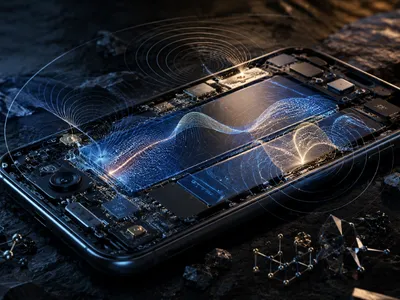
In contrast, tunneling challenges the semiconductor industry. Ultra-thin transistor gate oxides permit electrons to leak through the insulator, increasing power use and heat in processors. Engineers mitigate this by employing high-κ dielectrics, which maintain capacitive coupling while reducing undesired quantum leakage, allowing devices to function efficiently despite atomic-scale barriers.
The list below enumerates several prominent domains where quantum tunneling transitions from a theoretical curiosity to an indispensable operational principle or a critical design constraint.
- ☢️ Alpha Particle Decay — Heavy nuclei emit alpha particles via tunneling through the strong nuclear force potential barrier.
- 🔗 Josephson Junctions — Superconducting pairs tunnel through an insulating layer, enabling ultra-sensitive magnetometers and qubit designs.
- 💾 Flash Memory Erasure — Electrons are removed from floating gates via Fowler-Nordheim tunneling when high voltages are applied.
These applications underscore the dual nature of tunneling as both a cosmic enabler and a terrestrial engineering challenge. It bridges the gap between the esoteric mathematics of quantum mechanics and the tangible hardware of modern civilization.