Dynamic Adaptation in Plant Structure and Growth
Plants demonstrate remarkable phenotypic plasticity, allowing them to reconfigure root architecture in response to localized nutrient availability and optimize resource acquisition without mobility. Beyond morphological changes, cellular flexibility entails reversible adjustments in cell wall composition and turgor pressure, enabling tissues to withstand mechanical stress from wind or soil compaction while preserving vascular function. This dynamic structural recalibration is a core resilience trait explored in innovative plant research across vascular plants.
The Stress Response
When facing drought or salinity, plants trigger a complex signaling cascade centered on the hormone abscisic acid, with stomatal closure reducing water loss and osmoprotectant synthesis protecting cellular machinery from ionic imbalance.
Systemic acquired acclimation illustrates a sophisticated memory mechanism in which prior stress exposure primes tissues for future challenges. This epigenetic regulation of stress-responsive genes provides a preparedness that transcends immediate survival, allowing plants to convert transient adversity into lasting resilience.
Collective Strength in Community
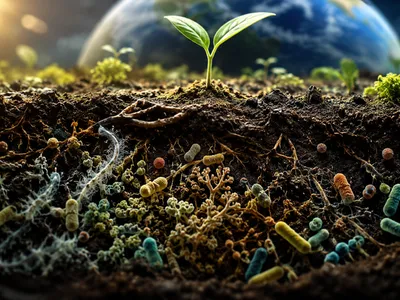
Beneath the soil surface, plants engage in sophisticated networks where mycorrhizal fungi facilitate resource exchange and chemical signaling, demonstrating how soil microbes shape our world through hidden interactions.
This underground economy enables the redistribution of carbon, nitrogen, and even defensive compounds from established individuals to vulnerable neighbors, fundamentally altering competitive dynamics into cooperative systems.
The ecological implications are profound: such mycorrhizal networks function as extended phenotypes, allowing plants to perceive herbivore attacks through volatile organic compounds and mount preemptive defenses. Kin recognition mechanisms further refine these interactions, with root allocation patterns shifting to favor genetically related individuals. Collective resilience emerges from reciprocity, demonstrating why botany matters for ecosystem health when survival strategies extend far beyond individual physiological limits.
Research distinguishes several cooperative behaviors within plant communities, each contributing to system-wide stability:
- Common mycorrhizal networks that transfer phosphorus and water across species boundaries
- Allelopathic signaling that coordinates flowering time to maximize pollinator visitation
- Root exudate-mediated recruitment of beneficial soil microbiota for pathogen suppression
- Canopy architecture adjustments that optimize light penetration for understory cohorts
How Do Plants Remember Past Environmental Stress?
Plants retain information from past environmental encounters through multiple interacting memory systems across different timescales. Transcriptional priming enables previously stressed individuals to respond faster and more robustly to recurring challenges, a mechanism conserved across diverse taxa.
The molecular basis of plant memory includes chromatin remodeling, small RNA pathways, and metabolic imprints that persist through cell divisions and, in some cases, across generations. Transgenerational stress memory provides progeny with adaptive advantages without altering DNA, and experience becomes encoded architecture, turning transient stress into enduring ecological insight.
Comparative analysis reveals divergent memory strategies across plant functional types, as summarized below:
| Memory Type | Duration | Example Species | Ecological Function |
|---|---|---|---|
| Transcriptional priming | Days to weeks | Arabidopsis thaliana | Accelerated pathogen defense |
| Epigenetic inheritance | Multiple generations | Linum usitatissimum | Heritable drought acclimation |
| Circadian anticipation | Daily cycles | Phaseolus vulgaris | Predictive resource allocation |
| Damage-induced signaling | Hours to months | Populus spp. | Herbivore deterrence coordination |
These memory mechanisms collectively enable plants to navigate stochastic environments with predictive accuracy, reducing the energetic costs associated with constant vigilance and broadening the temporal horizon of resilience planning.
Succession: Nature’s Long View
Ecological succession demonstrates that resilience is a dynamic process evolving over decades and centuries, as pioneer communities gradually modify inhospitable substrates through soil formation and organic matter accumulation, establishing niches that support increasingly complex assemblages.
This directional shift involves predictable phases where facilitation, competition, and tolerance sequentially structure community composition. Late-successional species exhibit distinct traits—slow growth rates, high shade tolerance, and extensive resource storage—that enable persistence under closed-canopy conditions. Resilience emerges through functional replacement, where ecosystem properties remain stable despite complete turnover in species identity, demonstrating that adaptive capacity resides in system architecture rather than individual components.
Practical Wisdom for Human Systems
Urban planners are increasingly inspired by plant strategies to design infrastructure that absorbs disturbances while preserving essential functions. Modular redundancy in green infrastructure mimics the decentralized vascular networks of trees, helping prevent cascade failures during extreme weather events.
Organizational theory has adopted principles of phenotypic plasticity to cultivate teams capable of rapid role reconfiguration under shifting demands. When human institutions embrace polycentric governance structures analogous to mycorrhizal networks, they distribute decision-making authority and create multiple pathways for resource flow during crises. Such biomimetic approaches transform resilience from a reactive capacity into a proactive design philosophy.
The most profound lesson from botanical systems may be their integration of persistence with transformation: plants neither rigidly resist change nor collapse under pressure but continuously reorganize around disturbance, converting disruption into evolutionary opportunity.