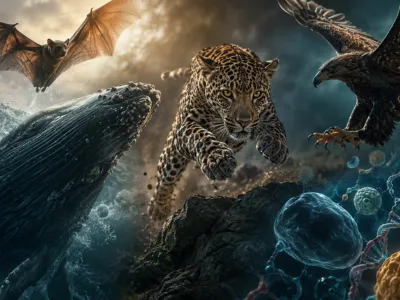
Acoustic Cipher
Bioacoustic research utilizes advanced computational methods, including machine learning algorithms, to parse this code. These tools analyze spectrograms for patterns imperceptible to the human ear, revealing structured syntax in bird song and information-dense sequences in cetacean clicks. The discovery of dialects within populations of orcas and certain songbirds underscores a cultural dimension to acoustic communication, challenging simplistic models.
A primary finding is that many species employ functional referential signaling, where specific acoustic units reliably denote external events, such as predator type. This capacity transforms vocalizations from mere expressions of arousal into a primitive form of referential communication. The acoustic cipher is not merely a signal but a rich, contextual data stream integral to social cohesion and survival.
Chemical Dialogues and Olfactory Networks
Chemical signaling constitutes one of the most ancient and pervasive communication channels in the animal kingdom. Pheromones and other semiochemicals relay precise information about reproductive status, territorial boundaries, and alarm. Insects like ants operate within a sophisticated olfactory network, using trail pheromones for collective problem-solving and colony coordination. The integration of multiple chemical compounds allows for a combinatorial "language" capable of conveying a surprisingly broad message set, from food source location to colony threat level.
This chemical dialogue operates across temporal scales, from immediate alarm to long-term territorial marking. Recent studies highlight the role of the major histocompatibility complex (MHC) in vertebrate chemical communication, influencing mate choice to ensure genetic heterozygosity. Chemical signals thus form an invisible, persistent information web that structures social hierarchies and genetic fitness. The decoding of these dialogues requires sensitive chromatographic analysis, moving beyond behavior to molecular intent.
Visual Displays and the Grammar of Gesture
Visual communication relies on dynamic sequences and morphological adaptations shaped by the sensory environment. Cephalopods, such as cuttlefish and octopuses, exhibit a stunning repertoire of skin pattern changes, postures, and movements to convey messages. Researchers analyze these displays using frame-by-frame coding to identify discrete units and combinatorial rules, suggesting a visual syntax. The male peacock spider’s intricate courtship dance is a sequenced performance where each step conveys specific information, and errors in sequence lead to rejection.
Gesture studies in great apes have identified a repertoire of intentional, goal-directed signals used in flexible contexts. This gestural communication shows hallmarks of turn-taking and adjustment based on audience attention, precursors to human conversation. The systematic structure of these visual and gestural systems implies a cognitive complexity moving beyond fixed action patterns. The challenge lies in distinguishing signals from incidental movements, requiring rigorous statistical analysis of behavioral sequences in natural contexts.
Multimodal Integration in Complex Signaling
Most natural communication integrates multiple sensory modalities to enhance efficacy, reduce ambiguity, and enable complex messaging.
A signal’s meaning often emerges from the combination of acoustic, visual, and chemical components, not from any single channel. For instance, a bird’s courtship display may synchronize a specific song with a unique flight pattern and feather presntation. The multi-modal enhancement hypothesis posits that combined signals increase detection and discrimination, while the redundant backup hypothesis suggests they ensure reception in noisy environments.
Advanced research employs synchronized multi-sensor data loggers and network analysis to model how different signal components interact.
The following table contrasts theoretical frameworks for understanding the evolution and function of multimodal signaling, highlighting key predictions and empirical examples from recent studies.
| Framework | Core Principle | Key Prediction | Example |
|---|---|---|---|
| Efficacy Enhancement | Signals evolve to improve detection/decodeability | Multimodal signals are more effective in suboptimal conditions for a single modality | Frog calls coupled with vocal sac inflation |
| Content Complementarity | Different modalities convey distinct information facets | Components provide non-redundant information (e.g., identity + motivation) | Bee waggle dance (direction & distance) |
| Signaler Reliability | Costly integration handicaps cheaters, ensuring honesty | Complex, integrated displays are harder to fake, correlating with quality | Peacock's train & shaking display |
Decoding this integration requires understanding the perceptual psychology of the receiver. Neuroethological studies show that receiver brains integrate cross-modal inputs in specialized areas, creating a unified percept. The whole communicative act is greater than the sum of its sensory parts. Key methodological challenges in studying multimodal integration include:
- 🔄 Synchronizing high-throughput data streams from video, audio, and chemical sensors in field conditions.
- 🧪 Designing playback experiments that can selectively present or omit specific modal components to test their function.
- 🤖 Applying machine learning for automated detection of cross-modal temporal patterning and sequence dependencies.
- 📐 Modeling information theory metrics to quantify redundancy versus novel information across channels.
The emergent property of multimodal signals points to a sophisticated communication landscape where evolution sculpts not just signals but integrated perceptual experiences. True decoding must therefore map the synergistic interfaces between channels, not just catalog isolated signals.