Animal Fairness Uncovered
Fairness in animals goes beyond simply rejecting disadvantageous outcomes. Understanding it requires complex cognitive comparison of effort and reward. Behavioral economists differentiate between basic inequity aversion and a more sophisticated sense of justice.
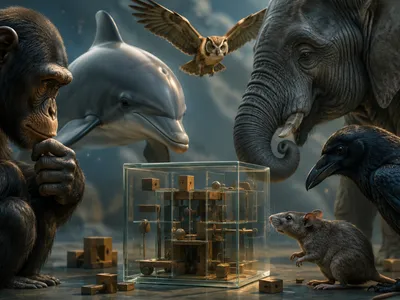
Researchers examine whether animals can detect third-party inequity or act to correct unfair distributions, suggesting early forms of moral reasoning. Foundational work with capuchin monkeys demonstrated this by showing refusals of inferior rewards when a partner received a better one. Operationalizing fairness involves controlled experiments that separate self-interest from normative judgment.
Tasks such as token exchanges and cooperative problem-solving reveal species-specific patterns: some show strong inequity aversion, while others respond mainly to effort-to-reward ratios. This variability indicates that fairness likely evolved convergently in socially complex lineages rather than as a single inherited trait.
Capuchins, Cooperation, and the Grape Test
The landmark 2003 experiment by Brosnan and de Waal placed capuchin monkeys in adjacent cages, exchanging tokens for food rewards. When a partner received a grape (a high-value reward) while the subject received a cucumber slice, subjects often refused the cucumber, threw it out, or stopped participating.
This reaction was interpreted as a behavioral marker of inequity aversion, challenging the assumption that only humans care about fairness. Subsequent replications introduced control conditions to rule out simple frustration effects, confirming that social comparison drives the refusal.
| Study Component | Key Finding |
|---|---|
| Inequity condition | Partner receives grape, subject receives cucumber → 80% refusal rate |
| Equity condition | Both receive cucumber → less than 15% refusal |
| Effort control | Same reward but unequal effort → refusal persists in some species |
Long-term studies extended these findings to chimpanzees, dogs, and corvids, each revealing nuanced patterns. For instance, chimpanzees exhibit inequity aversion primarily when they perceive a direct link between effort and reward. Canine studies produce mixed results, often influenced by the presence of a familiar experimenter or the subject’s prior training history.
Methodological refinements now use touchscreen tasks to isolate the decision to reject unfair offers from social agitation. These computerized paradigms allow fine-grained analysis of reaction times and choice patterns, demonstrating that subjects do not merely react emotionally but actively weigh costs and benefits. Capuchins in such setups will reject a cucumber even when a partner is absent if they previously observed a partner receiving a grape, indicating a lasting memory of inequity.
How Can We Measure Canine Justice?
Domestic dogs (Canis familiaris) present a unique window into fairness because they co-evolved with humans in cooperative contexts. Knowing why zoology helps us understand animal behavior, researchers use the paw-presentation paradigm, where two dogs perform a trained task—such as giving a paw—and receive unequal rewards. Unlike primates, dogs often show inequity aversion only when a partner is present and when the disparity is highly salient.
A landmark study using this setup revealed that dogs refuse to continue participating when they see a partner receiving higher-value food for the same action. The effect depends strongly on social familiarity: dogs paired with a familiar housemate display stronger protests than those paired with an unfamiliar dog. This suggests that canine responses are shaped by relationship history rather than a universal fairness principle.
| Variable | Effect on Inequity Aversion in Dogs |
|---|---|
| Reward disparity | Large disparity (sausage vs. bread) triggers refusal; small disparity (same reward type) does not |
| Partner relationship | Familiar partner increases refusal rate by approximately 40% compared to unfamiliar partner |
| Task difficulty | No effect when both dogs work; but if effort differs, dogs become sensitive to effort-reward imbalance |
Methodological critiques have prompted more rigorous controls. Automated feeding devices now eliminate human cueing, and touchscreen tasks allow dogs to choose between equitable and inequitable outcomes without social pressure. These refinements show that canine justice perception is not a simple reflex but involves weighing social history, reward quality, and even the perceived deservingness of the partner. One striking result from such automated studies is that dogs will voluntarily reject a high-value reward if it means a partner receives nothing, indicating a prosocial motivation that goes beyond mere envy.
The Evolutionary Roots of Inequity Aversion
Comparative data now span mammals, birds, and even some invertebrates, challenging the idea that fairness is a recent human invention. Phylogenetic analyses suggest that inequity aversion emerged independently in several lineages characterized by cooperative breeding, coalition formation, or complex social bonds. Convergent evolution appears to be a dominant pattern.
In corvids—ravens and crows—experiments using token-exchange tasks reveal that these birds reject unequal offers, especially when they have previously observed a partner receiving a better reward. This sensitivity correlates with performance on tests of social cognition, such as tracking who observes them caching food. The avian data align with the “social niche construction” hypothesis, where fairness capacities arise to stabilize cooperative interactions.
- 🐒 Cooperative breeding hypothesis – Species that rely on alloparental care (e.g., marmosets, wolves) show stronger inequity aversion than solitary species.
- 🤝 Coalition formation – In primates, inequity aversion is most pronounced in species where males form long-term coalitions, suggesting fairness helps maintain alliance stability.
- 🐕 Domestication effect – Dogs and domesticated foxes exhibit more prosocial behavior than their wild counterparts, implying that selection for reduced aggression also selected for heightened sensitivity to unfair treatment.
The evolutionary framework also accounts for the absence of fairness in many species. Solitary foragers like many reptiles show no evidence of inequity aversion, as their social structure offers no selection pressure for such computations. Neural correlates in mammals point to the anterior cingulate cortex and the amygdala as key nodes for processing unequal outcomes, regions that are highly conserved but show expanded connectivity in species with complex social hierarchies. This neurobiological scaffolding supports the view that fairness is a mosaic trait, pieced together from ancestral social-monitoring circuits and refined by the specific demands of cooperative living.
A Mosaic of Morality, Not a Mirror
Evidence on animal fairness does not yield a simple yes-or-no answer. Fairness sensitivity appears selectively across species and contexts, with behaviors influenced by social conditions and experimental paradigms. Apparent inequity aversion may sometimes reflect frustration rather than genuine fairness, highlighting the importance of methodological rigor for valid comparisons.
Fairness likely evolved via convergent pathways shaped by each species’ social ecology. Factors such as cooperative breeding, coalitional alliances, and domestication leave distinct signatures on fairness-related behaviors, revealing complex cognitive computations that weigh effort, relationships, and rewards simultaneously. Simple economic models of self-interest fail to capture this multilayered processing.
Comparative research now focuses on which cognitive building blocks—like inequity aversion, prosociality, and third-party punishment—exist in different lineages. Comparative justice research moves beyond anthropocentric benchmarks, illustrating how cooperative norms emerge across the animal kingdom and tracing the evolutionary roots of human morality.