AI-Driven Autonomy in Modern Warehouses
Contemporary warehouse robots are increasingly defined by their capacity to operate autonomous decision systems rather than merely execute tasks. This shift is underpinned by sophisticated artificial intelligence that processes vast sensor datasets to navigate complex environments. The technology enables robots to interpret their surroundings and adapt to dynamic conditions without human intervention.
A core component of this autonomy is the integration of simultaneous localization and mapping algorithms with deep learning models. These systems allow robots to construct real-time maps of sprawling facilities while accurately pinpointing their own position. Consequently, autonomous mobile robots can deviate from pre-programmed paths to circumvent unexpected obstacles, such as pallets or personnel.
Multi-agent coordination allows fleets of robots to communicate, reducing congestion and optimizing workflow through swarm robotics and decentralized swarm intelligence. By assigning tasks based on proximity and battery levels, systems operate as a self-regulating ecosystem of machines that improves efficiency and scalability. This shift also transforms warehouse software into AI-driven orchestration platforms that predict bottlenecks, reroute operations in real time, and adapt strategies dynamically, merging execution with intelligent planning.
Intelligent Picking and Grasping
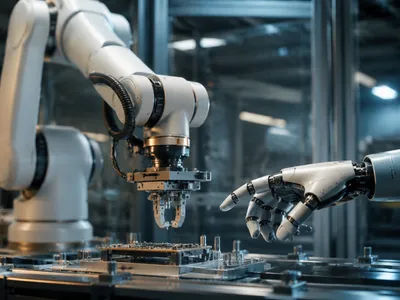
The automation of item picking, historically a significant bottleneck, has been revolutionized by combining computer vision with advanced gripping mechanisms. Deep learning-based object detection algorithms now enable robots to identify and localize millions of distinct products, from fragile electronics to oddly shaped consumer goods, with remarkable accuracy. This visual acuity is the first critical step toward replicating human dexterity.
Beyond identification, the physical manipulation of diverse items is addressed by adaptive gripper technologies. These end-effectors, which may utilize suction, compliant fingers, or even electrostatic adhesion, are controlled by AI models that predict the optimal grasp strategy. The system assesses an item's material, shape, and weight distribution in milliseconds, dramatically reducing product damage and increasing pick reliability. This intelligence allows for the handling of heterogeneous inventories without manual reconfiguration.
Recent advancements integrate tactile sensors that provide feedback during the gripping process, allowing for micro-adjustments in force. This sensory loop is crucial for handling delicate items where excessive pressure could cause damage. The AI model continuously learns from both successful picks and failures, refining its approach over time. This capability moves robotic picking beyond simple suction cups, enabling the manipulation of items in cluttered bins or from mixed-SKU pallets, a task that demands a high degree of spatial reasoning and fine motor control.
Human-Robot Collaboration in Smart Warehouses
The integration of AI has redefined the relationship between human workers and machines, fostering a genuinely collaborative environment. This human-robot collaboration allows intelligent robots to function as force multipliers rather than replacing humans, taking over strenuous or repetitive tasks while workers focus on exception handling and value-added activities. This synergy is predicated on advanced safety systems that use 3D vision to create protective fields around robots.
These collaborative robots, or cobots, are equipped with predictive collision avoidance algorithms that enable them to slow down or alter their trajectory when a human approaches. This fluid interaction eliminates the need for safety cages and allows for truly integrated workflows where humans and robots share the same floor space. The AI continuously refines its understanding of human motion patterns, making the collaboration increasingly seamless over time and enhancing overall operational fluidity.
The cognitive load on human workers is also reduced through AI-powered augmented reality systems that overlay digital information onto the physical workspace. Pickers, for instance, might see the most efficient route highlighted directly on the floor or receive visual cues about the exact item to retrieve. This fusion of human intuition with machine precision creates a work environment where errors are minimized and productivity is maximized, fundamentally altering the skill sets required in modern logistics.
A critical aspect of this collaborative model involves the dynamic allocation of tasks based on the unique strengths of both parties. AI orchestration platforms assess factors such as item weight, complexity of the pick, and worker proximity to assign tasks to either a human or a robot. This flexible allocation ensures that robots handle heavy or high-volume picks while humans manage intricate packaging or quality assurance. The following list illustrates common task distributions observed in next-generation fulfillment centers where this collaborative intelligence is deployed.
- Robot-Optimized Tasks High Throughput
- Pallet movement and replenishment Heavy Load
- High-volume case picking Repetitive
- Inventory cycle counting with RFID Data-Intensive
- Human-Focused Tasks Cognitive Value
- Multi-item gift basket assembly Complex
- Quality control for returned goods Variable
- Resolving system exceptions Problem-Solving
Dynamic Sorting and Route Optimization
The sheer volume of parcels moving through modern sortation systems demands real-time adaptability that only AI can provide. Intelligent algorithms now govern the trajectory of every item, dynamically reassigning destinations based on immediate downstream conditions. This capability prevents bottlenecks by redirecting flow when a particular chute or conveyor segment reaches capacity, ensuring continuous throughput.
This dynamic routing extends beyond the sortation system to the entire fleet of vehicles within the facility, demonstrating how robotics is changing industrial workflows. AI models analyze thousands of potential path combinations per second, accounting for robot traffic, human movement, and order urgency to calculate the most efficient route for each unit. To illustrte the comparative impact of these optimization strategies, the table below outlines key performance indicators before and after the implementation of AI-driven routing protocols.
| Metric | Legacy System | AI-Optimized System | Improvement Factor |
|---|---|---|---|
| Average Travel Distance | 2.8 km per order | 1.5 km per order | 46% reduction |
| Sortation Error Rate | 1.2 per 1000 items | 0.3 per 1000 items | 75% reduction |
| Peak Throughput | 12,000 units/hour | 18,500 units/hour | 54% increase |
| Energy Consumption | Baseline | 82% of baseline | 18% savings |
Predictive Maintenance and System Health
Modern warehouse robots are equipped with predictive maintenance algorithms that continuously monitor sensor data streams from motors, actuators, and power systems. These algorithms establish baseline performance profiles and employ anomaly detection to identify subtle deviations indicative of impending component wear or failure.
This proactive stance dramatically reduces unplanned downtime by enabling maintenance interventions to be scheduled during off-peak hours rather than in response to sudden breakdowns. The resulting optimization of spare parts inventory and maintenance labor represents a significant operational cost saving.
Advanced implementations integrate these algorithms with digital twin simulations that create virtual replicas of the entire robotic fleet. These simulations model the cumulative effects of stress cycles on mechanical components, predicting remaining useful life with high accuracy. The anomaly detection systems continuously refine their thresholds based on real-world data, creating a closed-loop learning environment. This holistic view of system health allows for the graceful degradation of performance when issues are detected, rather than catastrophic failure, ensuring uninterrupted operational continuity.
Optimizing Warehouse Layout with AI
The static floor plans of traditional warehouses are being replaced by continuously evolving configurations driven by dynamic slotting optimization. AI algorithms analyze historical order data to identify product affinities and velocity, repositioning fast-moving items closer to packing and shipping zones to minimize travel time.
This computational approach to slotting optimization considers not only order frequency but also physical attributes such as item dimensions, weight, and storage requirements. The system evaluates thousands of potential storage assignments to determine the arrangement that minimizes overall picking effort.
Through simulation-based testing, warehouse managers can visualize the impact of proposed layout changes before any physical rack is moved. Machine learning models run countless what-if scenarios, learning from each simulation to predict the throughput implications of different configurations with remarkable precision.
The true transformative power of AI emerges in its ability to adapt to seasonal demand patterns and promotional spikes. During peak periods, the system may temporarily convert bulk storage areas into forward pick zones or reconfigure pick paths to prioritize holiday bestsellers. This AI-driven layout reconfiguration ensures that the warehouse ooperates as a flexible, responsive entity rather than a rigid infrastructure, directly contributing to higher fulfillment accuracy and reduced labor costs. The following table quantifies the performance gains observed in facilities employing these advanced layout optimization techniques.
| Performance Metric | Traditional Layout | AI-Optimized Layout | Improvement |
|---|---|---|---|
| Average Picking Distance | 320 meters/order | 210 meters/order | 34% reduction |
| Order Cycle Time | 45 minutes | 28 minutes | 38% reduction |
| Warehouse Capacity Utilization | 72% | 91% | 26% increase |
| Labor Productivity | 80 orders/person-hour | 115 orders/person-hour | 44% increase |