How is Satellite Data Transforming Ecological Research?
Ecologists once relied on fragmented field surveys, but satellite-borne sensors now offer a continuous, global tapestry of environmental data. This technological leap fundamentally alters the scale at which ecological questions can be posed.
This shift moves ecology from a discipline of localized snapshots to one capable of monitoring planetary-scale dynamics in near real-time. Such capabilities redefine the boundaries of ecological inquiry and hypothesis testing.
The true transformation lies not merely in data volume but in the synthesis of spectral, thermal, and structural information into testable hypotheses. Researchers can now interrogate ecosystem resilience, productivity, and biodiversity patterns across previously inaccessible temporal and spatial gradients. These integrated analyses reveal complex interactions that field-based studies alone often miss.
How Do Algorithms Reveal Ecological Patterns from Satellite Data?
Transforming raw radiance values into meaningful ecological metrics requires advanced algorithms and reliable ground-truthing, where machine learning models classify land cover with remarkable accuracy and convert digital signals into ecologically relevant categories; meanwhile, time-series analyses uncover phenological shifts, disturbance patterns, and recovery trajectories once invisible to static field observations, providing essential insights into ecosystem vulnerability and long-term resilience.
These pixel-level transformations aggregate into coherent patterns that define functional types, habitat connectivity, and carbon dynamics. Integrating optical, radar, and LiDAR data further refines our ability to differentiate species composition and three-dimensional forest architecture across heterogeneous landscapes.
The fusion of multispectral imagery with synthetic aperture radar (SAR) exemplifies the frontier of pattern extraction. SAR penetrates cloud cover and captures surface texture, while optical sensors provide compositional detail. By combining these modalities, ecologists can monitor deforestation, floodplain dynamics, and even soil moisture regimes with a consistency that field campaigns alone cannot match. Such integrated approaches complement how ecology explains natural balance, reshaping foundational concepts in biogeography and ecosystem ecology and moving the discipline toward a truly systems-level understanding.
How Do LiDAR and Radar Reveal Forest Structure?
Active sensors such as LiDAR and radar penetrate vegetation layers, revealing three-dimensional forest structure. This capability exposes understory complexity that optical sensors alone cannot capture.
By quantifying vertical stratification and biomass distribution, researchers can now model habitat suitability for cryptic species and assess fuel loads for wildfire risk. Such detailed structural data are essential for understanding below-canopy biodiversity dynamics and carbon storage potential across diverse forest types.
Integrating waveform LiDAR with multispectral imagery allows ecologists to differentiate understory plant communities and detect invasive species before they dominate the forest floor. This fusion of structural and spectral data also enables precise estimation of aboveground biomass in dense tropical forests, where traditional field plots are logistically prohibitive. Advances in spaceborne LiDAR now provide near-global coverage of vertical canopy profiles, fundamentally shifting how ecologists quantify habitat heterogeneity and its influence on wildlife distribution across regional scales.
| Sensor Type | Under-Canopy Application | Key Advantage |
|---|---|---|
| LiDAR (GEDI, ICESat-2) | Vertical structure, biomass | Penetrates foliage gaps |
| P-band SAR (BIOMASS) | Root-zone biomass, trunk volume | Deep canopy penetration |
| Hyperspectral | Understory composition | Species-level discrimination |
These technological advances collectively enable a holistic view of forest ecosystems, linking canopy architecture with below-canopy processes. Such integration is critical for predicting climate feedbacks and managing biodiversity in an era of rapid environmental change.
How Does Remote Sensing Reveal Animal Movement Patterns?
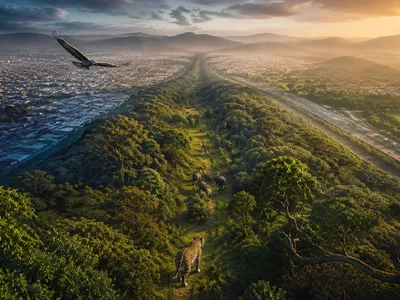
Telemetry collars, satellite imagery, and animal-borne sensors are integrated to map migration corridors with unprecedented precision, revealing how landscape features influence movement behavior; researchers now combine high-resolution land cover data with GPS tracking to identify functional connectivity and barriers affecting gene flow, providing critical insights into the ecology of wildlife corridors and informing the design of corridors that remain viable under future climate conditions.
Integrating movement ecology with remote sensing has advanced beyond simple path mapping. By coupling accelerometer data with continuous environmental layers, scientists can infer animal behavior states—foraging, resting, migrating—directly from satellite-derived metrics such as vegetation greenness, surface water availability, and anthropogenic disturbance. This synergy allows for mechanistic understanding of how animals respond to shifting resource pulses and human encroachment, transforming conservation planning from static reserve design to adaptive management frameworks that anticipate species responses to ongoing landscape change.
- Biologging platforms – ICARUS, Movebank – integrate sensor data with satellite observations
- Landscape resistance models use remote sensing to parameterize movement costs
- Time-lapse satellite imagery captures phenological triggers for long-distance migrations
These integrated approaches allow ecologists to predict how infrastructure expansion, agricultural intensification, and climate shifts will alter movement networks. The result is a more predictive, dynamic science of animal space use.
The Pulse of the Planet
Satellite constellations now provide daily observations of terrestrial and marine ecosystems, capturing the rhythmic oscillations that shape life on Earth and revealing phenological cycles, seasonal productivity pulses, and sudden disturbances; by analyzing spectral indices such as NDVI and fluorescence, researchers can quantify the planet’s metabolic heartbeat, from leaf-level photosynthesis to biome-scale carbon fluxes.
This continuous monitoring uncovers critical thresholds where ecosystems shift from resilience to collapse. Tracking these transitions enables early warning of regime shifts in forests and drylands while assessing whether coral reefs can adapt to warming seas before irreversible damage occurs. Such predictive capacity is a cornerstone of proactive ecosystem stewardship.
Integrating satellite microwave radiometry with optical time series further reveals subsurface water dynamics and soil moisture anomalies that govern vegetation vigor. When combined with atmospheric CO₂ measurements from missions like OCO-3, these data form a comprehensive picture of the biosphere’s response to climate variability, allowing ecologists to disentangle anthropogenic forcing from natural climatic oscillations.
How is Remote Sensing Advancing Ecological Forecasting?
Remote sensing provides the spatiotemporal context essential for forecast models that project ecosystem states under future climate scenarios. These projections move ecology from descriptive to predictive science.
Assimilating satellite observations into dynamic global vegetation models improves the accuracy of simulations for carbon storage, species distribution shifts, and disturbance regimes. This integration reduces uncertainties that plague purely theoretical projections.
A new generation of hybrid models couples process-based equations with machine learning trained on remote sensing data, enabling high-resolution forecasts of vegetation mortality, fire risk, and habitat fragmentation decades into the future. By leveraging near‑real‑time observational constraints, these frameworks produce actionable projections that guide conservation investments, agricultural adaptation, and green infrastructure for climate resilience. This convergence of empirical observation and predictive modeling represents the maturation of remote sensing from a descriptive tool to a cornerstone of applied ecological forecasting and environmental decision‑support systems.