The Autonomous Factory Floor
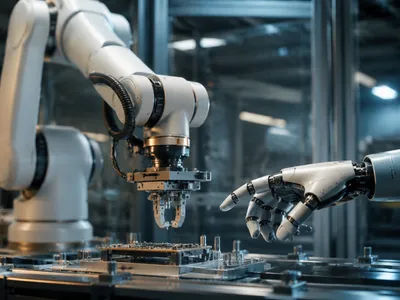
Modern industrial robotics has catalyzed the transition towards fully autonomous production environments. These systems operate with minimal human oversight, guided by sophisticated algorithms and sensor arrays that enable continuous, self-optimizing operation across entire manufacturing cells.
Key to this evolution is the integration of cyber-physical systems and the Industrial Internet of Things (IIoT). Machines are no longer isolated units but interconnected nodes in a vast data ecosystem, communicating in real time to synchronize activities and predict maintenance needs.
This network generates vast operational datasets, which are analyzed by machine learning models to identify inefficiencies invisible to human planners. The resulting shift is from programmed automation to cognitive automation, where workflows are dynamically reconfigured by the system itself in response to fluctuating demand, material variances, or equipment performance, leading to a fundamentally adaptive manufacturing paradigm.
Collaborative Robots in Assembly Lines
The advent of cobots has dismantled the traditional barrier between automated and manual workstations. Unlike their caged predecessors, these robots are designed with advanced force-limiting sensors and reactive programming to work safely alongside human operators.
This collaboration unlocks hybrid workflows where human dexterity and problem-solving are augmented by robotic precision and endurance. A worker might perform a complex wiring task while a cobot holds a component perfectly steady or handles the repetitive application of adhesives.
The economic and ergonomic impacts are profound. Lower-cost, easily programmable cobots allow small and medium enterprises to automate intricate assembly processes that were previously unsuitble for large-scale robotic systems. Furthermore, they reduce physically strenuous and ergonomically injurious tasks for human workers, reallocating labor to higher-value oversight and quality control roles. The following table contrasts traditional industrial robots with modern collaborative systems.
| Feature | Traditional Industrial Robot | Collaborative Robot (Cobot) |
|---|---|---|
| Primary Safety Method | Physical segregation (cages, light curtains) | Inherent safety (force feedback, rounded edges) |
| Deployment Flexibility | Low; fixed, dedicated stations | High; mobile, easily redeployed |
| Programming Complexity | High; requires specialized expertise | Lower; often uses hand-guiding or intuitive software |
| Ideal Use Case | High-speed, high-volume, uniform tasks | Lower-volume, variable, human-centric tasks |
Implementing a cobot-integrated assembly line requires careful analysis of the existing workflow to identify optimal handoff points between human and machine. The goal is to create a seamless symbiotic cycle, not merely to insert a robot into an existing process. This often leads to a complete re-engineering of the station for mutual efficiency.
Successful integration yields measurable benefits beyond productivity. The reduction in worker fatigue and musculoskeletal disorders leads to lower absenteeism and higher job satisfaction. Furthermore, the flexible nature of cobots supports mass customization, as they can be quickly reprogrammed for different product variants, a critical capability in modern manufacturing.
What Constitutes a Smart Workflow?
A smart industrial workflow transcends simple automation by embedding intelligence at every decision point. It is characterized by a continuous data flow where physical operations and digital models are tightly synchronized, enabling systems to learn and adapt.
The core of this intelligence is the digital twin, a virtual, dynamic replica of the physical process fed by real-time sensor data. This model allows for simulation, analysis, and control, creating a feedback loop where the digital realm optimizes the physical one. Predictive analytics leverage this data stream to forecast machine failures or quality deviations before they occur, shifting maintenance from scheduled to condition-based.
True smart workflows achieve closed-loop control, where decisions are made and acted upon by the system with minimal latency. For instance, a vision system ddetecting a minor component defect can immediately instruct a robotic arm to reject the part and simultaneously adjust the machining parameters on the upstream station to correct the error. This level of adaptive response requires robust data architectures and interoperability between machines from different vendors, a challenge the industry addresses through open communication standards. The ultimate result is a self-optimizing and resilient system that minimizes waste and maximizes throughput. The transition involves several foundational shifts, as outlined below.
| Traditional Workflow Element | Smart Workflow Equivalent | Enabling Technology |
|---|---|---|
| Static, Sequential Programming | Dynamic, Event-Driven Process Maps | AI/ML Process Orchestration Engines |
| Periodic Quality Sampling | In-Line, 100% Automated Inspection | High-Resolution Vision Systems & Spectrometry |
| Preventive Maintenance Schedules | Predictive & Prescriptive Maintenance | IIoT Sensors & Advanced Analytics Platforms |
| Centralized SCADA Control | Distributed Edge Computing Nodes | Fog/Edge Computing Architectures |
Reshaping Logistics and Supply Chain Operations
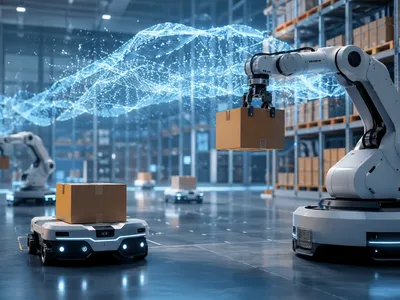
Robotic systems have revolutionized internal logistics, transforming warehouses from static storage facilities into dynamic, high-throughput distribution hubs. Autonomous Mobile Robots (AMRs) navigate complex environments using onboard sensors and maps, transporting goods between receiving, storage, and shipping zones.
This mobility enables flexible goods-to-person systems, where AMRs bring entire shelving units or individual bins to human pickers, dramatically reducing unproductive walking time. Concurrently, robotic arms mounted on mobile bases or gantries automate the depalletization of incoming goods and the precise picking of items for order fulfillment, handling a vast array of shapes and sizes with gentle grippers.
Beyond the warehouse, robotics impacts the broader supply chain through autonomous yard trucks and robotic loading arms at distribution centers. These applications compress dock turnaround times and mitigate chronic labor shortages in physically demanding roles. The integration of robotic logistics data with enterprise resource planning systems provides end-to-end inventory visibility, enabling unprecedented flexibility and resilience against disruptions. Key operational areas seeing rapid robotic adoption include:
-
📦 High-Density Storage & RetrievalAutomated guided vehicles for pallets and robotic shuttles for bins in ultra-high racking.
-
🔄 Sortation & SingulationRobotic arms and vision systems that identify, orient, and separate mixed parcels on conveyors.
-
📦 Last-Mile PreparationRobotics for automated packing, custom box creation, and labeling, accelerating dispatch.
-
📊 Inventory IntelligenceAutonomous drones and AMRs for continuous cycle counting and dynamic slotting recommendations.
How Robotics Elevates Technical Manufacturing Skills
The integration of advanced robotics fundamentally alters the occupational structure within manufacturing, precipitating a shift from manual execution to cognitive supervision. This transition does not merely displace jobs but redefines them, creating a pressing demand for a hybrid skill set that blends traditional technical knowledge with digital fluency.
Routine, repetitive manual tasks are increasingly automated, elevating the remaining human roles towards system oversight, exception handling, and process optimization. The modern technician must now be proficient in interacting with sophisticated robotic interfaces, interpreting complex system diagnostics, and performing preventative maintenance based on algorithmic predictions rather than fixed schedules.
This evolution necessitates a parallel transformation in vocational training and continuous education. Educational institutions and companies are developing new curricula focused on mechatronics, data literacy, and collaborative robot programming. A critical emerging competency is the ability to work symbiotically with AI-driven systems, requiring workers to understand robotic capabilities and limitations to effectively delegate tasks. This shift presents both a challenge and an opportunity, moving the workforce towards more engaging and less physically strenuous roles, ultimately fostering a more sustainable and intellectually rewarding industrial career path. The pervasive fear of job displacement is countered by the creation of new, often unforeseen, positions in robot coordination and data analysis, though this does necessitate a significant commitment to reskilling and upskilling at an industry-wide scale.