The Immersive Frontier
Virtual Reality (VR) represents a paradigmatic shift in entertainment, fundamentally altering the user's relationship with digital content. By constructing a sensory-rich, computer-generated environment, VR achieves a level of cognitive and perceptual immersion unattainable by traditional flat-screen media.
This immersion is primarily engineered through stereoscopic 3D visuals, rendered in real-time for each eye, and precise head-tracking technology. The resulting profound sense of presence and embodiment is the core differentiator, making the user an active inhabitant rather than a passive spectator. The psychological impact of this presence is a key focus of contemporary media studies.
The evolution of VR hardware, from early flight simulators to contemporary consumer-grade headsets, has been driven by exponential advances in processing power, display resolution, and motion sensor fidelity. This technological maturation has directly enabled its foray into entertainment. However, the transition from a novel technological demonstration to a compelling artistic and narrative medium requires more than just hardware; it necessitates a complete rethinking of content creation paradigms. Developers and storytellers must now consider spatial audio, user agency within a 360-degree narrative space, and the ergonomics of prolonged interaction, challenges that were largely irrelevant in conventional film or gaming.
Beyond the Screen: VR in Gaming
VR gaming is the most advanced and commercially established sector of this new medium. It transcends the traditional controller-based interface, promoting a kinesthetic connection between player and game world.
| Interaction Paradigm | Description | Impact on Gameplay |
|---|---|---|
| Motion-Controlled Actions | Using handheld controllers to mimic real-world actions like swinging, throwing, or aiming. | Enhances muscle memory, physicality, and intuitive skill development. |
| Room-Scale Exploration | Physically walking within a defined space to navigate the virtual environment. | Deepens spatial awareness and reinforces the illusion of being physically present. |
| Haptic Feedback | Tactile sensations delivered through controllers or vests to simulate touch or impact. | Provides critical sensory confirmation, increasing realism and emotional response. |
This direct interaction fosters unprecedented levels of player agency and emotional engagement. A player does not merely press a button to swing a sword; they perform the motion, experiencing the weight and consequence spatially. Genres like horror, simulation, and puzzle-solving are particularly transformed, as the embodied experience multiplies psychologcal and physiological effects.
The design philosophy shifts from designing *for* a player to designing *around* them. Level design must account for physical movement, object interaction relies on natural physics, and narrative pacing can be disrupted by user-driven exploration. This creates a dynamic, non-linear storytelling potential where the environment itself becomes a primary narrative device.
- Presence and Consequence: Actions feel direct and consequential, raising ethical and psychological stakes within game narratives.
- Spatial Puzzle Design: Puzzles require actual manipulation of 3D space, engaging cognitive faculties like proprioception.
- Physical Skill Gates: Progression can be tied to learned physical skills (e.g., accurate archery) rather than statistical character upgrades.
- Social VR Experiences: Multiplayer games evolve into shared virtual spaces where avatars and body language enable new forms of social interaction.
Cinematic Storytelling Reborn
The advent of VR challenges the century-old grammar of cinema, demanding a post-directorial approach to narrative construction. The fixed frame and controlled perspective of traditional filmmaking dissolve, replaced by a user-centric, explorable diegesis.
This shift redefines the role of the director from a omniscient presenter to an environmental architect. Story elements must be distributed spatially, using audio cues, environmental details, and character placement within a 360-degree sphere to guide attention. The narrative agency subtly shifts, as the viewer's gaze determines the focal point of any given moment. This creates a tension between authorial intent and viewer autonomy, a central debate in VR film theory.
| Cinematic Technique | Traditional Film | VR Film/Experience |
|---|---|---|
| Framing & Composition | Director selects exact 2D frame to control viewer's focus and meaning. | Composition is spherical and dynamic; focus is guided by light, sound, and movement within the user's field of view. |
| Editing & Pacing | Sequential cuts manipulate time and perspective to drive narrative rhythm. | Editing is minimized or replaced by spatial transitions, user movement, or changes within a continuous scene to avoid disorientation. |
| Point of View (POV) | POV can shift between characters, omniscient, and subjective shots. | Typically locked to a first-person perspective; empathy is built through embodied presence rather than shot-reverse-shot patterns. |
Consequently, emotional engagement is engineered differently. Rather than manipulating viewers through edited sequences, VR filmmakers build empathetic immersion by placing the participant directly within the story's circumstance. Documentaries gain profound power by transporting viewers to remote locations or into the subjective experiences of others, fostering a level of cognitive and emotional understanding that is qualitatively distinct from observational media.
- Environmental Narrative: The story is embedded in the set design, requiring active observation and exploration from the viewer.
- Ambisonic Audio as Guide: 360-degree spatial sound becomes the primary tool for directing attention and conveying off-screen events.
- Duration & Comfort: Narrative experiences are often shorter due to cognitive load and physical comfort constraints, influencing story structure.
- Interactive Non-Linearity: Some narratives incorporate branching paths or interactive elements, blending cinematic and ludic forms.
Live Events in a Virtual Sphere
VR is democratizing access to and redefining the economics of live events. From concerts and sports to theatre and conferences, the virtual sphere offers a scalable, front-row experience unbounded by physical venue limitations.
The core value proposition extends beyond mere live-streaming. Attendees are represented by customizable avatars, enabling social co-presence with geographically dispersed peers. This transforms a broadcast into a shared social event, complete with the ability to gesture, cheer, and interact. For performers and organizers, VR provides detailed analytics on audience engagement, novel monetization through virtual merchandise, and a persistent venue that can host events long after the physical show ends. The technological infrastructure relies on robust, low-latency streaming and scalable server instances to support thousands of concurrent users in a single shared space, a significant engineering challenge that differentiates it from pre-recorded content.
This medium also unlocks impossible perspectives and augmented overlays. A fan can watch a concert from the perspective of the stage, or a sports enthusiast can view a match with real-time statistical visualizations overlaid on the field. These features create a hybrid experiential layer that transcends physical reality, offering added value that cannot be replicated in a traditional stadium or arena.
| Event Type | VR-Enabled Enhancement | Business Model Impact |
|---|---|---|
| Music Concerts | Dynamic stage visuals, interactive crowd effects, artist avatar meet-and-greets. | Global ticket sales without capacity limits, sale of exclusive virtual goods (e.g., light sticks, clothing for avatars). |
| Sports Broadcasting | Selectable camera viewpoints (e.g., from the ball, sideline), real-time player stats and biometrics overlay. | Premium subscription tiers for immersive views, new advertising inventory within the virtual environment. |
| Academic Conferences | Virtual poster halls, networked breakout rooms for serendipitous discussion, recorded sessions accessible as spatial volumes. | Reduced cost and carbon footprint for attendees, increased accessibility, potential for persistent, on-demand conference environments. |
The sociodynamics of these events are a rich area of study. Norms for virtual audience behavior, the psychology of avatar-mediated interaction, and the balance between programmed spectcle and user-generated social activity are all emergent properties of this new format. The success of a virtual event increasingly depends on fostering these organic social layers as much as on the quality of the core broadcast.
- Networked Audiences: Creates global, simultaneous communities around live events, altering fan culture and collective engagement.
- Persistent Venues: Virtual spaces can exist perpetually, allowing for pre- and post-event gatherings and ancillary activities.
- Accessibility Revolution: Provides front-row experiences for individuals with mobility or geographic constraints.
- Data-Driven Engagement: Organizers gain precise metrics on where attendees look, move, and socialize, informing future production design.
The Social Fabric of Virtual Worlds
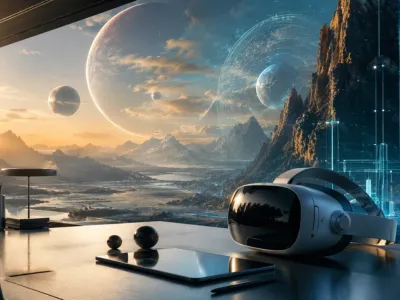
Virtual reality has catalyzed the evolution of social interaction from networked text and voice chats into embodied shared presence. Platforms dedicated to social VR are not merely communication tools but persistent digital territories where identity, community, and culture are performed through avatars.
This avatar-mediated sociality introduces complex non-verbal communication layers. Proxemics, gaze direction, and gesture gain renewed importance, as users subconsciously apply real-world social physics to virtual interactions. The psychological phenomenon of the Proteus Effect—where an individual's behavior shifts to align with their avatar's identity—fundamentally shapes community dynamics and personal expression.
Economies and governance models emerge organically within these worlds. Users trade virtual assets, establish social norms, and even create virtual real estate markets, mirroring and sometimes diverging from physical-world socioeconomic systems. The design of these spaces—their architecture, the affordances of avatars, and the rules of interaction—directly influences the types of communities that form, from collaborative learning environments to open-ended creative sandboxes. This positions social VR as a critical site for studying the future of human association, digital citizenship, and the construction of meaning in a post-geographic society.
- Embodied Communication: Head and hand tracking enable nuanced body language, making interactions feel more authentic and reducing the cognitive load of pure textual mediation.
- Persistent Identity: Avatars and personal spaces become extensions of self, accumulating history and social capital over time, unlike ephemeral chat rooms.
- User-Generated Context: The primary activity often becomes co-creating the social experience itself, through conversation, gameplay, or collaborative world-building.
- Digital Anthropology: These platforms serve as live laboratories for observing the formation of cultural practices, languages (emotes, slang), and social hierarchies in nascent societies.
A New Canvas for Artists
For artists, VR dismantles the traditional confines of the frame, stage, or screen, offering an inhabitable medium. It enables the creation of experiential art where the viewer is immersed inside the artwork, becoming a participant in its narrative or form.
This shift necessitates mastering spatial aesthetics and temporal architecture. Composition must account for a 360-degree volume, narrative can be non-linear and exploratory, and scale becomes a visceral tool—allowing a viewer to shrink to microscopic size or walk among monumental structures. The artist's role expands to that of an environmental psychologist, orchestrating emotion through space, sound, and the viewer's anticipated path.
| Art Form | Traditional Manifestation | VR Transformation |
|---|---|---|
| Sculpture & Installation | Static, physical objects viewed from exterior vantage points; limited by material and space. | Dynamic, scalable forms that can be experienced from within; materials defy physics; spaces can be infinite or impossible. |
| Painting & 2D Art | Pigment on a flat, bounded surface; illusion of depth created through technique. | Creation occurs in three dimensions with virtual "material;" the artwork becomes an environment to move through, not look at. |
| Performance Art | Live, ephemeral act shared with a physically present audience in a specific time/space. | Performances can be recorded as immersive volumetric experiences, re-lived from any angle, or feature virtual entities interacting with the viewer directly. |
Tools like Tilt Brush and Quill have pioneered a new form of haptic creativity, where the act of drawing is a full-body, kinetic performance. The resulting artworks are not just visual but records of gestural movement in space. Furthermore, VR enables powerful empathic art, placing participants in first-person perspectives that address complex themes like migration, climate change, or neurological conditions, fostering understanding through direct sensory experience rather than symbolic representation.
The Challenge of Virtual Motion
A significant barrier to universal VR adoption lies in the sensorimotor conflict inherent in many experiences, commonly manifested as cybersickness. This physiological response, akin to motion sickness, occurs when visual motion cues contradict the vestibular system's perception of stillness.
The primary technical culprits are latency and tracking inaccuracies. Any delay between head movement and visual update disrupts the brain's expectation of perfect synchrony, triggering discomfort. Furthermore, locomotion techniques that involve artificial movement through a virtual space—such as joystick-based navigation—while the body remains physically stationary, create a profound sensory dissonance. Mitigating these effects is not merely a comfort issue but a fundamental requirement for expanding user demographics and acceptable session durations. Researchers are exploring a multi-faceted approach, combining hardware improvements like higher refresh rates and wider fields of view with sophisticated software solutions and user-centered design principles.
Beyond comfort, the paradox of embodiment presents a philosophical and design challenge. While VR excels at providing a first-person perspective, accurately mapping and representing the user's full body in a way that feels natural and responsive remains complex. Inconsistent or absent proprioceptive feedback can break immersion and cause a sense of disembodiment. This challenge is central to achieving the medium's highest goal: a seamless, sustained, and comfortable illusion of presence that feels as intuitive as physical reality.
Developers employ various locomotion metaphors to navigate this challenge, each with trade-offs. Teleportation minimizes sensory conflict but can disrupt spatial continuity. Arm-swinging or walking-in-place techniques provide a kinesthetic cue that reduces nausea for some users. The ongoing research in this area underscores that there is no one-size-fits-all solution, and the optimal method often depends on the specific application and individual user tolerance.
Charting the Unseen Path
The future trajectory of VR in entertainment is being shaped by the convergence of several nascent but rapidly advancing technologies. The ultimate goal is the achievement of full perceptual fidelity, where the virtual becomes indistinguishable from the real across all sensory modalities. This pursuit is driving innovation in haptics, with research into gloves, suits, and even direct neural interfaces that can simulate texture, weight, temperature, and force feedback. Such technology would not only deepen immersion but fundamentally expand the vocabulary of interactive storytelling, allowing for narratives built around delicate touch or powerful physical resistance.
Simultaneously, the integration of Artificial Intelligence is poised to revolutionize content creation and dynamism within virtual worlds. AI-driven procedural generation can create vast, unique, and responsive environments, moving beyond pre-scripted experiences. Non-player characters (NPCs) could evolve from simplistic dialog trees to entities with complex, emotionally responsive behaviors, capable of forming unique relationships with each user. This shifts entertainment from a static, authored product to a persistent, living world that learns and adapts, offering potentially infinite narrative possibilities and personalized experiences tailored to individual user choices and psychological profiles.
The boundary between VR, Augmented Reality (AR), and Mixed Reality (MR) is also expected to dissolve, leading to the concept of the ambient computing environment. Future entertainment may not be confined to a dedicated headset session but could be woven into the fabric of daily life through lightweight, always-available glasses. This would enable seamless transitions between fully immersive virtual escapes, contextually-aware AR overlays that enhance physical spaces, and social interactions that blend real and virtual participants. The ethical and societal implications of such pervasive simulated layers—from data privacy and psychological addiction to the redefinition of public and private space—will become increasingly critical areas of scholarly and public discourse.
The economic and production models of entertainment will continue to be disrupted. The high cost of producing premium VR content currently limits its scale, but the advent of more accessible creation tools and user-generated content platforms suggests a future democratization similar to the rise of YouTube. This could lead to a flourishing of independent, avant-garde VR experiences alongside blockbuster productions. The role of the entertainment conglomerate may evolve to curate and distribute these experiences within vast, interoperable virtual platforms, giving rise to new forms of intellectual property, authorship, and collaborative art that we are only beginning to conceptualize.
In conclusion, while current VR entertainment excels in offering unprecedented immersion and novel interactions, its long-term significance lies in its potential to become a primary substrate for human experience. It challenges our fundamentl definitions of narrative, social interaction, and art. The path forward is not merely one of incremental technological improvement, but of continuous creative and ethical exploration, requiring deep collaboration between engineers, artists, psychologists, and philosophers to fully realize a medium that has the power to reshape not only how we are entertained, but how we perceive, connect, and understand reality itself.