When Does a Digital Twin Become an Active System?
A digital twin starts as a high-fidelity virtual replica, accurately reflecting the geometry, state, and behavior of its physical counterpart through continuous real-time data streams. The evolution from a passive mirror to an active master occurs when the twin can simulate future states and recommend corrective actions. This transition from descriptive to prescriptive functionality represents a fundamental leap in industrial value, allowing engineering teams to run what-if scenarios without disrupting physical operations. For example, a gas turbine twin can forecast metal fatigue weeks in advance, enabling operators to adjust loads proactively, with predictive foresight replacing reactive maintenance schedules.
When the digital twin not only mirrors but also regulates the physical asset via closed-loop feedback, it achieves full operational mastery. This bi-directional synchronization fosters a self-optimizing system where autonomous decisions emerge from continuous simulation combined with real-world validation, significantly reducing downtime and extending asset lifespan, proving why adaptive systems outperform static ones in complex environments.
The Convergence of Simulation, Data, and IoT
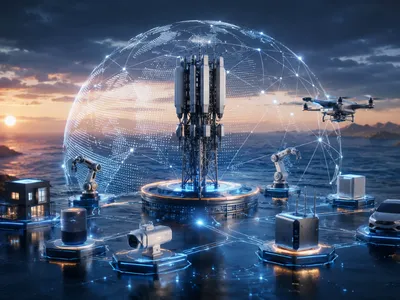
Traditional simulation tools operated in isolation, using idealized inputs that rarely matched field conditions. Industrial IoT networks now feed live sensor data directly into simulation engines, bridging the gap between design assumptions and physical reality, a process further accelerated by advancements in the impact of 5G on IoT connectivity.
This convergence enables a new class of hybrid models that combine physics-based solvers with machine learning algorithms. The result is a system that learns from historical anomalies while respecting fundamental engineering constraints.
One critical outcome is the ability to maintain accuracy even when sensor coverage is sparse. Generative models fill data gaps by leveraging spatial and temporal correlations captured from adjacent assets, ensuring the twin remains reliable under variable instrumentation.
The architectural foundation of this convergence rests on three pillars that work in unison. The table below outlines their distinct roles and how they integrate to form a unified digital twin ecosystem.
| Pillar | Primary Function | Integration Contribution |
|---|---|---|
| High-Fidelity Simulation | Physics-based prediction | Provides causal, interpretable forward projections |
| Industrial IoT | Real-time sensing & connectivity | Delivers continuous ground-truth data for calibration |
| Data Analytics & AI | Pattern recognition & anomaly detection | Enhances simulation with empirical learning |
A long-standing barrier to adoption was the computational cost of high-resolution simulations. Edge computing architectures now distribute workloads, running lightweight twin instances on local gateways while cloud systems handle deep analysis. Latency drops to milliseconds, enabling control loops that were previously unfeasible.
Organizations that integrate simulation, IoT, and data science build a continuously improving asset intelligence layer. Each operational cycle refines simulation parameters, making digital twins progressively more accurate and fostering cross-functional collaboration that compresses development timelines and enhances system engineering efficiency.
How Do Digital Twins Change Maintenance Strategies?
Traditional maintenance relies on fixed schedules or reactive repairs, but digital twins disrupt this paradigm by embedding continuous condition monitoring into workflows. Early adopters in heavy industries report unscheduled downtime reductions exceeding forty percent, with subtle degradation patterns detected weeks before failure, enabling proactive interventions.
Predictive maintenance combines physics-based wear models with real-time vibration and thermal data. Algorithms compare actual performance against simulated healthy baselines to flag anomalies human operators might miss. This shifts maintenance from a calendar-driven task to just-in-time, data-driven execution, emphasizing precision and efficiency. Implementing this requires organizational adaptation, where technicians trust algorithmic recommendations, and cross-functional teams of reliability engineers and data scientists maximize outcomes, turning maintenance into a strategic value driver.
At full maturity, predictive strategies allow self-healing operations. For instance, a wind farm twin can automatically redistribute loads when one turbine shows early bearing wear, maintaining output while scheduling repairs optimally. This closed-loop system unifies operations and maintenance, extending asset life and maximizing availability and economic return.
The Role of Digital Twins in Adaptive Value Chains
Digital twins extend beyond individual assets to function as value chain orchestrators, linking suppliers, production lines, and distribution networks to reveal interdependencies often hidden from traditional planning tools. This synchronized ecosystem allows firms to simulate potential disruptions in real time, evaluating supplier delays against inventory buffers and alternative logistics routes within seconds. Such orchestration capabilities directly enhance agility in volatile markets, enabling organizations to dynamically reallocate resources and align production schedules with shifting demand signals.
The following table illustrates how digital twins transform core value chain functions by shifting from static planning to adaptive execution. Each function gains new capabilities that were previously unattainable due to information silos.
| Value Chain Function | Traditional Approach | Digital Twin‑Enabled Capability |
|---|---|---|
| Procurement | Fixed lead‑time assumptions | Dynamic supplier risk simulation |
| Manufacturing | Static production schedules | Self‑adjusting workcell orchestration |
| Logistics | Reactive rerouting | Predictive congestion avoidance |
| Service & Support | Break‑fix dispatch | Predictive parts prepositioning |
Achieving this level of orchestration requires a deliberate architectural choice. Rather than building isolated twins for each department, leading organizations deploy a federated twin platform where models share semantic interoperability while preserving domain-specific fidelity. This approach avoids the common pitfall of creating new data silos disguised as digital replicas.
The practical benefits extend beyond efficiency. When the entire value chain is mirrored virtually, companies can stress‑test scenarios that would be too risky to attempt physically. Scenario‑based agility becomes a repeatable competitive advantage, allowing firms to pivot supply chains overnight in response to geopolitical shifts or sudden demand spikes.
Key capabilities that underpin this orchestration model are summarized below. These elements form the minimum viable foundation for any organization seeking to move beyond pilot projects to enterprise‑wide agility.
- ⭐ Unified data fabric – enables seamless information flow across twin instances without custom integration work.
- ⭐ Federated simulation – allows each domain to run local optimizations while respecting global constraints.
- ⭐ Shared semantic model – ensures that “throughput” means the same thing to procurement, manufacturing, and logistics twins.
- ⭐ Closed‑loop feedback – operational decisions update all connected twins, creating a single source of truth for planning.
Value chain orchestration through digital twins dismantles the traditional trade‑off between efficiency and resilience. Firms no longer need to hold excessive inventory to guard against uncertainty; instead they maintain a digital representation that continuously re‑optimizes trade‑offs. This capability turns the supply chain from a rigid cost structure into a strategic asset that actively adapts to market conditions, securing both short‑term profitability and long‑term survivability.
How Do Digital Twins Empower Frontline Teams?
The transformative potential of digital twins remains unrealized when insights are confined to engineering silos. Democratization means placing twin-generated intelligence directly into the hands of operators, field technicians, and supply chain planners through intuitive interfaces.
When frontline workers access simplified twin interfaces on mobile devices, they move from executing prescribed tasks to making informed decisions. A technician inspecting a compressor can view its simulated wear trajectory alongside current vibration data, instantly distinguishing normal variance from early failure indicators. This contextual intelligence transforms job roles from reactive problem-solvers to proactive asset stewards.
Organizations successfully scaling digital twins invest heavily in role-specific training and interface design. No-code configuration tools empower domain experts to customize dashboards without IT intervention, aligning closely with trends in the future of low-code development platforms. Cross‑functional collaboration replaces sequential handoffs, accelerating problem resolution and embedding continuous improvement into daily work. When every decision‑maker operates from the same virtual reality, organizations achieve a level of alignment that was previously unattainable.