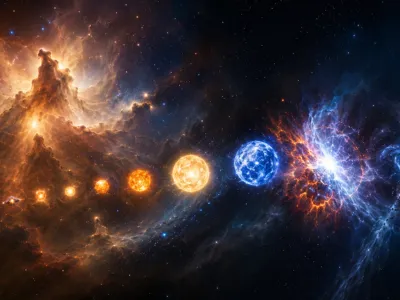
Stellar Engines of Creation
The vast majority of a star's lifetime is governed by the precise equilibrium between two titanic forces: the inward crush of gravity and the outward pressure generated by nuclear fusion in its core. This balance, known as hydrostatic equilibrium, defines stellar stability and dictates its evolutionary path.
Within stellar cores, temperatures and pressures reach extremes sufficient to overcome the electrostatic repulsion between atomic nuclei, enabling nuclear fusion. The primary reaction sequence for stars like our Sun is the proton-proton chain, which fuses hydrogen into helium and converts a small fraction of mass directly into energy as per Einstein's relation.
The energy produced by fusion does not immediately escape; it is transported outward through radiation and convection over immense timescales, a process that shapes the star's internal structure and surface phenomena. Different mass regimes utilize alternative catalytic cycles, such as the CNO cycle, which becomes dominant in more massive, hotter stars.
Thus, the sustained nuclear fusion within a star's core acts as the fundamental engine that drives its luminosity, longevity, and eventual fate.
The byproducts of these fusion processes are critical for cosmic chemical evolution. Each fusion stage synthesizes heavier elements, which are later dispersed into the interstellar medium.
- Hydrogen fusion (main sequence): Produces helium and energy.
- Helium fusion (red giant phase): Produces carbon and oxygen.
- Advanced burning stages (in massive stars): Creates elements up to iron in the core.
The Lifecycle of a Star
Stellar evolution is a direct consequence of initial mass, which determines the available fuel and the core pressures achievable. The journey begins within collapsing molecular clouds, where fragmentation and accretion lead to protostellar objects that initiate fusion upon reaching critical internal temperatures.
A star's position and duration on the main sequence are exclusively determined by its mass. Higher-mass stars, possessing greater gravitational pressure, burn their hydrogen fuel prodigiously through the CNO cycle, leading to luminosities millions of times that of the Sun but lifetimes orders of magnitude shorter.
The exhaustion of core hydrogen marks a pivotal transition, ending the main sequence phase. The core contracts and heats while the outer envelope expands and cools, creating a red giant or supergiant. Subsequent fusion stages occur in concentric shells, creating an onion-like structure of elemental layers.
The final state of a star is a stark demonstration of quantum mechanical forces battling gravity. For low-mass stars, the endpoint is a white dwarf supported by electron degeneracy pressure, while for more massive progenitors, the core collapse may result in a neutron star or a black hole. The mapping of initial mass to remnant is a key predictive success of astrophysical models.
The following table contrasts the evolutionary pathways for different stellar mass ranges, highlighting key characteristics and endpoints. This schematic overview encapsulates the mass-dependent fate that governs stellar populations across galaxies.
| Initial Mass (Solar Masses) | Primary Fusion Stages | Final Remnant | Key Signatures/Events |
|---|---|---|---|
| 0.08 - 0.5 | Hydrogen only (long duration) | Helium White Dwarf | Very long main sequence, no helium flash. |
| 0.5 - 8 | H, He (to C/O) | Carbon-Oxygen White Dwarf | Planetary nebula ejection, degenerate core. |
| 8 - 20 | H, He, C, Ne, O, Si | Neutron Star | Type II supernova, neutron degeneracy support. |
| > 20 | H through Fe-core formation | Stellar-Mass Black Hole | Hypernova/collapsar, potential gamma-ray burst. |
The observable characteristics of a star at any point are elegantly summarized in the Hertzsprung-Russell diagram, which plots luminosity against temperature. Evolutionary tracks across this diagram provide a powerful framework for interpreting stellar populations in star clusters of varying ages.
- Main Sequence: Stable hydrogen burning in the core (longest phase).
- Red Giant/Supergiant: Shell hydrogen burning around an inert helium or heavier core.
- Helium Burning Phase: Core helium fusion, often starting with a thermal pulse in low-mass stars.
- Terminal Evolutionary Phase: Mass loss, instability, and final core collapse or quenching.
Gravitational Choreography of Orbits
Celestial mechanics, rooted in Newtonian and Einsteinian physics, describes the motion of astronomical bodies under the influence of gravity. The Keplerian laws of planetary motion provide a foundational framework, revealing orbits as elliptical paths with the central body at one focus.
General Relativity refines this picture by describing gravity as the curvature of spacetime by mass and energy. This geodesic motion explains subtle orbital anomalies, such as the precession of Mercury's perihelion, which Newtonian gravity could not fully account for.
In multi-body systems, like trinary star systems or planetary systems with moons, gravitational interactions become complex. These systems exhibit orbital resonances, where periodic gravitational influences lead to stable, synchronized patterns or, conversely, to chaotc behavior and eventual ejection.
The precise mathematical modeling of these gravitational dances allows for the prediction of celestial events and the detection of unseen masses.
The following table illustrates key orbital parameters and their dynamical effects, crucial for understanding the stability and evolution of astronomical systems. These parameters are derived from observational data and numerical integration of the equations of motion.
| Orbital Parameter | Physical Significance | Observable Consequence |
|---|---|---|
| Eccentricity (e) | Deviation from a circular orbit | Variation in orbital speed and distance. |
| Inclination (i) | Tilt of orbit relative to a reference plane | Seasonal effects and transit probability. |
| Semi-major Axis (a) | Orbit size, average star–planet distance | Determines orbital period via Kepler's Third Law. |
| Orbital Resonance | Integer ratio of orbital periods | Enhanced stability or instability in multi-body systems. |
Supernovae as Cosmic Forges
Supernovae represent the most violent stellar explosions, marking the cataclysmic end of certain stars and serving as the primary nucleosynthesis site for elements heavier than iron. These events are categorized into two primary physical mechanisms: thermonuclear disruption of white dwarfs and core-collapse of massive stars.
Type Ia supernovae originate in binary systems where a carbon-oxygen white dwarf accretes matter from a companion. Upon approaching the Chandrasekhar limit, runaway carbon fusion ignites, incinerating the entire star in a uniform, predictable explosion used as a standard candle for cosmology.
Core-collapse supernovae, designated as Type II, Ib, and Ic, occur when a massive star's iron core can no longer support itself against gravity. The core collapses catastrophically into a proto-neutron star, triggering a shock wave that blows the star apart. The neutrino-driven mechanism is now considered central to reviving this shock and powering the explosion.
The explosive nucleosynthesis during these events, particularly the rapid neutron-capture process, is responsible for creating approximately half of all elements beyond iron in the periodic table.
The newly synthesized elements and the shock wave itself have profound impacts on the interstellar medium. The expanding remnant enriches the surrounding gas with metals, compresses nearby molecular clouds to trigger new star formation, and can leave behind a rapidly rotating neutron star or a black hole. The kinetic energy injected into the galaxy influences its chemical evolution and dynamical structure over cosmic time.
- Type Ia (Thermonuclear): No hydrogen lines, strong silicon lines, uniform peak luminosity.
- Type II (Core-Collapse): Strong hydrogen lines, variable luminosity, associated with massive star regions.
- Type Ib/c (Stripped Envelope): Weak or no hydrogen/helium lines, linked to Wolf-Rayet star progenitors.
- Supernova Remnants: Expanding shock waves (e.g., Crab Nebula) that accelerate cosmic rays and emit synchrotron radiation.
The Enigma of Dark Matter Halos
The rotational velocities of stars and gas within spiral galaxies remain nearly constant at large radii, a phenomenon starkly inconsistent with the distribution of visible matter. This observational conundrum provides the most direct evidence for the existence of a dark matter halo, a massive, non-luminous component that dominates the galactic gravitational potential.
Dark matter is inferred to interact predominantly, if not exclusively, through gravity, exhibiting negligible electromagnetic cross-sections. Its presence is also confirmed through gravitational lensing observations, where the distorted images of background galaxies reveal the mass profile of foreground clusters.
Cosmological simulations employing the Lambda Cold Dark Matter model successfully replicate the large-scale structure of the universe. In these models, dark matter halos provide the gravitational scaffolding for baryonic matter to condense and form galaxies.
Despite its gravitational dominance, the fundamental particle nature of dark matter remains one of the most pressing unsolved problems in modern physics.
The detailed internal structure of dark matter halos, such as the predicted cuspy density profiles, is an active area of research, with observations sometimes suggesting smoother cores. Resolving this core-cusp problem may require new particle physics or a refinement of our understanding of baryonic feedback mechanisms.

Probing the Event Horizon
Black holes represent spacetime regions where gravity is so intense that the escape velocity exceeds the speed of light, creating a boundary of no return called the event horizon. Their properties are uniquely described by their mass, spin, and electric charge, as encapsulated by the no-hair theorem.
The first direct image of a black hole's shadow, captured by the Event Horizon Telescope, revealed the photon capture region around the supermassive black hole in M87. This observation confirmed general relativistic predictions of light bending and shadow asymmetry caused by relativistic frame-dragging.
Accretion physics plays a critical role in making black holes observable. Matter spiraling into a black hole forms a hot, magnetized accretion disk, emitting copious X-rays. Some systems also launch relativistic jets perpendicular to the disk, processes powred by the extraction of rotational energy from the black hole itself.
The following table classifies black holes by their mass scale and primary formation channels, highlighting the distinct observational techniques required to study each category. This classification underscores the universality of black hole physics across immense mass ranges.
| Class | Mass Range | Formation Mechanism | Primary Detection Methods |
|---|---|---|---|
| Stellar-Mass | 3–100 M☉ | Core-collapse supernova | X-ray binaries, gravitational waves (LIGO/Virgo) |
| Intermediate-Mass | 10²–10⁵ M☉ | Unknown (possible merger or direct collapse) | Dynamical studies in globular clusters, tidal disruption events |
| Supermassive | 10⁵–10¹⁰ M☉ | Accretion and mergers in galactic nuclei | Active galactic nucleus emission, stellar/gas dynamics, direct imaging (EHT) |
The study of gravitational waves from merging black holes has opened an entirely new observational window. The inspiral and ringdown phases of the detected waveforms provide exquisite tests of general relativity in the strong-field regime and allow for precise measurements of the remnant's mass and spin, which align with Kerr black hole predictions.
The confluence of multi-messenger astronomy—electromagnetic, gravitational-wave, and neutrino observations—is now providing a more complete and tested picture of black hole astrophysics and their extreme environments.
- Event Horizon Telescope: Uses very-long-baseline interferometry to image shadow and accretion flow.
- X-ray Spectroscopy: Analyzes iron K-alpha line broadening to probe spacetime geometry near the innermost stable circular orbit.
- Gravitational Wave Astronomy: Detects ripples in spacetime from coalescing binaries, revealing pre-merger dynamics.
- Tidal Disruption Events: Monitors flares from stars ripped apart by black holes, probing dormant galactic nuclei.
The Cosmic Microwave Background
The Cosmic Microwave Background is the relic thermal radiation from the hot, dense early universe, now observed as a near-uniform blackbody glow at 2.7 Kelvin. Its 1965 discovery provided definitive evidence for the Big Bang cosmology and a direct probe of the universe's state at approximately 380,000 years old.
This radiation exhibits an almost perfect isotropy, indicating a remarkably homogeneous early cosmos. Minute temperature fluctuations, at a level of one part in 100,000, are imprinted as acoustic oscillations in the primordial plasma, revealing the seeds of all future cosmic structure.
Detailed measurements from satellite missions like WMAP and Planck have mapped these anisotropies with exquisite precision. The angular power spectrum of these fluctuations encodes fundamental parameters: the universe's geometry, its total matter and energy density, and the primordial baryon acoustic oscillation scale that acts as a standard ruler.
The CMB's temperature and polarization patterns serve as the most powerful dataset for constraining the six key parameters of the standard Lambda Cold Dark Matter cosmological model. Analysis of E-mode polarization confirms the standard picture of recombination, while the elusive B-mode polarization could provide evidence for primordial gravitational waves from cosmic inflation. The exquisite agreement between CMB predictions and large-scale structure observations forms the bedrock of modern precision cosmology, tightly defining the composition and evolutionary history of the universe from its first moments to the present day.
The Cosmic Microwave Background remains the oldest and most pristine observational window into the fundamental physics governing the origin and evolution of the cosmos.