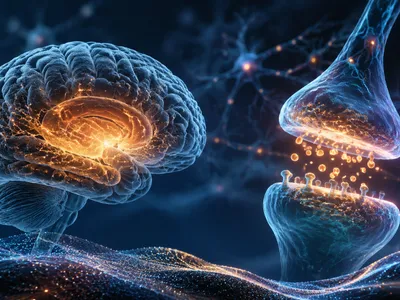
The Neurological Loop of Habit
Contemporary neuroscience conceptualizes habit formation as a computational learning process deeply embedded within specific brain circuits. This process enables the conversion of deliberate, goal-oriented actions into automatic behavioral scripts. The transition from conscious effort to unconscious routine represents a fundamental adaptive mechanism for cognitive efficiency.
At its core, this process is described by a recurrent neurological loop. This loop involves a coordinated sequence of neural firing patterns that become more robust and efficient with repetition. The loop's primary function is to delegate behavioral control from areas associated with executive function to those specialized in pattern recognition and automaticity, thereby freeing up cognitive resources.
The reinforcement of this loop is governed by dopaminergic signaling, which strengthens synaptic connections within the circuit. Each successful completion of the loop results in a slight but measurable change in neural pathway efficiency. This iterative strengthening is the physical trace of a habit in the brain, moving from a fragile state to a dominant neural pathway.
Research distinguishes between two parallel systems for action control: a deliberative system and a habitual system. Initial learning heavily engages the prefrontal cortex, hippocampus, and other regions for planning and memory. As a behavior becomes habitual, the locus of control shifts subcortically. The pivotal brain structures involved in this shift include the basal ganglia, particularly the dorsolateral striatum, and specific regions of the cortex that provide contextual input.
What Role Does the Basal Ganglia Play?
The basal ganglia is the central neural hub for habit encoding and execution. This subcortical structure operates through a complex system of direct and indirect pathways that facilitate or inhibit motor programs. Its primary role in habit formation is to mediate the transition from voluntary action to automatic routine through a process called action chunking.
Action chunking involves compressing a sequence of individual behaviors into a single, fluid unit of activity. The dorsolateral striatum, a key region within the basal ganglia, is particularly critical for this process. Neural activity in this area increases as a behavior becomes habitual, shifting from representing the action's goal to initiating the sequence itself based on contextual cues.
This shift underscores the basal ganglia's function as a switch between goal-directed and habitual systems. While the prefrontal cortex initially drives behavior toward a desired outcome, repetitive success transfers control to the basal ganglia's sensorimotor loop. The striatum effectively learns to associate specific contextual stimuli with the execution of a packaged behavioral response, minimizing cortical effort. The basal ganglia acts as the gatekeeper of automaticity, releasing well-practiced routines while suppressing competing actions.
Trigger, Routine, and Reward Circuitry
The classical habit loop model comprises three interconnected elements: a cue or trigger, a routine, and a reward. Neuroscience has mapped each component onto specific, interacting brain circuits. The loop's efficiency depends on the strength of predictive signals between these components, which are honed through repetition.
The cue or trigger is processed by sensory and associative cortices, which project to the striatum. This activation initiates the encoded routine execution sequence within the motor cortices and basal ganglia. The anticipated reward prediction error signal, mediated by midbrain dopaminergic neurons, is the reinforcing mechanism that stamps in the association between cue and routine.
The neural architecture of reward processing is central to habit strength. Dopamine release from the ventral tegmental area to the striatum does not merely signal pleasure but encodes the difference between expected and actual outcomes. A positive prediction error—when a reward is unexpected or better than anticipated—causes a surge that powerfully consolidates the preceding action sequence. This dopaminergic teaching signal is crucial for transforming a novel action into a compulsive habit, making the reward circuitry a ppotential target for intervention in maladaptive behaviors.
The following table outlines the primary neural correlates of each component in the habit loop, illustrating the distributed network involved.
| Habit Loop Component | Primary Neural Correlates | Key Function in the Loop |
|---|---|---|
| Cue/Trigger | Prefrontal Cortex, Sensory Cortices, Hippocampus | Context detection and pattern recognition to initiate the loop. |
| Routine | Dorsolateral Striatum, Motor Cortex, Cerebellum | Execution of the compressed, automated behavioral sequence. |
| Reward | Ventral Striatum (Nucleus Accumbens), Ventral Tegmental Area, Orbitofrontal Cortex | Provides the reinforcing dopamine signal that strengthens the cue-routine link. |
Habit formation progresses through identifiable neurobiological stages. The transition from deliberate practice to automaticity is not abrupt but involves gradual changes in regional brain activity and connectivity. Understanding these stages helps explain why breaking a habit requires more than simple willpower, as it involves weakening a well-established neural pathway.
- 1. Learning Phase: Prefrontal cortex and hippocampus are highly active; behavior is goal-directed and effortful.
- 2. Repetition Phase: Control begins shifting to the dorsolateral striatum; actions start to chunk together.
- 3. Automaticity Phase: Prefrontal cortex activity diminishes; the basal ganglia loop dominates, executing the routine with minimal cognitive oversight.
The Delicate Balance of Habit and Goal-Directed Systems
The brain maintains a dynamic and competitive interaction between its habitual system and its goal-directed system. These parallel systems are anatomically distinct but functionally interconnected, constantly vying for behavioral control. The habitual system, centered on the dorsolateral striatum, promotes efficient, cue-driven responses, while the goal-directed system, relying on the prefrontal cortex and dorsomedial striatum, evaluates outcomes and flexibly adjusts behavior.
Under normal conditions, this balance is context-sensitive. Novel situations or changing reward contingencies engage the goal-directed network, which can override automated habits. However, this balance can become pathological, as seen in conditions like addiction or obsessive-compulsive disorder, where habit systems become dominant and resistant to goal-based intervention.
Neuroimaging studies reveal that the strength of functional connectivity between the prefrontal cortex and the striatum predicts an individual's propensity for habitual versus goal-directed control. Stress, cognitive load, and sleep deprivation can shift this balance by iimpairing prefrontal function, thereby releasing habitual control. This explains why people often fall back on old habits when tired or overwhelmed, a state where the goal-directed system is neurologically compromised.
The competition between these systems is not merely one of inhibition but of predictive models. The habitual system operates on a model of cached values—past successes stamped into the striatum. The goal-directed system continuously computes action-outcome contingencies. When the environment is stable, the cached model is efficient; when volatile, the computational model is necessary for adaptation.
The following table contrasts the key characteristics of these two competing neural systems, highlighting their distinct contributions to behavior.
| Feature | Goal-Directed System | Habit System |
|---|---|---|
| Primary Neural Substrate | Prefrontal Cortex, Dorsomedial Striatum | Dorsolateral Striatum, Sensorimotor Cortex |
| Basis of Action Selection | Current value of desired outcome (model-based) | Stored value from past repetition (model-free) |
| Cognitive Demand | High (requires executive function) | Low (automatic) |
| Flexibility | High, adapts to new rules | Low, rigid to context cues |
| Vulnerability | Impaired by stress, fatigue | Strengthened by stress, fatigue |
Several key neurotransmitter systems modulate the interplay between goal-directed and habitual control. Dopamine, as previously noted, reinforces habits but also plays a role in goal-directed motivation through different pathways. Serotonin and acetylcholine are also critical modulators, influencing behavioral flexibility and the salience of environmental cues.
Targeted interventions for maladaptive habits must therefore aim to recalibrate this neural balance. Effective strategies work by either strengthening the goal-directed system's capacity for override or by weakening the habit loop's automaticity at its source. The plasticity that allowed the habit to form remains the primary avenue for its dissolution.
- Goal-Directed System Dominance Adaptive Context
- Associated with learning, planning, and deliberate decision-making.
- Habit System Dominance Efficient Context
- Associated with routine, automaticity, and behavioral efficiency under stable conditions.
- Pathological Imbalance Maladaptive Context
- Seen in addiction and compulsive disorders, where habits persist despite negative consequences.