Unraveling Signals From Cosmic Dawn
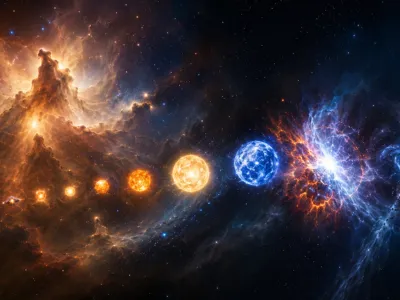
Contemporary astrophysics prioritizes understanding the universe's first luminous sources. Missions are designed to capture the faint signals from this formative epoch, pushing telescopic sensitivity to unprecedented limits.
The cosmic microwave background provides a snapshot of the infant cosmos, but the subsequent billion years remain shrouded. New observatories aim to map the distribution of primordial hydrogen, seeking the telltale signature of its transformation.
Advanced spectrographs on cutting-edge space telescopes now dissect the light from the earliest known galaxies, revealing their chemical composition and growth mechanisms. These observations challenge existing simulations of structure formation, indicating that initial star formation may have been more efficient and widespread than previously theorized. The detection of surprisingly massive and luminous galaxies at extreme redshifts poses significant questions about the timeline of cosmic dawn, suggesting our models of early baryonic physics require refinement. This era represents the final frontier for observational cosmology.
How Do Scientists Detect Exoplanet Atmospheric Composition?
The search for life drives the quest to find and characterize exoplanets. Modern techniques have moved beyond mere detection to atmospheric analysis, targeting Earth-like planets orbiting within stellar habitable zones.
Transit spectroscopy has emerged as a primary tool for this investigation. When a planet crosses its host star, atmospheric constituents imprint signatures on the transmitted starlight, allowing for remote chemical analysis.
Recent findings have uncovered a stunning diversity of planetary atmospheres, from water-vapor-rich envelopes to worlds shrouded in titanium oxide clouds. The detection of biosignature gases, such as potential biological origins of oxygen or methane in combination with other gases, remains a primary goal. However, abiotic processes can mimic these signals, requiring a comprehensive understanding of planetary context and stellar activity to avoid false positives. This complexity necessitates multi-wavelength campaigns and sophisticated photochemical models to interpret observational data correctly.
Key recent and forthcoming missions specialize in different aspects of exoplanet science, from statistical census to detailed atmospheric characterization. Their complementary capabilities are essential for constructing a holistic picture of planetary systems.
| Mission | Primary Method | Key Objective |
|---|---|---|
| Transiting Exoplanet Survey Satellite (TESS) | Transit Photometry | Identify small planets around bright, nearby stars |
| James Webb Space Telescope (JWST) | Transit & Direct Imaging Spectroscopy | Characterize atmospheres of rocky exoplanets |
| PLAnetary Transits and Oscillations (PLATO) | High-precision Transit Photometry | Discover and analyze Earth-like planets around Sun-like stars |
| Atmospheric Remote-sensing Infrared Exoplanet Large-survey (ARIEL) | Transit Spectroscopy | Statistical chemical survey of exoplanet atmospheres |
The interpretation of atmospheric data focuses on identifying chemical disequilibria. A planetary atmosphere in chemical equilibrium is predictable, whereas life introduces energy sources that create unexpected compound mixtures.
Unraveling Solar Mysteries
The Sun, our nearest star, remains a dynamic and complex system with fundamental unresolved questions. Recent missions have transitioned from passive observation to multi-point, in-situ measurement within the heliosphere.
A primary objective is understanding the mechanisms of coronal heating and solar wind acceleration. The corona's temperature, exceeding a million degrees Kelvin, starkly contrasts with the cooler photosphere, defying classical thermodynamics. Contemporary theories iinvolve magnetic reconnection and wave heating, but precise energy partitioning remains elusive. New data from probes operating close to the Sun reveal a highly structured and turbulent solar wind at its source, with discrete jet-like events contributing significantly to mass and energy flux.
Solar activity cycles and the generation of the magnetic dynamo are core to predictive space weather models. The following table contrasts the focus of two landmark missions probing different solar regions.
| Mission | Orbital Profile | Key Investigative Target |
|---|---|---|
| Parker Solar Probe | Perihelion within Sun's corona | In-situ particle, field, and solar wind measurements |
| Solar Orbiter | Ecliptic-inclined orbit | High-latitude and polar observations of solar magnetism |
How Do Astronomers Map Dark Matter Structure?
Cosmic structure is dictated by dark matter, an invisible component interacting only gravitationally. Its distribution forms a web-like scaffold guiding the formation of galaxies and clusters.
Indirect mapping techniques are therefore essential. Weak gravitational lensing surveys measure the subtle distortion of background galaxy shapes, statistically revealing the intervening mass distribution.
Large-scale spectroscopic surveys complement this by tracing the spatial distribution of visible galaxies, which are biased tracers of the underlying dark matter halos. Comparing these maps with predictions from Lambda Cold Dark Matter cosmology has revealed potential tensions, such as the clustering amplitude of matter, known as the S8 tension. This may indicate limitations in the standard cosmological model or unknown systematic effects in observations. Precision cosmology now hinges on these detailed comparisons.
Upcoming observatories will employ novel methods to probe dark matter properties with greater fidelity, moving beyond mere gravitational effects to search for more direct signatures of particle interactions.
- 🌌🔭 Primary Techniques for Dark Matter Investigation
- 🌀🔍 Gravitational lensing (weak and strong) of distant light sources.
- ⭐📡 Precision tracking of stellar kinematics within dwarf galaxies.
- ☢️🩻 Searches for X-ray emission from hypothetical particle decay or annihilation.
- 🌠📶 Subtle disturbances in the cosmic microwave background polarization patterns.