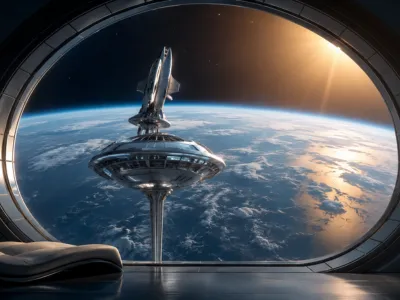
Why Should Humanity Become a Multiplanetary Civilization?
The trajectory of human civilization has long been tethered to a single planetary body, a condition that scholars argue is an unsustainable long-term strategy for species survival. This planetary monodependence presents a critical vulnerability to existential threats, ranging from asteroid impacts to anthropogenic global catastrophes. Consequently, a multipanetary existence is no longer a science fiction trope but a strategic imperative for the continuity of consciousness and culture.
This imperative transcends mere survival, evolving into a complex driver for technological and social advancement. The act of becoming a spacefaring civilization forces a fundamental re-evaluation of resource management, international cooperation, and the human capacity for adaptation in extreme environments. It compels an unprecedented synthesis of engineering, biology, and social sciences to solve problems with no terrestrial analogue.
Historically, exploration has been fueled by a blend of necessity, curiosity, and the pursuit of resources. The cosmic imperative of the 21st century uniquely merges these drivers with a profound ethical dimension: the stewardship of life itself. This shift represents a move from viewing space as a void to be crossed to recognizing it as a domain for permanent settlement and ecological extension, requiring frameworks for sustainable activity beyond Earth to prevent the replication of terrestrial cycles of conflict and environmental degradation.
The philosophical underpinnings of this journey challenge the anthropocentric view that has dominated human thought. Engaging with the cosmos on a settlement scale necessitates developing an ethics for environments where no life currently exists, while simultaneously developing protocols to protect potential extraterrestrial biospheres. This dual responsibility frames space exploration not as an escape from Earth's problems, but as a catalyst for developing more sophisticated, holistic, and long-term thinking for managing our home planet and any future ones.
Technologies Enabling Human Expansion Across the Solar System
The contemporary roadmap for human expansion is strategically layered, targeting celestial bodies that offer progressive challenges and resources. The Moon serves as a critical proving ground, while Mars stands as the first viable target for sustained colonization. Beyond these, asteroids and the Martian moons present unique opportunities for resource extraction and deep-space infrastructure development.
Achieving these goals hinges on a suite of developing technologies. Closed-loop life support systems, capable of near-perfect recycling of water and air, are non-negotiable for long-duration transit and off-world habitation. In-situ resource utilization (ISRU) technologies, which aim to extract water from lunar regolith or produce methane fuel from the Martian atmosphere, are pivotal for reducing Earth-dependent logistics chains and enabling sustainable presence.
Propulsion remains a key limiting factor. Chemical rockets, while effective for leaving Earth's gravity well, are inefficient for interplanetary travel. The development of nuclear thermal propulsion (NTP) and, in the longer term, advanced concepts like solar electric propulsion or even theoretical models based on nuclear fusion, promise to drastically reduce transit times to Mars, lowering crew exposure to cosmic radiation and microgravity.
The success of these endeavors is inextricably linked to advances in robotics and artificial intelligence. Autonomous systems will be required to construct habitats, conduct mining operations, and maintain critical systems before human arrival. Furthermore, breakthroughs in biomedical engineering—such as advanced radiation shielding, pharmacological countermeasures to bone density loss, and even genetic adaptations—are essential to safeguard human health in the harsh environment of space for years or generations.
The architecture for deep space exploration is evolving from single-destination missions towards a flexible, integrated cislunar and interplanetary infrastructure. This includes concepts like the Lunar Gateway, reusable landers, and depots for fuel and supplies strategically placed in stable orbital locations. Such an infrastructure network transforms space from a series of isolted destinations into an interconnected domain of human economic and scientific activity, enabling a gradual and sustainable expansion into the solar system.
How is the Space Economy Transforming Industry?
The emerging space economy is transitioning from a model funded solely by government agencies to a complex, multi-trillion-dollar marketplace driven by private capital. This shift is catalyzing unprecedented innovation, as the imperative for cost reduction and efficiency drives technological advancements with significant terrestrial spillover effects. The economic model is evolving from one of pure exploration to one of utilization and settlement.
At its core lies the controversial prospect of space resource extraction, particularly from asteroids and the lunar surface. These bodies contain vast quantities of water ice, rare-earth elements, and platinum-group metals. Water is the "oil of space", convertible to breathable air, drinking water, and more critically, rocket propellant (hydrogen and oxygen), enabling in-space refueling and drastically altering the economics of deep-space travel.
Beyond extraction, the microgravity and vacuum of space offer unique environments for manufacturing. The production of exotic alloys, perfect fiberoptic cables, and advanced pharmaceuticals through protein crystallization are not mere possibilities but active areas of research. These processes, impossible or inefficient on Earth, could create high-value products and establish entirely new industrial sectors in low-Earth orbit.
| Economic Sector | Primary Activity | Key Value Proposition | Potential Market Scale |
|---|---|---|---|
| Space Resource Utilization | Mining water ice, volatiles, metals | Reduces cost of in-space operations, enables sustainable exploration | Foundational, enabling other sectors |
| Orbital Manufacturing & Research | Advanced material science, biotech | Produces goods with superior properties unattainable on Earth | High-value, niche markets initially |
| Space-Based Solar Power | Collecting solar energy in space, beaming to Earth | Provides baseload, clean energy independent of weather or day/night cycle | Potentially global energy market disruption |
| Space Tourism & Hospitality | Suborbital, orbital, and later lunar experiences | Democratizes access, funds technological development, inspires public | Growing from luxury to broader experiential market |
This economic expansion raises profound legal and governance questions. The Outer Space Treaty of 1967 prohibits national appropriation of celestial bodies but is ambiguous regarding resource extraction. New frameworks, such as the Artemis Accords, are emerging to establish principles for safe and sustainable explortion, but a comprehensive legal regime for property rights, liability, and environmental protection in space is still in its infancy. The risk of a "tragedy of the commons" in orbit or on the lunar surface is real, necessitating proactive international cooperation to avoid conflict and ensure equitable access.
The space economy promises to be a powerful engine for global technological progress. The challenges of living and working off-world will drive breakthroughs in robotics, AI, renewable energy, and closed-loop life support systems. These technologies will find critical applications on Earth, addressing issues from climate change and resource scarcity to sustainable agriculture and disaster resilience, creating a feedback loop where investment in space yields direct terrestrial benefits and economic growth.