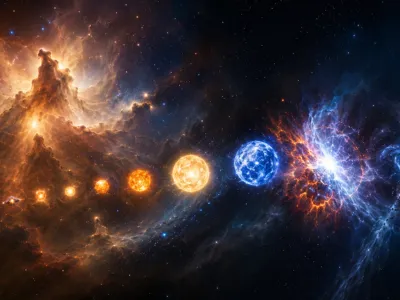
The Stellar Crucible
Stellar evolution models are sophisticated computational frameworks that simulate the life cycle of a star.
These theoretical constructs solve the fundamental equations of stellar structure, governing hydrostatic equilibrium, energy generation, and energy transport from a star's nascent formation to its final fate.
The primary physical ingredients include the equation of state, which describes matter under extreme conditions, nuclear reaction networks for energy production, and precise treatments of opacity that regulate how photons escape the stellar interior. Convection remains a particularly challenging phenomenon to model accurately, often requiring parameterized mixing-length theory to approximate the complex, turbulent motions of plasma. These models transform abstract physics into a predictive narrative for celestial objects, connecting microscopic atomic processes to macroscopic stellar properties observed across the galaxy.
Modern codes iteratively calculate how parameters like luminosity, radius, and internal composition change over millions to billions of years.
Mass The Ultimate Destiny
A star's initial mass is the paramount parameter dictating its evolutionary pathway, luminosity, and ultimate demise. This single characteristic sets the central temperature and density, which in turn control the rate of nuclear fusion and the sequence of burning stages.
- ⭐ Low-mass stars (below ~0.5 solar masses) evolve slowly, may never ascend the red giant branch, and fade as helium white dwarfs.
- ⭐ Solar-mass stars undergo a helium flash, lose their envelopes, and leave behind carbon-oxygen white dwarfs.
- ⭐ Massive stars (above ~8 solar masses) progress to fuse successive elements up to iron, leading to core-collapse supernovae and neutron star or black hole remnants.
The precise boundaries between these mass regimes are constantly refined. For instance, the minimum mass for supernova initiation is influenced by factors like metallicity and rotation, which affect mass loss and internal mixing. Stars between approximately 8 and 12 solar masses may follow an intermediate path, potentially resulting in electron-capture supernovae rather than iron-core collapse. This mass-centric framewrk allows astronomers to classify stellar populations and predict the chemical enrichment history of galaxies based on the initial mass function of star-forming regions.
Consequently, model grids are computed across a spectrum of masses, providing a reference map to interpret observations of star clusters and galactic demographics.
Computational Stellar Laboratories
Creating a stellar model requires solving a coupled set of differential equations that describe the conservation of mass, energy, and momentum throughout the star's interior.
Advanced numerical methods are employed to discretize these equations across a mesh of hundreds or thousands of mass shells, evolving the structure through small time steps.
The fidelity of a model hinges on the microphysics it incorporates, including updated opacities and nuclear reaction rates derived from laboratory experiments.
A critical challenge in modern modeling is the treatment of convective boundary mixing, which determines how chemical elements are stirred at the edges of convective zones. This process profoundly affects a star's lifetime and nucleosynthetic output, yet it cannot be derived from first principles and must be calibrated against observations. Similarly, the impact of rotation and magnetic fields introduces multidimensional complexities often approximated by diffusion coefficients in one-dimensional codes.
These approximations are necessary compromises to make the computations feasible, transforming the stellar interior into a virtual laboratory where physical assumptions can be tested.
The following table categorizes the primary input physics and the associated challenges in their implementation within stellar evolution codes.
| Physics Domain | Key Input | Major Uncertainty |
|---|---|---|
| Equation of State | Ionization, degeneracy pressure | Plasma non-ideality in dense cores |
| Nuclear Reactions | Cross-sections, reaction networks | Low-energy resonance measurements |
| Opacity | Element abundances, temperature | Treatment of heavy elements in cool stars |
| Convection | Mixing-length parameter | Boundary location and overshooting |
The calibration of free parameters is achieved by ensuring models reproduce well-constrained benchmarks, such as the present-day Sun. This solar calibration adjusts mixing lengths and initial compositions until the model's radius, luminosity, and surface temperature match observed values at the Sun's age. This tuned model then serves as a foundation for predicting the evolution of other stars. Beyond the Sun, benchmark stars in binary systems and star clusters provide critical data points for validating models across the Hertzsprung-Russell diagram.
Stellar Models Reveal Galaxy Formation History
Stellar models provide the theoretical backbone for interpreting the vast array of stellar populations observed in our galaxy and beyond.
They translate the fundamental parameters of luminosity and effective temperature into a predicted position on the Hertzsprung-Russell diagram for any given age and composition.
By superimposing model isochrones—lines of constant age—onto observational data from star clusters, astronomers can determine cluster ages and distances with remarkable precision.
This application is a cornerstone of galactic archaeology, allowing researchers to reconstruct the formation history of the Milky Way. Different stellar populations, characterized by their chemical fingerprints and kinematic properties, can be traced back to their birth environments and epochs. Models that incorporate detailed nucleosynthesis predict the chemical enrichment of the interstellar medium by stellar winds and supernovae explosions. These predictions are compared against the observed abundance patterns in ancient, metal-poor stars, offering a direct test of the integrated model physics. This iterative process of prediction and observation continuously refines our understanding of stellar physics and galactic chemical evolution, turning static snapshots of the sky into a dynamic history of cosmic construction.
The synergy with asteroseismology has been transformative, as oscillation frequencies probe stellar interiors with unprecedented detail.
Data from space missions like Kepler and TESS deliver precise measurements of stellar oscillations for thousands of stars. These seismic observables, such as the large frequency separation, are highly sensitive to internal density profiles. By matching observed oscillation spectra to those predicted by models, astronomers can determine fundamental stellar properties—mass, radius, and age—with uncertainties often below a few percent. This method, known as 'asteroseismic stellar modeling', provides robust benchmarks that are revolutionizing our ability to date stars and test interior physics. It has exposed subtle discrepancies in model-predicted core sizes and mixing processes, driving the development of more physically complete simulations.
| Observational Probe | Constraints Provided | Impact on Models |
|---|---|---|
| Star Cluster Isochrones | Age, distance, reddening | Calibrates bulk evolution timescales |
| Binary Star Parameters | Masses, radii, luminosities | Tests mass-luminosity relation directly |
| Asteroseismology | Internal sound speed, core size | Reveals inaccuracies in mixing processes |
| Spectroscopic Abundances | Surface chemical composition | Validates nucleosynthesis and dredge-up |
Beyond single stars, models underpin population synthesis for entire galaxies. They are integrated into cosmological simulations to predict the light and chemical output of stellar populations formed under varying conditions. This allows astronomers to interpret the integrated spectra of distant galaxies and map the star formation history of the universe. The predictive power of stellar evolution models is thus not cconfined to individual objects but extends to the grand scale of cosmic evolution, linking the life cycles of stars to the observable properties of galaxies across cosmic time.
-
Galactic ArchaeologyUsing chemical clocks to date stellar populations and map accretion events.
-
Extragalactic Stellar PopulationsDeriving ages and metallicities of unresolved stars from integrated light.
-
Gravitational Wave ProgenitorsPredicting rates of compact object mergers from binary stellar evolution.