The Chemical Conversation of Neurons
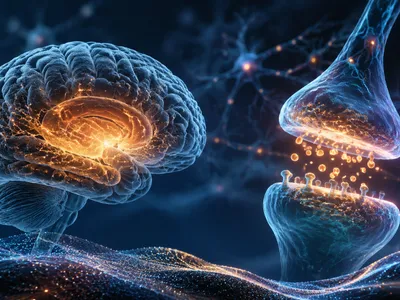
Synaptic signal modeling fundamentally begins with the chemical transmission process across the synaptic cleft. This neurotransmitter-mediated signaling is not a simple diffusion event but a highly regulated spatiotemporal cascade. The precise concentration and timing of neurotransmitter release are critical for determining the strength and fidelity of the neuronal message, influencing whether a signal is propagated or dampened.
Key ligands, such as glutamate, GABA, and dopamine, bind to specific postsynaptic receptors. Each receptor type possesses distinct kinetic properties and activation thresholds, which directly shape the postsynaptic potential. The probabilistic nature of vesicle release introduces a fundamental stochastic element into all synaptic computations.
Modern models must account for the nonlinear summation of multiple synaptic inputs arriving at a dendritic segment. The interaction between excitatory and inhibitory currents within a confined subcellular space is a core computational challenge. These interactions are not merely algebraic but involve complex electrochemical feedback loops.
The clearance of neurotransmitter via specialized transporters and enzymatic degradation terminates the signal. This reuptake mechanism is crucial for maintaining synaptic homeostasis and preventing receptor desensitization. Dysfunction in this clearance process is implicated in numerous neuropsychiatric disorders.
Advanced quantal analysis frameworks now incorporate presynaptic calcium dynamics and the heterogeneous probability of release across individual active zones. The concept of the vesicle release probability (Pr) is central, varying significantly between synapses and being subject to dynamic short-term plasticity. This quantal stochasticity provides a substrate for both noise and reliability in neural circuits, requiring models to move beyond deterministic averages to capture the essential variability that characterizes biological computation.
How Do Synaptic Signals Trigger Neurotransmitter Release?
The journey of a synaptic signal originates with the docking and priming of synaptic vesicles at the presynaptic active zone. Voltage-gated calcium channels open in response to an action potential, creating a nanodomain of elevated calcium ions. This localized calcium influx is the critical trigger for the SNARE protein complex to catalyze membrane fusion.
Following exocytosis, the behavior of neurotransmitters in the cleft is governed by diffusion equations and boundary conditions. The geometry of the synaptic cleft, often only 20-40 nanometers wide, profoundly influences concentration profiles. Receptor activation kinetics are then modeled using state-transition diagrams, such as Markov models, to describe the ligand-gated ion channel behavior.
The table below summarizes the core parameters and their typical values used in biophysical models of this transmission stage. These values are derived from empirical studies and are essential for constructing numerically accurate simulations of synaptiic function. Variability in these parameters across different synapse types is a primary source of functional diversity in the brain.
| Modeling Parameter | Symbol | Typical Range / Value | Primary Influence |
|---|---|---|---|
| Vesicle Release Probability | Pr | 0.1 - 0.9 | Signal reliability, short-term plasticity |
| Synaptic Cleft Width | d | 20 - 40 nm | Neurotransmitter diffusion time |
| Neurotransmitter Diffusion Coefficient | D | 0.2 - 0.8 µm²/ms | Rise time of postsynaptic current |
| Channel Mean Open Time | τopen | 0.1 - 5.0 ms | Postsynaptic current decay kinetics |
Integrating these presynaptic and postsynaptic components requires solving coupled differential equations that describe calcium influx, vesicle pool depletion, neurotransmitter diffusion, and receptor channel gating. The resulting model output is a postsynaptic conductance change that can be integrated into larger neuronal membrane models. Discrepancies between model predictions and experimental recordings often reveal hidden regulatory mechanisms, such as presynaptic metabotropic autoreceptors or perisynaptic scaffolding proteins that alter local geometry.
Computational Frameworks for Synaptic Simulation
Mathematical modeling of synapses employs distinct computational frameworks, each offering unique advantages and trade-offs between biophysical accuracy and computational cost. Choosing an appropriate framework is the first critical step in any simulation study.
The Hodgkin-Huxley formalism, while foundational for action potential generation, is often too computationally expensive for large-scale network simulations involving thousands of synapses. Consequently, simplified phenomenological models like the exponential or alpha function synapse are widely used in network neuroscience. These models sacrifice molecular detail for simulation speed, representing the postsynaptic conductance with a single differential equation. This abstraction is necessary for whole-brain scale modeling efforts.
In contrast, detailed biophysical models utilize Markov chain formalisms to simulate the stochastic gating of individual ionotropic receptor channels. This approach captures the inherent noise and variability of synaptic transmission, which can influence network dynamics. The Monte Carlo method is frequently applied here, simulating random transitions between receptor states based on kinetic rate constants. Such models require precise parameters for neurotransmitter diffusion, binding, and unbinding, often derived from single-channel recordings. While computationally intensive, this granularity is indispensable for studying pharmacological interventions or genetic mutations that alter specific channel properties.
The following table contrasts the primary computational frameworks used in contemporary synaptic modeling, highlighting their core characteristics and typical applications in modern neuroscience research.
| Framework Type | Key Characteristics | Computational Demand | Primary Use Case |
|---|---|---|---|
| Phenomenological | Single equation, deterministic, lacks mechanistic detail. | Low | Large-scale network simulations, theory. |
| Biophysical (Markov) | Stochastic, multi-state channel kinetics, spatially detailed. | Very High | Drug discovery, channelopathy studies. |
| Mean-Field Approximation | Represents average population activity, reduces dimensionality. | Medium | System-level analysis, EEG/MEG signal modeling. |
A robust synaptic modeling pipeline integrates several key software components and theoretical considerations. The list below outlines the essential elements required for building, simulating, and validating a computational model of synaptic transmission, moving from concept to simulation output.
- 📊 Parameter Estimation: Deriving kinetic constants from experimental patch-clamp or imaging data.
- 🧮 Numerical Solvers: Selecting appropriate algorithms (e.g., Euler, Runge-Kutta) for differential equations.
- ✅ Validation & Fitting: Comparing model output to empirical electrophysiology traces.
- 🔍 Sensitivity Analysis: Determining which parameters most influence model behavior.
- 💻 Open-Source Simulators: Utilizing platforms like NEURON, Brian, or NEST for implementation.
How Do Astrocytes Regulate Synaptic Communication?
The traditional neuron-centric view of synaptic function has been fundamentally revised by the recognition of tripartite synapse architecture. Astrocytic processes ensheath synaptic clefts, forming an integral third component. These glial cells are not passive bystanders but active regulators of information transfer.
Astrocytes express a wide array of metabotropic receptors that are activated by synaptically rreleased neurotransmitters. This activation triggers internal calcium waves within the astrocyte network, leading to the feedback release of gliotransmitters such as ATP, D-serine, and glutamate. The temporal dynamics of this glial feedback are orders of magnitude slower than neuronal signaling.
The most established role is the astrocytic uptake of glutamate via high-affinity transporters (EAAT1/2), which is critical for limiting spillover and preventing excitotoxicity. Furthermore, the glial release of D-serine acts as an essential co-agonist for NMDA receptor activation, thus modulating synaptic plasticity thresholds. This places astrocytes at the heart of learning and memory mechanisms. Advanced synaptic models now incorporate these glial pathways, representing them as delayed feedback loops or homeostatic controllers that adjust synaptic gain based on integrated neuronal activity. Failure to model this tripartite structure risks oversimplifying synaptic dynamics, particularly in studies of neurological diseases where astrocyte dysfunction is a known pathological feature.