The Brain's Predictive Engine
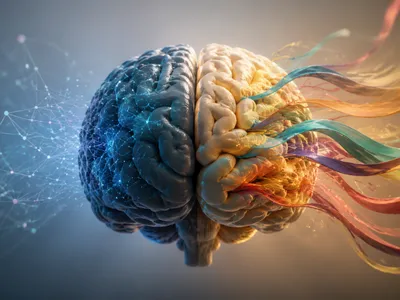
Contemporary neuroscience reframes the brain not as a passive receiver but as an active predictive organ constantly generating models of the world. Its primary function is to anticipate incoming sensory data based on prior experiences and internal schemas.
This process, formalized in predictive coding theory, posits that perception is a dialogue between top-down predictions and bottom-up sensory signals. Discrepancies between prediction and reality generate prediction errors, which are crucial learning signals. The brain's objective is to minimize these errors by refining its predictive models, either by updating its internal representations or by acting on the world to make sensory input match expectation. This continuous cycle of prediction, comparison, and model adjustment constitutes a fundamental algorithm for learning, where surprise motivates cognitive revision and knowledge acquisition.
How Neural Systems Filter Raw Sensory Inputs?
The raw stream of sensory information is overwhelmingly complex and unstructured, posing a significant computational challenge. Pattern recognition acts as the essential cognitive filter that identifies statistical regularities, recurring sequences, and stable features within this noise.
Neurobiologically, this involves hierarchical processing where simpler patterns detected in lower-level sensory cortices are integrated into increasingly abstract representations in higher-order association areas. This progressive extraction of invariance from variability allows the mind to construct a stable and comprehensible reality. The efficiency of this system is paramount; recognizing a familiar pattern is metabolically less costly than processing novel, unpredictable stimuli. Therefore, the drive to find patterns is also a drive for cognitive efficiency and energy conservation. Key neural structures like the hippocampus and neocortex work in concert to encode, consolidate, and retrieve these patterns, forming the physical substrate of memory and learning.
The following table outlines the primary cognitive transformations facilitated by pattern recognition across different domains of input.
| Sensory Input Domain | Pattern Type Recognized | Cognitive Outcome |
|---|---|---|
| Visual Stream | Shapes, contours, spatial relationships, object constancy | Object identification, scene understanding |
| Auditory Stream | Phonemic sequences, rhythmic structures, melodic contours | Speech perception, music comprehension |
| Linguistic Information | Syntax, grammatical rules, narrative arcs | Language acquisition, discourse meaning |
| Conceptual Information | Causal relationships, taxonomic categories, theoretical frameworks | Scientific reasoning, knowledge schema formation |
How Does Chunking Build Expertise?
Chunking describes the cognitive process of binding discrete units of information into a single, coherent pattern. This compression is fundamental to overcoming the severe constraints of working memory capacity.
Through practice, novices initially struggle with isolated elements, but experts perceive and manipulate chunks—meaningful clusters that behave as single units. This recursive bundling allows for the efficient storage and rapid retrieval of ccomplex information, from chess positions to musical phrases. The table below illustrates the transformative effect of chunking on cognitive performance across skill levels.
| Performance Metric | Novice (No Chunking) | Expert (Advanced Chunking) |
|---|---|---|
| Working Memory Load | High; each element taxed separately | Low; chunks treated as single elements |
| Recall Speed & Accuracy | Slow, prone to error | Fast, highly accurate |
| Problem-Solving Approach | Analytical, step-by-step | Intuitive, pattern-based |
The development of expertise is marked by the acquisition of a vast library of domain-specific chunks. This reorganization of knowledge is not merely quantitative but qualitative, enabling fluent, intuitive performance. The key mechanisms through which chunking facilitates expert learning are summarized in the following list.
- 🧠 Reduction of Cognitive Load: Freeing working memory resources for higher-order reasoning and problem-solving.
- ⚙️ Automation of Procedures: Converting deliberate sequences into automatic routines, requiring minimal conscious attention.
- 🔍 Enhanced Pattern Recognition: Enabling the rapid identification of familiar configurations within new problems or situations.
- 🔄 Facilitation of Analogical Transfer: Allowing experts to apply learned chunks to novel but structurally similar domains.
How Mental Templates Drive Deep Learning?
Pattern recognition’s ultimate cognitive product is the schema, an organized framework of interrelated concepts that guides perception and understanding. Schemas act as mental templates, predicting what information is relevant and how new data should be assimilated.
When a learner encounters new information, they attempt to fit it into an existing schema through assimilation. If the information cannot be accommodated, the schema itself must undergo accommodation, a process of revision and growth that constitutes deep learning. This dynamic equilibrium drives intellectual development, as robust schemas provide the scaffolding for increasingly complex knowledge structures. Effective instruction strategically activates and challenges these schemas to promote meaningful integration rather than superficial memorization.
The Critical Role of Feedback Loops
Pattern recognition is not a static event but a dynamic process refined through continuous interaction with the environment. Feedback loops provide the essential error-correction mechanism that validates or disproves the brain's predictive models, closing the gap between expectation and outcome.
Effective learning systems are architecturally built upon these loops, where the consequences of an action or interpretation are fed back to inform future predictions. This creates a self-correcting cycle where accuracy is iteratively improved. In computational models of learning, algorithms adjust their internal parameters based on feedback to minimize future error. Similarly, human learning thrives on timely and specific feedback that highlights discrepancies, whether in mastering a motor skill or refining a concptual understanding. The neurological substrate for this involves dopaminergic pathways that signal prediction error, reinforcing successful pattern predictions and discouraging inaccurate ones.
The table below categorizes primary feedback types and their distinct roles in calibrating the pattern recognition system across different learning contexts.
| Feedback Type | Mechanism & Source | Learning Impact |
|---|---|---|
| Intrinsic (Internal) | Sensory proprioception, discrepancy between intended and actual movement, metacognitive monitoring. | Enables self-directed calibration and fine-tuning of skills. |
| Extrinsic (External) | Direct instruction, automated system responses, peer review, empirical data from an experiment. | Provides objective benchmarks and corrects unseen errors. |
| Positive Reinforcement | Reward signals confirming a correct pattern match or successful prediction. | Strengthens neural pathways, increasing the likelihood of pattern recall. |
| Negative Feedback | Error signals indicating a failed prediction or mismatch. | Drives cognitive accommodation and schema revision, preventing stagnation. |
Motivation and the Reward of Pattern Discovery
The human cognitive system is inherently motivated to seek and resolve patterns. Successfully recognizing a pattern or solving a puzzle activates the brain's reward circuitry, releasing neurotransmitters that create a sense of pleasure and satisfaction.
This neurochemical response transforms pattern recognition from a cold computational process into a motivated exploration. The anticipation of the "aha!" moment—the cognitive reward—fuels curiosity and persistence in problem-solving. This intrinsic motivation is a powerful driver of self-directed learning, as individuals seek out challenges of optimal complexity where patterns are discernible but not immediately obvious. The learning environment can thus amplify engagement by structuring tasks to provide a clear trajectory from confusion to pattern clarity, offering intermittent and meaningful rewards for discovery. This cycle ensures that the cognitive labor of pattern seeking is perpetually renewed.