The Uniqueness Question
The proliferation of high-resolution digital reproductions challenges the traditional aura of the painted original. Tactile materiality and physical presence become defining features when an artwork can be instantly shared online.
This tension forces a re-examination of what aura means in the twenty-first century. Walter Benjamin's concept of mechanical reproduction gains new complexity when the copy is not just a photograph but a shareable digital file.
Paintings offer a resistant site of a profound sensory dialogue that screens cannot fully simulate. The physical presence of pigment and canvas asserts itself precisely because of its opposition to the ephemeral nature of digital consumption. Contemporary scholarship suggests that this very opposition may reinforce, rather than diminish, the value of the unique object. The digital context repositions the traditional painting as a counterpoint to technological mediation.
Redefining Authenticity in a Digital World
Authenticity is no longer a fixed property but a negotiated concept within contemporary artistic discourse. Post-authenticity frameworks suggest that value is increasingly assigned through narrative and process.
The digital environment fosters a new appreciation for the conceptual framework behind a painting, not just its physical execution. Viewers engage with an artist's intent and historical context through readily accessible online archives, fundamentally shifting the criteria for what constitutes a genuine artistic contribution.
This redefinition allows traditional painting to coexist with digital media by occupying a distinct phenomenological space. The documentary value of a painting increases as digital platforms disseminate its image, creating a layered identity. The physical object remains the anchor, while its digital shadow circulates, accumulating interpretations and context. This dynamic challenges the notion of a singular, unchanging authentic work, proposing instead a model where authenticity is continuously constructed through the dialogue between the material artefact and its global, digital reception. New forms of verifiable authenticity emerge through high-resolution archival practices and the artist's own digital narrative.
The shifting criteria for authenticity can be mapped across different domains of value. The following comparison illustrates how traditional and emerging frameworks assess a painting's significance.
| Domain of Value | Traditional View | Emerging Digital View |
|---|---|---|
| Provenance | Physical chain of ownership, exhibition history. | Digital documentation, blockchain verification, online archive presence. |
| Materiality | Primacy of original canvas, pigment, and artist's hand. | Materiality as one component, valued for its contrast with the immaterial. |
| Artist's Intent | Discovered through historical analysis and physical evidence. | Constructed through artist's statements, social media, and direct digital access. |
This conceptual shift does not negate the importance of the physical object but rather places it within a broader informational ecosystem. The painting's authenticity is now partly sustained by the very digital networks that were once seen as a threat to its uniqueness. Collectors and institutions increasingly consider an artist's digital provenance and online scholarly footprint as integral components of a work's overall authenticity and historical record.
Hybrid Practices Emerge
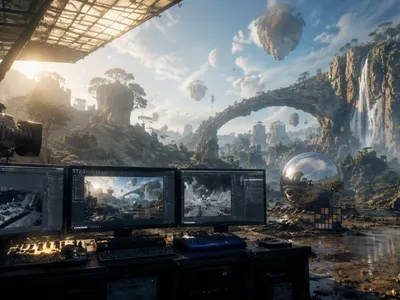
Contemporary artists increasingly navigate between studio and screen, integrating digital tools into traditional workflows, as demonstrated by how 3D modeling transforms visual storytelling. Hybridity manifests when an oil painter uses a tablet for preliminary composition studies before transferring the design to canvas.
This methodological fusion challenges the notion of pure, medium-specific practice. Digital underdrawing and projected imagery become a deliberate, self-aware approach that acknowledges technological mediation while retaining the conceptual fusion of manual execution.
The resulting paintings often carry the visual memory of their digital origins, incorporating pixelated aesthetics or glitch effects rendered in viscous oil. This dialogue between code and pigment produces works that resist easy categorization, appealing to audiences fluent in both gallery spaces and online image cultures. The hybrid artist functions as a translator between material and immaterial realms, and the painting becomes a site where these two worlds coalesce. This practice redefines the transformed status of the original object as a convergence point for multiple creative processes.
The integration of digital methods varies significantly across artistic disciplines and intentions. The table below outlines common hybrid approaches observed in contemporary painting studios.
| Digital Tool | Traditional Application | Artistic Outcome |
|---|---|---|
| Projection mapping | Underdrawing and image transfer | Precise scaling, complex compositions, photorealism foundations |
| Digital collage | Source material for oil or acrylic | Layered imagery, juxtaposed perspectives, contemporary iconography |
| Algorithmic generation | Pattern development and color studies | Systematic complexity, non-repeatable structures, data-driven aesthetics |
The Evolution of the Artist's Hand and Skills
Digital fluency now stands alongside manual dexterity as a core competency for emerging painters. The Artist's Hand is no longer solely defined by brushwork but by the capacity to orchestrate both physical and digital mark-making.
Pedagogical shifts in art education reflect this transformation, with curricula incorporating digital imaging, 3D modeling, and virtual reality as complementary studio skills. This expansion does not erode traditional craftsmanship but rather recontextualizes it within a broader new literacy of material translation. Students learn to see thee digital not as a replacement but as an expanded repertoire of preparatory and conceptual tools that ultimately enrich physical execution.
The contemporary painter's toolkit now encompasses a diverse range of competencies that bridge historical techniques with emerging technologies. These evolving skills redefine artistic preparation and production.
-
Digital imaging fluency – Advanced Photoshop and Procreate skills for composition development and color testing before canvas work.
-
Material translation expertise – The capacity to convert digital effects and pixel aesthetics into traditional media like oil, tempera, or fresco.
-
Digital provenance management – Understanding blockchain authentication, high-resolution archival practices, and online portfolio curation.
The artist's hand, therefore, evolves into a site of synthesis where centuries-old techniques meet twenty-first-century cognitive and technical demands. This expanded skill set does not dilute traditional mastery but rather situates it within a digital literacy framework that contemporary audiences and institutions increasingly expect. The painter who commands both domains possesses a unique communicative power, capable of addressing viewers through the immediacy of pigment and the pervasive language of digital culture.
This dual competency transforms the creative process itself. Preliminary sketches executed digitally can be endlessly revised, tested for compositional balance, and even simulated under various lighting conditions before a single brushstroke touches canvas. The physical act of painting then becomes a focused, deliberate translation of resolved digital ideas into material form. Such workflows demand rigorous conceptual clarity and technical adaptability, positioning the painter as a sophisticated operator across media rather than a defender of obsolescent methods.
Bridging Physical and Digital Museum Experiences
Museums and galleries face the challenge of dual-audience curation, balancing the intimate experience of original paintings with the reach of digital platforms. Institutions experiment with immersive physical displays emphasizing material presence while also offering high-resolution digital experiences, artist interviews, and archival context, creating a digital and physical nexus. Virtual exhibitions reveal that online viewers engage differently, highlighting the potential for complementary modes of attention. Successful integration positions traditional painting within a cultural continuum that bridges centuries-old techniques with contemporary digital dissemination.
The divergent demands of physical and digital audiences require curators to make strategic decisions across multiple exhibition dimensions. The comparison below illustrates key considerations in contemporary curatorial practice.
| Curatorial Dimension | Physical Exhibition Priority | Digital Exhibition Priority |
|---|---|---|
| Lighting design | Optimized for in-person viewing, material revelation, surface texture | Uniform illumination for photography, color accuracy across devices |
| Interpretive text | Concise wall labels, spatial integration, minimal interference | Expanded essays, video content, hyperlinked archival references |
| Spatial arrangement | Choreographed physical movement, sightlines, room ambiance | Virtual navigation, zoom functionality, curated image sequences |
| Audience engagement | Live tours, lectures, physical catalogs | Social media integration, shareable content, virtual events |