Immersive Worlds
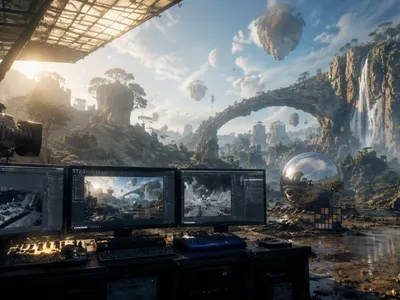
3D modeling introduces spatial depth absent in 2D visuals, placing viewers within the narrative space, while textures and lighting convincingly replicate real-world materials through shadows and reflections that strengthen realism. With real-time rendering, users can interactively explore environments, shifting from passive viewing to active engagement, and when these spaces follow consistent physical rules, the mind perceives them as a believable setting for story events.
Advanced techniques such as photogrammetry and procedural generation push immersion toward photorealism. Scan real locations or algorithmically creating vast terrains, artists build worlds with unprecedented detail. These environments support complex narrative layering where background elements carry subtext. A cracked door or distant mountain peak becomes a storytelling device.
A structured comparison reveals how 3D modeling transforms environmental storytelling.
| Feature | Traditional 2D | 3D Modeling |
|---|---|---|
| Spatial continuity | Broken by cuts | Continuous camera |
| Lighting cues | Static symbols | Dynamic, time-based |
| Viewer agency | None | Interactive exploration |
Dynamic Characters
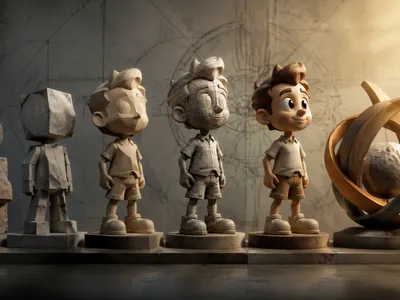
3D character rigging enables precise control over facial micro-expressions and eye movement, allowing characters to express complex emotions without dialogue. Combined with anatomically accurate modeling and subsurface scattering, light interacts with skin in a realistic way, enhancing muscle deformation and joint motion to create believable, lifelike figures.
Cloth and hair simulations react naturally to motion and environment, reinforcing realism and emotional connection. The key strength of 3D character creation lies in its ability to refine performance digitally, where animators can adjust expressions and body language with frame-level accuracy. This flexibility allows directors to perfect emotional moments even after production, while blend shapes and morph targets ensure smooth transitions between expressions and support deeper character development.
Manipulating Time and Space in Stories
Three-dimensional environments give editors the ability to pause or replay action from any perspective, reshaping traditional linear storytelling, while virtual cameras moving through digital space can condense long periods into moments, allowing a continuous shot to shift from morning to evening within a single environment and creating a strong sense of temporal compression.
The ability to reposition the viewer instantly across vast distances changes how stories handle geography. A character in a modeled skyscraper can appear next to a distant forest without a cut, preserving spatial continuity while breaking physical limits. This technique, often called virtual cinematography, supports non‑local storytelling where cause and effect jump across traditional boundaries. For example, a whispered secret in one room can visually echo in another location through matched camera moves and lighting.
Below is a comparison of temporal and spatial techniques enabled by 3D modeling.
| Technique | Narrative Effect |
|---|---|
| Time remapping | Slow‑motion emotion beats |
| Space compression | Simultaneous parallel events |
| Bullet‑time freezing | Multi‑angle moment analysis |
Such manipulations rely on point‑cloud data and unified scene graphs. By storing every object’s position over time, editors extract any view at any frame. This data‑rich workflow transforms editing from a process of selecting footage into one of authoring spacetime itself. Directors no longer ask which camera angle? but from which impossible perspective?
How Does Camera Movement Shape Emotion?
A slowly dolly‑in on a modeled face can signal dread or intimacy. The same move on a 2D drawing lacks parallax cues that trigger deep empathy.
Three‑dimensional camera paths follow physical lens properties. Rack focus pulls attention between foreground and background elements, directing gaze without editing.
Steadicam‑like orbits around a character generate unconscious trust or suspicion depending on speed and direction. When a digital camera circles clockwise, Western audiences often perceive stability; counter‑clockwise introduces unease. These subtle biases, rooted in real‑world psychology, become programmable narrative tools utilized within modern animation studios. Furthermore, camera shake algorithms simulate handheld authenticity during tense moments, while locked‑off tripod shots create oppressive stillness for horror sequences.
To apply these principles effectively, storytellers calibrate several motion parameters. Consider the following checklist when designing camera behavior in 3D scenes.
- 🔍 Focal length breathing – gradual zoom to isolate a secret
- 📐 Height angle shifts – low angle for power, high angle for vulnerability
- 🏃 Lateral tracking speed – fast for chaos, slow for melancholy
- 🌀 Axis tilts – Dutch angles signal psychological fracture