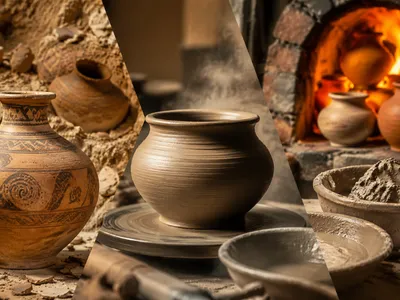
How Can Potters Reclaim and Reuse Clay?
Clay reclamation from trimmings and failed pieces significantly reduces raw material use, with studios cutting clay purchases by nearly thirty percent. The process collects scraps, slakes them, and dewaters slip on plaster bats, and simple techniques like these prevent large amounts of ceramic waste from reaching landfills.
Avoiding cross-contamination between clay types is essential, as mixing earthenware with stoneware can cause defects. Reclaimed clay often offers improved workability, and many potters note that recycled clay feels smoother and more plastic, enhancing throwing and handbuilding performance, which is a great cost-saving asset when learning how to start a pottery hobby at home.
Energy-Efficient Kiln Firing Techniques
Energy-efficient kiln firing offers the greatest potential to lower a studio's carbon footprint, as electric and gas kilns consume significant power during long cycles. Optimizing kiln loading and thermal mass management improves heat distribution, with dense packing reducing dead air space and minimizing heat loss.
Digital kiln controllers allow precise ramping and soaking profiles, preventing overfiring and temperature spikes. Properly tuned schedules can reduce electricity usage by up to fifteen percent per firing, enhancing both efficiency and consistency.
Incorporating high-quality kiln furniture and refractory fiber insulation decreases thermal mass and heat-up times. Silicon carbide shelves use less energy than traditional cordierite, and studios retrofitting kilns often recoup their investment within two years.
Non-Toxic Glazes
Traditional glazes often contain heavy metals like lead, barium, or chromium, posing serious health hazards. Contemporary practices favor non-toxic glaze chemistry using tin, titanium, or rare earth oxides, producing vibrant, stable colors without environmental contamination.
Innovations such as boron-based frits and alkaline earth fluxes enable mid-range firing safely, and many contemporary studios now exclusively stock boron-calcium glazes. Laboratory testing confirms these formulations retain durability and gloss, with long-term studies showing no detectable heavy metal leaching.
Reducing Water Use in Ceramics
Pottery studios reduce freshwater use by recycling wash water through settling tanks, where a three-bucket system separates coarse sediments from fine clay. The clarified water re-enters the workflow for mopping and tool rinsing, saving thousands of liters monthly, while reclaiming valuable clay solids that can be harvested weekly for reuse.
Before detailing the water-saving process, the following table summarizes key interventions and their impact.
| Intervention | Water saved per session | Implementation effort |
|---|---|---|
| Settling tank system | 40–60 liters | Moderate |
| Spray gun with shut-off valve | 15–20 liters | Low |
| Dry clean before hosing | 25–35 liters | Low |
Studios adopting these measures report lower utility bills and reduced clay purchases. Closed-loop water management represents a core principle of sustainable ceramic practice.
Closing the Loop on Studio Waste
Ceramic studios apply circular economy principles to transform waste materials like worn kiln shelves, broken molds, and packaging into reusable resources. Much like the resourcefulness found in ancient pottery techniques still used today, crushed refractory bricks replace grog in raku bodies, gypsum from broken molds is reground and mixed with fresh plaster, and cardboard or bubble wrap is reused for greenware transport, with zero‑landfill studios reporting annual savings exceeding five hundred dollars.
A systematic waste audit helps identify the most frequently discarded items. The following categories represent the highest diversion potential for small to mid‑size studios.
- Worn kiln shelves → crushed into grog or garden drainage aggregate
- Paper and plastic packaging → reused for shipping or donated to community art programs
- Broken plaster bats and molds → ground, sieved, and blended with fresh plaster
- Metal scrap (copper wire, kiln elements) → recycled through electronic waste facilities
Implementing these loops requires minimal capital but demands consistent sorting habits. Closed‑loop studios integrate waste segregation into daily cleaning routines. Over time, the practice reduces purchase frequency of consumables and lowers the studio’s ecological footprint. Adopting even two of these strategies moves a facility measurably toward true circularity.