Cryovolcanic Worlds
Cryovolcanism replaces molten silicate magma with mobile brine slurries and liquid water, fundamentally reshaping icy moons. This process operates under extreme pressure regimes, creating distinct surface features such as chaotic terrains and cryo-lava flows.
Thermal evolution models now indicate that tidal dissipation alone cannot sustain subsurface oceans indefinitely. Instead, radiogenic heating within silicate cores contributes significantly to the longevity of internal liquid reservoirs.
Spectroscopic data from Cassini’s Ion and Neutral Mass Spectrometer confirmed that Enceladus’ plumes contain molecular hydrogen, a likely product of hydrothermal reactions between water and ultramafic rock at the seafloor. Such alkaline vent systems generate redox gradients capable of supporting chemosynthetic microbial communities, positioning these satellites as prime targets for astrobiological investigation. The detection of nanophase silica grains further corroborates the existence of sustained high‑temperature fluid–rock interaction beneath the south polar terrain.
The Silica‑Rich Sands of Titan
Titan’s equatorial dune fields, spanning millions of square kilometers, consist primarily of organic sand rather than silicates. However, recent radar reflectivity data from the Cassini RADAR mapper revealed localized units exhibiting unusually high dielectric constants.
These anomalies point to the presence of water‑ice bedrock mixed with amorphous silica precipitates, likely formed during ancient cryovolcanic episodes where ammonia‑rich water interacted with the subsurface crust. The silica signature implies a past period of elevated thermal flux capable of altering the original icy composition.
| Dune Field Region | Dielectric Constant (ε') | Inferred Composition |
|---|---|---|
| Belet | 2.1 – 2.4 | Organic sand with minor silicate |
| Fensal | 2.7 – 3.2 | Silica‑rich mixtures |
| Aztlan | 3.5 – 4.0 | Water ice + amorphous silica |
The geographic confinement of silica‑enriched dune materials to the mid‑latitude band suggests a tectonic control on the distribution of ancient cryovolcanic edifices. Fluvial erosion from methane rainfall redistributed the altered sediments, creating a secondary sedimentary cycle that interleaves organic and aqueous alteration products. This dual‑process mechanism refines our understanding of sediment transport on Titan and highlights how exogenic and endogenic forces converge to form complex planetary surfaces.
The Evidence for a Global Subsurface Magma Reservoir
Magnetic induction measurements from the Galileo spacecraft indicate the presence of a deep, globally conductive layer consistent with a partially molten silicate reservoir, extending beyond what a simple asthenosphere could explain. Continuous tidal deformation generates heat that sustains a widespread magma ocean with melt fractions exceeding 20% beneath a rigid outer shell.
Combined gravity and electromagnetic data suggest this magma layer is tens of kilometers thick and has low viscosity, enabling efficient tidal energy dissipation. This structure isolates the lithosphere from deeper regions and supports the production of ultramafic magmas enriched in sulfur, driving intense volcanism and maintaining a persistent SO₂-rich atmosphere.
Several independent lines of evidence now converge to support the existence of a global subsurface magma reservoir. The following indicators have been confirmed through combined remote sensing and geodynamic modeling.
- 🧲 Induction response phase lag – matches a conductor with melt connectivity exceeding the percolation threshold
- 🌋 Volcanic heat flow asymmetry – peaks at sub-Jovian and anti-Jovian longitudes, consistent with tidal dissipation in a low-viscosity layer
- 🔥 High-temperature silicate eruptions – require source regions at temperatures >1600 K, attainable only in a sustained global magma reservoir
Arid Mars
The transition from a fluviolacustrine environment to an arid, hyperdesiccated surface occurred during the late Noachian to early Hesperian. Evaporite deposits, particularly chloride and sulfate salts, preserve the final stages of groundwater upwelling, leading researchers to ask: what can rocks tell us about ancient climates when surface water completely vanishes?
Orbital spectral mapping by CRISM has identified thousands of chloride‐bearing exposures, many located within topographic depressions indicative of ancient playa systems. These late‑stage brines represent the last major hydrological activity before the planet became largely desiccated.
Detailed stratigraphic relationships reveal that chloride‐forming fluids postdate the formation of valley networks and most phyllosilicate‐rich units. This temporal pattern suggests a progressive decline in surface water availability, with saline groundwater becoming increasingly concentrated until only isolated brine pools remained, ultimately precipitating chloride salts in closed basins. Such deposits now serve as prime targets for understanding the planet’s final habitable window.
What Lies Beneath Ceres’ Crust?
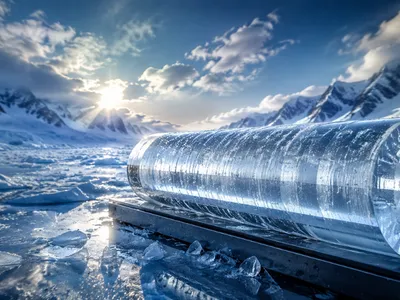
Data from the Dawn mission indicate that the crust consists of mixed ice, silicates, and extensive brine deposits, with a խոր reservoir helping to explain the formation of Ahuna Mons as a cryovolcanic feature. Observations of fractures and flow-like structures suggest that these formations are not solely impact-related, but instead result from brine ascent driven by density inversion, producing the observed surface morphology. This kind of layered subsurface record, where volatile materials preserve evidence of past environmental conditions, parallels approaches used in unlocking climate secrets with ice core samples on Earth.
The mechanical behavior of Ceres’ crust is strongly influenced by its porosity and volatile content. Recent geophysical models indicate that the uppermost 40 kilometers consist of a porous, clay‑rich matrix saturated with sodium carbonate brines. Over time, impact fracturing created pathways for these brines to ascend, forming distinct cryolava flows and faculae. This process is episodic, triggered by thermal perturbations that reduce brine viscosity and allow localized extrusion. The following list summarizes the principal geological indicators of this subsurface mobile layer.
- 🪨 Occator Crater’s central facula – youngest exposed carbonates, dated to < 20 Ma, implying recent brine mobilization
- 🌍 Regional gravity anomalies – correlate with low-density zones interpreted as brine pockets at depth
- 🧊 Absence of extensive viscous relaxation – suggests a rheological gradient that confines fluid layers to the mid-crust
Comparative Planetary Tectonics Across the Solar System
Comparative planetology now integrates observations from icy satellites, terrestrial planets, and exoplanetary systems to establish universal tectonic principles. Key parameters such as lithospheric thickness and strain rate govern the transition from brittle to ductile behavior across bodies.
Mapping of global tectonic structures reveals that one‑plate planets like Venus and Enceladus exhibit distinct stress patterns shaped by mantle convection and tidal forces. Europa’s cycloidal ridges, for instance, form under diurnal tidal stresses acting on a thin, elastic lithosphere.
| Planetary Body | Primary Tectonic Style | Controlling Mechanism |
|---|---|---|
| Venus | Pancake domes, rift zones | Mantle plumes, high surface temperature |
| Europa | Cycloidal ridges, dilational bands | Diurnal tidal stress, thin ice shell |
| Mars | Graben systems, wrinkle ridges | Volcanic loading, regional contraction |
| Ganymede | Grooved terrain, strike‑slip faults | True polar wander, tidal heating |
The integration of geodetic data with mechanical models allows quantification of stress magnitudes across diverse planetary bodies. For example, Pluto’s extensional fault systems require a heat flux significantly higher than previously assumed, implying ongoing or recent subsurface activity.
These comparative analyses yield predictive frameworks for interpreting future spacecraft data from missions such as JUICE and Europa Clipper. By characterizing how lithospheric rheology and heat transport operate under non‑terrestrial conditions, researchers can forecast tectonic landform assemblages on exoplanets with similar interior structures. The resulting taxonomy of planetary tectonics moves beyond Earth‑centric models, enabling a more robust understanding of geological evolution across the solar system and beyond.