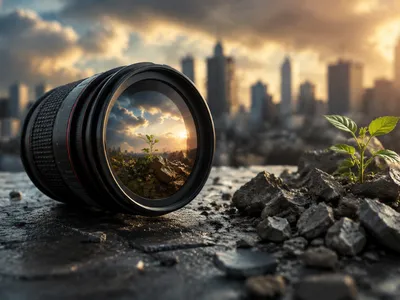
The Framed View: Nature as Spectacle
Photography transforms the boundless complexity of the natural world into a series of discrete, manageable images. This act of framing is not neutral; it inherently selects and elevates specific moments, effectively turning nature into a aesthetic commodity. The viewer encounters not the ecosystem itself, but a curated representation of it.
The camera's crop excludes the surrounding context—the sounds, the smells, the climatic conditions, and the ecological interconnections. What remains is a visual fragment, often prized for its composition and color rather than its biological significance. This process encourages a perception of nature as a collection of beautiful scenes to be consumed visually.
| Frame Characteristic | Resulting Perception of Nature |
|---|---|
| Isolates subject (e.g., a single flower) | Nature seen as a collection of independent objects |
| Crops out surrounding environment | Loss of ecological context and interdependence |
| Focuses on aesthetic peak (e.g., sunset) | Nature valued for spectacle, not process |
This visual extraction fosters a mindset where the value of a landscape is tied to its 'photogenic' qualities. A forest becomes a backdrop, a mountain a mere subject for a captivating frame, distancing us from a more holistic understanding of these systems.
The widespread circulation of dramatic nature imagery has saturated public perception, gradually making extraordinary landscapes feel ordinary and increasing the demand for ever more striking photographs. In this pursuit, photographers often observe from a distance through telephoto lenses, reinforcing the idea of nature as a spectacle rather than an environment to experience directly. Over time, such images demonstrate how photography shapes cultural memory, as iconic photographs—like Yosemite’s Tunnel View—come to define entire locations, sometimes overshadowing the richer, multi-sensory reality of visiting them.
Mediating Wilderness Through a Lens
The camera acts as a powerful mediator between the human observer and the untamed environment, filtering raw experience through a technological interface. This mediation demonstrates how photography shapes perception, creating a psychological distance that transforms the visceral reality of wilderness into a two-dimensional artifact. The paradox of representation emerges: the image brings the wild closer while simultaneously holding it at an arm's length.
This technological interface imposes its own logic on our perception. The viewfinder establishes a clear boundary between the observer and the observed, turning an immersive encounter into a targeted act of capture. The photographer becomes a viewer first and a participant second, a shift with profound implications for our relationship with wild spaces.
The drive to photograph wildlife, for instance, can alter animal behavior and prioritizes obtaining a 'good shot' over quiet observation. The focus shifts from understanding the creature's life to documenting its appearance. This dynamic underscores how the lens can redefine our purpose for being in nature.
Photography’s mediating role is perhaps most evident in how it constructs our understanding of remote or inaccessible wilderness. For many, images are the sole point of contact with polar ice caps or deep ocean trenches. These photographs, therefore, bear the immense responsibility of accuratelyy conveying the reality of these places, yet they are inherently limited by the frame.
Consider the primary ways photography filters our perception of wild places:
- 👁️ It translates a multi-sensory experience into a purely visual one.
- ⏳ It freezes dynamic processes into static moments, obscuring change and flux.
- 🌿 It often emphasizes the charismatic and dramatic, sidelining the mundane but ecologically vital.
- 📖 It creates a narrative, imposing a story onto a landscape that exists outside of human storytelling.
The rise of drone photography and camera traps further complicates this mediation. These technologies offer novel perspectives, but they are also profoundly disembodied. The aerial view creates a sense of detached mastery, while the hidden camera offers an illusion of unmediated access, yet both are deeply technological constructs shaping our technological mediation of the wild.
This curated window into wilderness can foster a sense of intimacy and concern, yet it may also breed complacency. The act of viewing a stunning photograph of a pristine forest might satisfy a desire for connection, reducing the impetus to physically seek out and advocate for the protection of such places. The mediated experience becomes a substitute for direct engagement.
The lens teaches us to see wilderness as a series of potential images. This conditions the eye to scan for the 'perfect shot,' potentially blinding us to the less spectacular but equally significant ecological narratives unfolding at our feet. The camera, in this sense, does not just record our view of nature; it actively shapes perceptual habits.
How Photography Shapes Conservation Priorities?
The visual economy of nature photography plays a critical role in determining which species and ecosystems receive public attention and funding. Images of charismatic megafauna—polar bears on melting ice, solitary tigers—dominate conservation campaigns, steering resources toward these flagship species. This visual bias creates a hierarchy of value within the natural world.
| Image Type | Typical Conservation Outcome | Potential Blind Spot |
|---|---|---|
| Charismatic Megafauna | High public engagement & funding | Neglects less photogenic but critical species |
| Pristine Wilderness Landscape | Supports land preservation efforts | Obscures degraded ecosystems needing restoration |
| Graphic Habitat Destruction | Spurs outrage and immediate action | Can lead to compassion fatigue or avoidance |
This selective visibility means that ecosystems lacking visual appeal or photogenic inhabitants often remain invisible in the public consciousness. A damp meadow teeming with rare invertebrates struggles to compete with a breaching whale for the limited attention span of the global audience. The result is a skewed conservation agenda driven by aesthetic appeal rather than ecological urgency.
The repeated circulation of environmental imagery—often portraying nature as either untouched or severely threatened—strongly influences public perception and policy debates. Powerful photographs, much like documentary photography driving social change, can support preservation efforts or trigger regulatory action, though they frequently reduce complex ecological realities to simple visual narratives. At the same time, conservation groups rely on fresh, emotionally compelling images to maintain public and donor engagement, which raises concerns about the ethics of image-making when photographers pursue rare or disruptive shots. Over time, widely photographed places such as the Serengeti or the Great Barrier Reef become symbolic conservation priorities, sometimes diverting attention and funding from less visible yet equally vulnerable ecosystems.