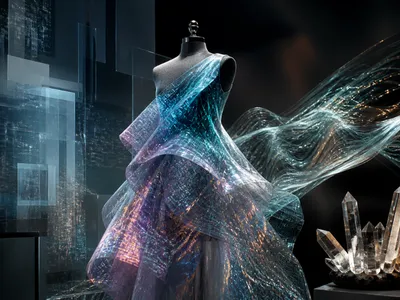
Can Immersive Space Redefine Fashion Experience?
Immersive fashion installations represent a radical departure from traditional runway presentations, situating garments within curated spatial narratives. This practice deliberately blurs the demarcation between wearable art and environmental sculpture, challenging passive spectatorship.
Designers and artists leverage installation to interrogate and expand fashion's fundamental premises, treating the body as one component within a larger aesthetic and conceptual system. The gallery or alternative space becomes a critical site for this exploration, framing fashion within discourses of contemporary art and experiential design. This contextual shift is not merely scenographic but fundamentally alters the phenomenological encounter with the clothing object.
Historical antecedents in performance art and avant-garde salon presentations inform today's practices, yet current technologies enable unprecedented sensory layering. The primary objective moves beyond displaying next-season trends towards crafting a memorable, totalizing aesthetic experience that engages viewers on multiple cognitive and affective levels.
These constructed environments often function as tangible manifestos, materializing a brand's philosophical concerns or an artist's critique of social issues like sustainability, identity, or consumption. The spatial dynamics—encompassing scale, pathway, and proximity—are meticulously engineered to guide emotional and perceptual responses, transforming the vvisitor's role from observer to inhabitant of a branded or critical worldview.
The Multisensory Fabric of Experience
Central to immersion is the strategic orchestration of multiple sensory channels beyond the visual. Sonic landscapes, olfactory elements, tactile interfaces, and even gustatory suggestions are integrated to construct a more cohesive and absorbing reality.
This multisensory approach is grounded in embodied cognition theory, which posits that understanding is rooted in physical experience. A scent diffused in a room, for instance, can evoke memory and emotion more potently than imagery alone, anchoring the fashion narrative in a deeper psychological space.
Auditory components, from composed scores to ambient soundscapes, dictate rhythm and mood, influencing the visitor's pace and emotional tone.
Tactility, whether through interactive surfaces, material samples, or climatic controls, directly involves the haptic system, breaking the traditional "do not touch" barrier of fashion exhibition. This layered sensory strategy aims to produce a synesthetic effect, where stimulation in one sense modality influences perception in another, making the experience more memorable and personally resonant. The goal is a holistic perceptual engagement that bypasses purely analytical viewing.
The following elements are frequently deployed to achieve this multisensory complexity:
- Dynamic Acoustics: Spatialized sound that changes based on visitor movement, creating a unique audio journey.
- Olfactory Scenography: Custom scents designed to complement visual themes and evoke specific memories or associations.
- Haptic Interfaces: Materials and surfaces that invite touch, conveying texture and temperature as part of the narrative.
- Kinetic Elements: Moving parts, flowing fabrics, or responsive mechanics that engage a sense of bodily motion and time.
How Virtual Technology Redefines Physical Fashion?
A defining tension in current practice lies between the celebration of physical materiality and the embrace of the digital dematerialized. Designers are investigating radical textiles and sustainable biomaterials with inherent performative qualities, treating fabric as an active, responsive architectural element.
Conversely, digital technologies like augmented reality (AR), volumetric projection, and generative design are creating phantom garments and virtual couture that exist only within a mediated space. This duality does not represent a binary but a spectrm of hybridized experience, where a physical garment may trigger a digital twin or a projected environment may respond to the drape of real cloth.
The post-digital condition in fashion installation thus refers to a seamless integration where technology is not the spectacle but an invisible enabler of deeper narrative or interaction. Smart materials that change color or shape with environmental stimuli further blur this line, creating objects that are both materially present and computationally animated.
This convergence challenges traditional notions of craft and permanence, proposing a new material lexicon where data streams and algorithmic patterns are as crucial as silk and embroidery. The result is an expanded field where the tangible and intangible coalesce, redefining the very substance of fashion.
Critical Reception and the Commerce of Artistic Fashion
The ascent of immersive fashion installations into prominent cultural institutions necessitates an analysis of their dual existence as critical art objects and potent instruments of commercial strategy. This convergence generates a complex dialogue between aesthetic validation and brand capital, challenging traditional hierarchies within both the art market and the fashion industry.
Curatorial acceptance into museums and biennials bestows a form of cultural legitimacy that transcends seasonal trends, framing fashion practices within art historical discourse. This institutional embrace is often predicated on the perceived conceptual rigor and social commentary of the work, elevating the designer to the status of auteur. However, this critical acclaim is inextricably linked to commercial mechanisms, as the resulting media coverage and cultural buzz directly translate into enhanced brand equity and symbolic value for the associated house.
The economic model underpinning these ambitious projects is multifaceted, rarely relying on direct ticket sales for profitability. Instead, installations function as loss leaders within a broader experience economy, generating incalculable value through social media amplification, press mentions, and the blstering of brand mythology. They are strategic investments in brand aura, creating tangible cultural capital that justifies premium pricing and cultivates consumer loyalty far more effectively than conventional advertising. This phenomenon reflects a broader shift where cultural production becomes a primary site of value creation in late capitalism, with experiences commodified as luxury goods.
The commercial and critical dimensions of immersive fashion can be mapped across distinct frameworks, each representing a different strategic alignment between artistic intent and economic function. The table below delineates these primary modalities, highlighting their respective drivers and outcomes.
| Strategic Modality | Primary Driver | Commercial Manifestation | Critical Focus |
|---|---|---|---|
| Brand Mythography | Heritage & Narrative Deepening | Enhanced luxury pricing power, customer loyalty | Storytelling, archival exploration, legacy |
| Conceptual Provocation | Artistic & Social Commentary | Media capital, influencer engagement, niche prestige | Political, environmental, or technological critique |
| Sensory Marketing | Direct Experiential Engagement | Memorability, shareable content, destination tourism | Phenomenology, affect theory, audience embodiment |
| Technological Showcase | Innovation & Future Vision | Positioning as industry leader, B2B partnerships | Material science, digital ethics, post-humanism |
This interdependence creates a fertile yet contested ground where artistic autonomy negotiates with corporate interest. Critical discourse often grapples with assessing whether such works constitute a genuine critique of consumer culture or are merely its most sophisticated refinement. The installation's location—a publicly funded museum versus a corporate flagship—further inflects its reception, priming audiences to interpret it either as a cultural donation or an elaborate advertisement. Ultimately, the immersive fashion installation stands as a definitive artifact of our time, a hybrid form that simultaneously deconstructs and accelerates the mechanisms of desire, value, and meaning in a globally mediated culture.