How Does an Animated Film Begin?
The inception of any modern animated feature is a highly structured creative chaos. It begins not with a single idea, but with a convergence of thematic explorations, character archetypes, and visual motifs. Studios like Pixar and Studio Ghibli invest heavily in this incubation phase, where writers, directors, and key artists engage in intensive brainstorming sessions. The primary objective is to define the emotional and narrative core of the project, ensuring the story possesses universal resonance before a single frame is drawn.
This foundational stage relies heavily on interdisciplinary collaboration. Narrative artists work alongside researchers to ground fantastical elements in believable logic or historical context. Concurrently, preliminary artistic direction is established through loose concept paintings and mood boards that capture the film's intended aesthetic and tonal palette. This phase culminates in a robust story bible, a living document that governs all subsequent creative decisions and ensures narrative coherence across the production's sprawling pipeline.
Visualizing Stories Through Sequential Storyboards
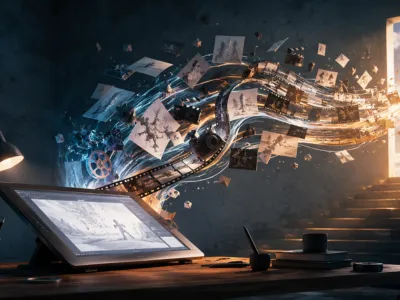
Storyboarding translates the written script into a visual blueprint. This is not merely illustration; it is the first true cinematic iteration of the story. Skilled story artists, functioning as cinematographers, determine shot composition, pacing, and editing flow. They explore character performance and emotional beats through sequential drawings, often creating animatics or story reels by adding temporary dialogue and sound.
This stage is intensely iterative. Sequences are constantly reworked based on feedback from the director's review sessions. The storyboard acts as a vital communication tool, aligning the vision across departments. Key considerations during this phase include:
- 🎬 Clarity of action and spatial relationships within the frame.
- 📖 Effective visual storytelling that reduces reliance on exposition.
- 🎭 Establishing a dynamic rhythm between action, comedy, and drama.
- 🛠️ Identifying potential technical or budgetary challenges early.
The evolution from a rough story sketch to a finalized board is a process of distillation. Each panel is scrutinized for its narrative efficiency and emotional impact. Technological integration is now pivotal, with software like Storyboard Pro enabling non-linear editing and seamless integration into the pipeline. This digital workflow allows for rapid prototyping of complex sequences, facilitating a more experimental and dynamic pre-visualization process than traditional methods allowed.
The approved story reel becomes the definitive roadmap for production. It locks the timing, establishes the film's pacing, and provides every subsequent department—from layout to animation to lighting—with a precise creative and technical target. This meticulous planning is what enables the seamless final product, where every visual element serves the story.
Visual Development for Animated Film Production
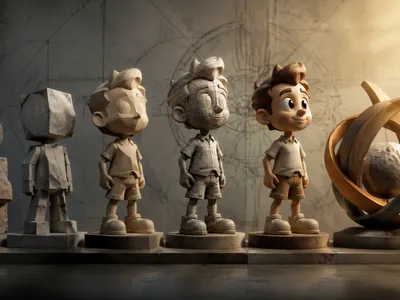
Following story approval, the project enters the art department, a dedicated research and development hub. Here, concept artists, visual development painters, and sculptors embark on the exhaustive task of defining the film's complete visual lexicon. Every environment, prop, and character must be designed not only for aesthetic appeal but also for narrative function and technical feasibility within the 3D pipeline.
This process involves creating turnarounds, orthographic views, and detailed model sheets that serve as the absolute blueprint for the modeling department. Color scripts, which are sequential paintings mapping the emotional color palette of the entire film, are developed to guide lighting and compositing. A critical academic focus is placed on stylistic coherence—ensuring that all design elements, from the grandest architecture to the smallest utensil, feel as if they originate from the same world. The table below illustrates the core deliverables from this phase:
| Deliverable Type | Primary Function | Receiving Department |
|---|---|---|
| Concept Paintings & Mood Boards | Establish tone, lighting, and color palette. | Lighting, Shading |
| Character & Prop Model Sheets | Provide precise 3D construction guides. | Modeling, Rigging |
| Environmental Orthographics | Define scale, layout, and architectural details. | Layout, Modeling |
| Color Script | Chart emotional and color narrative arc. | Lighting, Directing |
The art department's work is a foundational constraint that enables creative freedom downstream; by solving core design problems early, it grants animators and technical directors a stable visual framework within which to innovate. This phase often involves extensive material studies and real-world reference gathering to achieve a believable, tactile quality, even in highly stylized films, ensuring that every visual element supports the overarching story and emotional journey.
The Conductor of Digital Production
With assets and performances approved, the production enters its most technically intensive phase. This stage is orchestrated by the Visual Effects Supervisor and a battalion of technical directors (TDs), who act as the critical bridge between artistic vision and digital reality. Their role is to solve the complex technical challenges of rendering an animated world, ensuring that every element—from a character’s fur to a city’s reflection—behaves believably.
The pipeline is a multi-layered, concurrent workflow where departments like modeling, rigging, animation, simulation, lighting, and rendering operate in a delicate, interdependent balance. Animation brings the performances to life, but it is the simulation (FX) department that breathes authenticity into the environment. They are responsible for creating dynamic, physics-based elements such as cloth, hair, water, fire, and destruction. These elements are computationally expensive and require sophisticated solvers to achieve the desired artistic effect while maintaining render efficiency.
A central nervous system for this complexity is the pipeline's proprietary or third-party software suite. The efficiency of data flow between departments is paramount, as illustrated in the following table of core pipeline dependencies:
| Upstream Department | Deliverable | Downstream Dependency |
|---|---|---|
| Modeling & Rigging | Finalized, topology-clean character meshes with articulation rigs. | Animation, Simulation |
| Animation | Final character performance data (keyframes or motion capture). | Simulation (for cloth/hair), Lighting |
| Simulation (FX) | Cache data for dynamic elements (e.g., water, cloth sims). | Lighting, Rendering |
| Shading & Texturing | Material and surface property definitions for all assets. | Lighting, Rendering |
Lighting, perhaps the most cinematographically nuanced stage, involves placing virtual lights to shape mood, direct attention, and integrate all elements into a cohesive frame. This is not merely technical illumination but visual storytelling at its most potent. Render wrangling then distributes the final, frame-by-frame computation accross vast server farms. The technical director’s role is to troubleshoot this entire ecosystem, optimizing processes and ensuring that the creative intent is not lost in translation.