Architecting Sensory Narratives
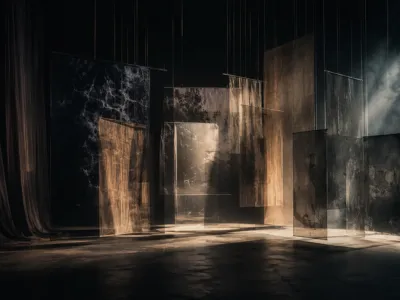
Contemporary immersive theatre fundamentally reimagines narrative construction by treating the entire environment as a primary signifier and text. This approach deliberately dismantles the traditional frontal and auditory hegemony of the proscenium stage, replacing it with a multi-sensory dramaturgy. Narrative information is distributed across olfactory, tactile, visual, and proprioceptive channels, requiring audiences to synthesize meaning from a fragmented yet totalizing phenomenological experience.
The spatial narrative is no longer a static backdrop but an active, diegetic participant that evolves in response to, or in deliberate ignorance of, the audience's presence. This environmental storytelling leverages architectural layout, ambient data streams, and controlled sensory deprivation or overload to guide emotional and cognitive responses. The space itself becomes the first and most pervasive performer. Such architectures are meticulously designed to facilitate a spectrum of journeys, acknowledging that each participant will curate a unique narrative thread based on their path and focus.
How Does Haptic Technology Transform Theater?
A significant innovation lies in integrating haptic technology and biometric feedback to create closed-loop interactive systems. These systems move beyond simple touch to convey narrative elements through vibrotactile patterns, temperature shifts, and atmospheric pressure changes, effectively scripting the spectator's somatic experience.
Advanced productions experiment with real-time biometric monitoring, such as heart-rate variability and galvanic skin response, to adapt narrative intensity or direction. This affective computing loop transforms the participant's physiological state into a direct input mechanism, where anxiety or calm can alter sonic landscpes or trigger encounters with performers. The ethical implications of this datafication of emotional response are profound, questioning where the boundary between artistic immersion and physiological surveillance lies. The body is thus enrolled as both interface and co-author.
This technological integration necessitates a new design philosophy for interactive narrative, where algorithmic responsiveness must feel organic and meaningful rather than merely reactive. The challenge is to craft feedback loops that deepen narrative empathy and agency without reducing the experience to a predictable input-output game, preserving the essential liveness and uncertainty of theatrical encounter.
How Does Audience Agency Transform Theater?
Immersive performance redefines the audience's role from passive observer to active narrative agent, a shift demanding a new vocabulary of performative consent and agency. This model grants participants meaningful choices that tangibly alter story trajectories or environmental conditions, creating a unique ludic contract between spectator and production.
This agency manifests in several distinct performative modes, which can be categorized to understand the spectrum of participant engagement.
- 🧭 The Explorer: Navigates a pre-scripted environment, uncovering fixed narrative fragments in a non-linear but predetermined sequence.
- ⚡ The Catalyst: Their presence or specific actions trigger pre-programmed narrative events, affecting the experience for themselves and often others.
- 🎭 The Performer-Collaborator: Enters into improvised, unscripted interactions with trained actors, contributing original dialogue or actions that shape the scene.
- 🧩 The Problem-Solver: Engages with environmental puzzles or logistical challenges that must be resolved to advance the collective narrative.
This framework necessitates highly adaptive acting methodologies, where performers must balance narrative integrity with authentic improvisation. The actor becomes a facilitator of emergence, skilled in steering unpredictable interactions toward cohesive dramatic ends without breaking the immersive illusion, a practice that blends traditional Stanislavskian techniques with live role-playing game mastery.
Dynamic Soundscapes and 360-Degree Acoustics
Audio design in immersive theatre escapes the stereo pan to become a sculptural, localized, and mobile element. Advanced wave field synthesis and binaural recording techniques allow sound designers to place distinct audio sources in precise three-dimensional locations, creating the illusion of a whispering character just behind a participant's shoulder or a distant crowd moving through an adjacent virtual space.
This hyper-localized audio functions as both a narrative guide and an atmospheric deepener, often replacing traditional lighting cues for directing attention. Soundscapes become reactive, shifting in response to a participant's location, orientation, and even biometric state, fostering a profound sense of embodied presence. The acoustic environment is no longer a unified field but a personalized and dynamic composition, different for each audience member based on their unique path and choices.
The technical infrastructure for such precision involves complex arrays of hidden speakers, wearable personal audio devices, and real-time audio rendering engines. This allows for the creation of overlapping, non-interfering sound narratives in a single physical space, enabling parallel story threads to coexiist. The ultimate aim is an acoustic verisimilitude that matches the visual and tactile depth, making the soundscape as navigable and interactive as the physical set, thus completing the sensory illusion of occupying another world entirely.