The Artist's Inner Alchemy
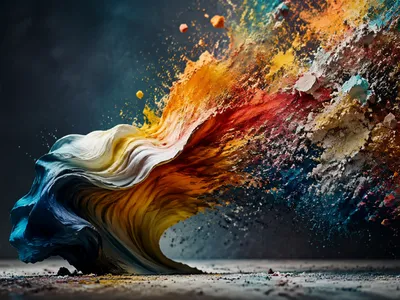
The process of emotional expression in art constitutes a profound act of inner alchemy, where raw, subjective feeling is transmuted into objective form. This transformative act is not merely illustrative but ontologically generative, creating a new entity—the artwork—that embodies the artist's affective state. Scholars like Susanne Langer posit art as the creation of forms symbolic of human feeling, suggesting the artwork itself becomes a complex symbol for internal experience.
This alchemical process is fundamentally cathartic for the creator, serving as a mechanism for emotional regulation and self-discovery.
| Theoretical Framework | Core Mechanism | Role of Emotion |
|---|---|---|
| Expression Theory (Croce/Collingwood) | Clarification of pre-conscious feeling through the act of making. | Emotion is the origin and subject; art is its cognitive clarification. |
| Formalism (Bell/Fry) | Arousal of aesthetic emotion through significant form. | Emotion is a response to formal relations, not necessarily the artist's own. |
| Psychoanalytic Approach (Kris) | Sublimation of unconscious drives into socially acceptable imagery. | Emotion is a primal drive channeled and disguised by creative work. |
The artist engages in a dialectical struggle with the medium—whether paint, clay, or sound—where the material's resistance shapes the final expressive output. This interaction ensures that the expressed emotion is not a pristine transfer but a negotiated, materially-embedded construct, giving rise to what is often termed the aesthetic emotion, distinct from its everyday counterpart.
Encoding Emotion into Form and Color
The translation of affect into aesthetic components relies on a sophisticated formal vocabulary. Line, shape, texture, composition, and, most viscerally, color become the primary conduits for non-verbal communication. A jagged line can convey agitation, while a languid curve suggests calm.
The psychological impact of color is particularly potent, with cultural and biological underpinnings influencing its reception.
Research in empirical aesthetics demonstrates that certain formal configurations reliably elicit specific emotional responses across viewers.
- Formal Elements: Angularity (tension, dynamism), Curvilinearity (softness, safety), Complexity (arousal, interest), Symmetry (stability, beauty).
- Color Attributes: Hue (associative meaning), Saturation (intensity of feeling), Value (lightness/darkness mood).
- Compositional Principles: Balance (harmony), Contrast (conflict, emphasis), Movement (visual rhythm guiding emotional flow).
For instance, the use of a high-key palette with saturated yellows and reds often encodes excitement or joy, while a low-key, desaturated scheme heavy in blues and greys typically communicates melancholy or introspection. This encoding is not universally fixed but operates within a shared semiotic framework that artists manipulate. The Abstract Expressionists, like Rothko, exploited this directly, using vast fields of color to evoke sublime, ineffable emotional states, proving that form itself, absent representation, can be profoundly expressive.
| Formal Element | Potential Emotional Connotation | Artistic Example |
|---|---|---|
| Vertical Lines | Aspiration, stability, potential rigidity. | Barnett Newman's "zips" in Vir Heroicus Sublimis. |
| Chaotic, Impasto Texture | Angst, raw energy, turbulent psyche. | Willem de Kooning's Woman series. |
| Closed vs. Open Form | Containment/entrapment vs. freedom/expansion. | Comparison of a Renaissance tondo to a Turner seascape. |
This process of encoding is therefore a sophisticated structural mapping of psychological states onto perceptual features, creating an isomorphic relationship between feeling and form that the viewer instinctively decodes.
The Viewer's Psychological Mirror
The artwork functions as a psychological mirror, activating complex empathetic and projective mechanisms within the viewer. This encounter is not passive reception but an active, co-constructve process where the viewer's own emotional repertoire and memories engage with the artwork's formal cues. The phenomenon of Einfühlung or empathy is central, describing a visceral, felt response to the perceived emotions within the form.
Neuroscientific studies using fMRI reveal that viewing emotionally charged art activates mirror neuron systems and limbic regions associated with direct emotional experience. This suggests a biological underpinning for our capacity to feel with and through an artwork.
Conversely, projective identification occurs when viewers unconsciously attribute their own feelings onto the artwork, using it as a screen for personal affect.
- Empathetic Resonance: Direct, mirror-like sharing of the emotion perceived in the work.
- Associative Memory: Artwork triggers personal memories, coloring the emotional response with subjective history.
- Cathartic Release: The viewer experiences a purgation or clarification of their own emotions via the artistic proxy.
- Cognitive Evaluation: Emotional response is moderated by intellectual understanding of context, style, and intent.
The psychological impact is thus a dynamic transactional model between the artifact and the observer's psyche. This model is influenced by the viewer's cultural background, personal trauma, and aesthetic sensitivity, meaning the same artwork can become a mirror for anguish, joy, or contemplative silence depending on who stands before it. The artwork's stability of form paradoxically enables this plurality of emotional reflection, offering a secure framework within which deeply personal and variable psychological processes can safely unfold. Reception theorists like Wolfgang Iser argue for the implied reader or viewer, whose engagement actualizes the work's potential meanings and affects, completing the circuit of emotional expression initiated by the artist.
Cultural Landscapes of Feeling
Emotional expression is never a universal language but is invariably filtered through culturally specific lexicons of feeling. What constitutes a dignified expression of grief, a valid portrayal of love, or an acceptable display of anger is profoundly shaped by societal norms, religious beliefs, and historical narratives.
| Cultural Context | Emotional Paradigm | Artistic Manifestation |
|---|---|---|
| Japanese Heian Period | Mono no aware (pathos of things), a gentle melancholy for the transience of beauty. | Subtle, allusive imagery in The Tale of Genji scrolls; understated color and composition. |
| European Baroque | Extreme, demonstrative passion aimed at overwhelming the viewer for Counter-Reformation didacticism. | Dramatic chiaroscuro, diagonal compositions, and intense facial expressions in works by Caravaggio or Bernini. |
| Traditional Balinese Art | Codified emotional states linked to religious narratives and communal identity, not individual introspection. | Highly stylized facial expressions and gestures in dance and painting, following specific rasa (aesthetic flavors). |
The concept of emotional communities, as historian Barbara H. Rosenwein defines them, provides a framework for analyzing how artistic expressions of emotion reinforce or challenge the values of specific social groups across history. An artist working within or against these codes engages in a complex dialogue with tradition, either perpetuating normative emotional landscapes or subverting them to articulate new or marginalized feelings. The rise of globalized contemporary art has further complicated this landscape, creating hybrid forms where artists navigate multiple, often conflicting, emotional codes, leading to a rich polyphony of expressive modes that can resonate across cultures while remaining rooted in specific experiential frameworks.
This cultural conditioning extends to the very materials and styles deemed appropriate for emotional conveyance, making the analysis of emotional expression in art inseparable from the study of its anthropological and historical context. The political dimension of this becomes clear when considering how dominant cultures may impose their emotional aesthetics, while subaltern groups use art to preserve and assert their own affective paradigms, transforming art into a site of cultural resistance and identity preservation.
Historical Dialogues in Expressive Modes
The history of art can be read as a shifting dialectic of emotional expression, where each era develops and reacts against prior conventions for representing interiority. This dialogue is less a linear progression than a series of transformations in the epistemic grounds for what counts as a legitimate and sophisticated portrayal of feeling.
The restrained pathos of classical sculpture gave way to the encoded spiritual fervor of Byzantine icons.
The Renaissance rediscovery of individual psychology introduced a new complexity to facial expression and bodily gesture, as seen in the works of Leonardo da Vinci.
- Romanticism (late 18th-19th c.): Emotion as sublime, individual genius, and stormy nature. Art seeks to overwhelm (e.g., Géricault's The Raft of the Medusa).
- Modernism (late 19th-20th c.): Emotion as internalized, abstracted, and fractured. Focus on formal means and subconscious (e.g., Expressionism, Abstract Expressionism).
- Postmodernism (late 20th c.-onward): Emotion as mediated, ironic, and deconstructed. Skepticism towards authentic expression, exploring appropriated sentimentt and critique of feeling (e.g., Appropriation Art).
A pivotal shift occurred with Modernism, which dismantled the representational link between external sign and internal state. Artists like Munch, Kandinsky, and Rothko sought to evoke emotion not through depiction of a weeping figure, but through color, line, and composition itself—a move towards what Kandinsky called "inner necessity." This internalization marked a profound turn inward, making the artwork a direct trace of psychic energy or a trigger for transcendent experience, thereby redefining the very ontology of emotional expression in art and challenging viewers to engage with feeling on a pre- or non-representational level.
The contemporary moment exists in a post-expressionist landscape, where artists knowingly employ, critique, and hybridize these historical modes. This reflexive relationship to art history enriches the expressive palette, allowing an artist to wield the melancholic grandeur of Romanticism, the fractured urgency of Expressionism, and the cool detachment of Conceptualism within a single practice or even a single work, creating layered emotional addresses that speak to a complex, media-saturated contemporary consciousness.
The Neuroscience of Aesthetic Experience
The emerging field of neuroaesthetics provides empirical grounding for the mechanisms of emotional engagement with art, investigating the brain's response to aesthetic stimuli. Key findings indicate that viewing art considered emotionally powerful or beautiful consistently activates a core neural network involving the medial prefrontal cortex (mPFC), the anterior insula, and the amygdala.
This network bridges reward, emotion, and valuation processes.
| Brain Region | Primary Function in Aesthetic Experience | Associated Emotional Process |
|---|---|---|
| Medial Prefrontal Cortex (mPFC) | Self-referential processing, valuation, and judgment of personal relevance/beauty. | Assigning personal meaning and emotional significance. |
| Anterior Insula | Interoceptive awareness and subjective feeling states (conscious emotion). | The embodied, felt sense of an emotional response. |
| Amygdala | Rapid detection of emotional salience and arousal, especially for negative or intense stimuli. | Initial, often subconscious, emotional arousal and vigilance. |
| Mirror Neuron System (Premotor cortex, inferior parietal) | Simulation of observed actions, gestures, and expressions. | Empathetic resonance with depicted figures or the artist's gesture. |
Crucially, studies reveal a dopaminergic reward response in the striatum when viewing beautiful art, akin to the response to other primary rewards. This suggests that the emotional pull of art is rooted in fundamental biological circuitry. Furthermore, the default mode network (DMN), associated with mind-wandering and self-referential thought, shows increased connectivity during deep aesthetic engagement, supporting the idea that art facilitates a unique state of reflective immersion. These neuroscientific insights demystfy the profound impact of art by mapping it onto concrete neurobiological substrates, revealing that the emotional experience of art is not a metaphysical mystery but a robust, measurable phenomenon arising from the intricate interplay of perception, emotion, and cognition within the brain's architecture. This empirical approach complements humanistic theories, offering a fuller picture of how form becomes feeling in the human mind.