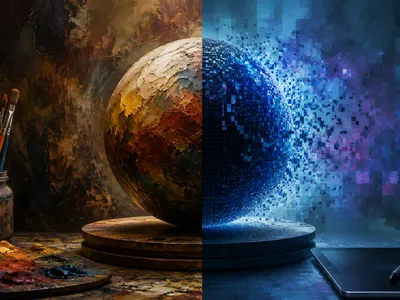
Technological Convergence
The rapid convergence of 5G networks, edge computing, and advanced wearable displays is dismantling the traditional boundaries of the screen. This technological synergy enables persistent, high-fidelity augmented reality experiences that are no longer tethered to handheld devices. Artists can now conceive works that exist continuously in public and private spaces.
This shift from screen-based media to spatial computing fundamentally alters the artistic medium. The artwork is no longer a self-contained object but an integrated layer upon physical reality, responding to the viewer's location and context. This new canvas demands a rethinking of composition, narrative, and audience engagement.
Future AR art will leverage seamless interaction between the digital and the physical. Imagine murals that animate as you pass, or sculptures that only reveal their full form through specific, embodied viewpoints. The technology recedes, allowing the artistic concept to merge directly with our perception of the world.
Redefining Audience and Artistic Authorship
As AR art grows increasingly interactive and adaptive, the audience shifts from being a passive observer to an active participant, with the viewer’s movements, decisions, and even biometric data functioning as real-time variables that directly influence the evolving form of the artwork, thereby cultivating a new mode of co-creation between artist and public. This participatory structure disrupts conventional understandings of authorship and leads to what scholars describe as algorithmic authorship, in which the artist establishes the foundational rules and aesthetic framework, yet the final, transient outcome is jointly produced by the system and each individual who engages with it; consequently, the artwork becomes a fluid, dynamic system rather than a static, unchanging artifact.
The role of the artist evolves into that of a curator of experiences or a set designer for potential realities. They construct the framework and the tools, but the narrative and aesthetic outcomes are emergent properties of human-machine interaction. This blurs the line between creator, spectator, and the artwork itself, pointing toward a collective, evolving process of artistic expression.
The Blending of Digital and Physical Realms
This fusion moves beyond mere overlay; it aspires to a state of ontological blending where digital objects possess physical properties like occlusion, shadow, and persistent location. When an AR sculpture remains in a park overnight, visible to any passerby with a compatible device, it claims a form of spatial citizenship alongside benches and trees.
The artistic implication is a medium that is inherently site-specific yet infinitely variable. A work can be designed to respond to weather data, foot traffic, or the specific architectural features of its location. This creates a dynamic feedback loop between the static physical world and the fluid digital layer.
Artists are now curating this hybrid reality, carefully considering how digital additions alter the phenomenological experience of a place. The goal is not simply to augment but to create a cohesive, unified experience where the digital and physical are indistinguishable in their impact. This is the crafting of a new, composite reality, demanding a sophisticated understanding of both material and code. Central to this evolution are several key characteristics that define this emerging medium.
The foundational elements of this blended reality can be understood through the following attributes:
- ⭐ Persistence: Digital objects remain anchored in the physical world across different user sessions and times of day.
- ⭐ Context-Awareness: Artworks react and adapt to real-world data, such as ambient light, weather, or the presence of other objects.
- ⭐ Multi-Sensory Integration: Experiences are designed to engage more than just vision, potentially incorporating spatial audio or haptic feedback.
- ⭐ Shared Experience: Multiple users can interact with the same persistent digital artifact from their own perspectives.
Can Digital Art Ever Be Truly Authentic?
The ephemeral and infinitely reproducible nature of digital art challenges traditional concepts of the unique, original artwork. In a medium where every instance is a perfect copy, questions of aura and authenticity become central to artistic and market value. The very notion of an original is destabilized.
However, AR art offers a potential resolution through its anchoring in the physical world. A work designed for a specific location cannot be truly experienced elsewhere, granting it a form of site-specific authenticity. Its value is tied to its unique interaction with a particular place and moment, which cannot be replicated.
Emerging technologies like blockchain-based provenance are being explored to certify the origin and ownership history of digital creations. While a digital file can be copied, a secure, decentralized ledger can track the authoritative version or edition. This creates a new kind of authenticity based on verifiable history rather than physical uniqueness.
The discourse is shifting from the object itself to the authenticity of the experience and the verifiable chain of custody for the digital asset. Some theorists argue that in a hybrid space, authenticity lies in the event—the unique, unrepeatable interaction between the viewer, the artwork, and the environment. The original is no longer an object, but an emergent phenomenon. To better understand these shifting paradigms, the following table contrasts traditional and emerging markers of authenticity.
| Marker of Authenticity | Traditional Art | Augmented Reality Art |
|---|---|---|
| Unique Existence | The single, physical artifact. | The persistent, site-specific digital instance. |
| Provenance | Physical ownership history, exhibition records. | Blockchain ledger, creator's cryptographic signature. |
| Experiential Value | Contemplation of the static object. | Unique, real-time interaction in a specific place. |
| Role of the Copy | Forgery or inferior reproduction. | Simultaneous, valid instance of the same work. |
New Aesthetics for a Hybrid World
The unique affordances of augmented reality are giving rise to entirely new aesthetic categories that resist traditional artistic classification, forming an emerging visual language defined by temporal fluidity, in which artworks exist in a continuous state of transformation, and by spatial dissonance, where digital elements intentionally contrast with their physical environmnts to provoke deeper reflection and disrupt habitual perception. Within this framework, artists are also investigating the idea of negative space in the digital layer, employing absence and emptiness as deliberate compositional strategies; a piece may take the form of a digital void that partially obscures a physical landmark, encouraging viewers to contemplate what is concealed rather than what is visible, thereby turning the manipulation of perception itself into the central artistic act.
Another emerging aesthetic is the glitch as placemaker, where intentional digital errors or artifacts become integral to the experience of a location. These purposeful imperfections highlight the underlying computational processes and question the desire for seamless technological integration. Beauty is found in the system's fragility, not its perfection.
The hybrid space fosters a new form of narrative fragmentation, where stories are no longer linear but distributed across physical locations and digital layers. Viewers piece together a narrative by moving through space and interacting with disparate digital elements, becoming active participants in the construction of meaning. This shifts the aesthetic focus from the object to the journey, from the static image to the embodied, exploratory experience. The artwork is not a destination but a constellation of moments waiting to be discovered.