The Semiotic Power of Recurring Forms
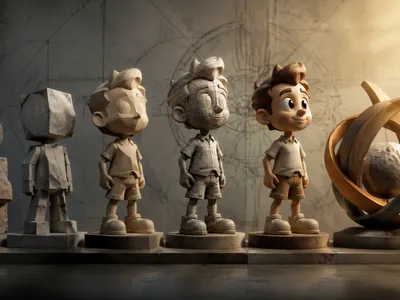
An iconic art style establishes a visual lexicon that becomes immediately recognizable across contexts. This lexicon consists of recurring forms, motifs, and compositional strategies that function as a coherent system.
These formal elements are not merely decorative but act as semiotic units carrying embedded meanings. For instance, the exaggerated elongation in Mannerist figures conveys tension and intellectual artifice, while the fragmented planes of Cubism dismantle traditional perceptions of space and form. The repetition of such elements across works solidifies their symbolic association.
The power of this formal repetition lies in its ability to generate a grammar of seeing that educates the viewer’s perception. Over time, this grammar transcends individual artworks, becoming a cultural shorthand that can be referenced, parodied, or evolved by subsequent generations of artists and designers.
Cultural Resonance and Historical Anchoring
Iconic styles rarely emerge in a vacuum; they are profoundly intertwined with the historical moment and cultural currents that birthed them. Their significance is often cemented by how they capture or challenge the spirit of an age.
Art Nouveau’s sinuous lines mirrored the organic forms of the Arts and Crafts movement and anxieties about industrialization. Similarly, De Stijl’s geometry linked to the post-WWI desire for universal harmony. These styles offer a definitive visual answer to the pressing questions of their time.
The durability of an iconic style is tested by its capacity for reinterpretation across cultural and temporal settings. A style locked in its original context may become a footnote, whereas one that can be adapted gains timeless relevance. The revival of Art Deco motifs in contemporary design shows how a formal vocabulary can be decoupled from its 1920s origins to signify modern luxury. This cultural transplantation ensures ongoing relevance beyond initial historical anchoring.
The following table illustrates how specific iconic art styles correspond to their historical and cultural contexts, highlighting the symbiotic relationship between form and zeitgeist.
| Art Style | Historical Period & Cultural Context | Core Formal Innovation |
|---|---|---|
| Renaissance | 15th-16th Century Europe; revival of classical learning, humanism | Linear perspective, anatomical realism, chiaroscuro |
| Romanticism | Late 18th-early 19th Century; reaction against Enlightenment rationalism, emphasis on emotion | Dramatic sublime landscapes, expressive brushwork, focus on individual experience |
| Pop Art | 1950s-60s consumerist boom; critique and celebration of mass culture | Appropriation of commercial imagery, bold flat colors, serial repetition |
A Dialectic of Innovation and Influence
True iconicity in art often emerges from a dynamic tension between radical originality and profound influence. A style must break from convention to be noticed, yet it must also provide a fertile generative framework for others to adopt and adapt.
The initial innovative rupture establishes the style’s signature, challenging perceptual norms and artistic techniques. This break, however, is only the first step. For a style to become iconic, it must demonstrate a capacity to spawn a lineage, inspiring derivative works, critical discourse, and even opposition that further cement its cultural footprint.
This dialectical process ensures the style is not a dead end but a living tradition. Impressionism’s loose brushwork was a scandalous innovation that later provided the foundational language for Post-Impressionists who pushed its boundaries in divergent directions. The following list outlines key phases in this dialectic of innovation and influence that characterize iconic art movements.
- Phase 1: Radical Rupture – The movement introduces a definitive break from prevailing artistic conventions, establishing its core formal or conceptual innovation.
- Phase 2: Codification & Dissemination – The new style’s principles are articulated by practitioners and critics, becoming a recognizable and teachable set of ideas.
- Phase 3: Assimilation & Diversification – The innovative elements are absorbed by the broader culture and adapted by other artists, leading to sub-styles and hybrid forms.
- Phase 4: Canonization & Critique – The style enters art historical canons, becoming a standard point of reference against which new movements define themselves, either through continuation or rejection.
The Role of Technical and Material Revolution
Iconic stylistic shifts are frequently catalyzed or enabled by advancements in materials and techniques. The relationship is symbiotic: new tools create new possibilities for expression, which in turn define a style’s visual character.
The development of portable oil paints in tubes facilitated en plein air painting, a technical precondition for the Impressionist focus on light and atmosphere. Similarly, the invention of synthetic pigments in the 19th century gave Post-Impressionists like Van Gogh access to previously unimaginable color intensities, directly shaping their emotive palettes.
A technical revolution provides more than just convenience; it fundamentally alters the artist’s relationship with the medium. The rise of digital tools and software has given birth to entire genres like generative art, where the style is inseparable from the algorithmic process that creates it. This underscores that an iconic style can be born from mastering a new technical language, which then becomes its defining aesthetic signature. The materials themselves can become a central theme, as seen in the industrial and readymade objects of Assemblage art, reflecting a profound shift in the very definition of artistic materiality.
The impact of these revolutions can be categorized by the type of freedom they grant the artist, as shown in the list below.
- 🖼️ Pictorial Freedom: Linear perspective, photography (freeing art from strict representation), and digital layers.
- ⏱️ Temporal & Spatial Freedom: Fast-drying acrylics, portable easels and paints, enabling new subjects and speeds of work.
- 💡 Conceptual Freedom: Readymades, photomontage, and 3D modeling software, expanding the realm of what can be considered an art object or process.
- 🎨 Coloristic Freedom: Development of stable synthetic pigments and expansive digital color spaces.
How Does Institutional Recognition Shape Legacy?
The journey of an art style from avant-garde novelty to iconic status is heavily mediated by institutional gatekeepers. Museums, academia, and the commercial art market perform a critical role in validating, preserving, and disseminating stylistic movements.
Acquisition by major museums confers a seal of historical importance, embedding the style within a sanctioned narrative of art history. Scholarly attention further solidifies this status through monographs, exhibitions, and curriculum integration, transforming visual experimentation into an academic discipline.
The commercial market amplifies this effect by assigning economic value, which, while often controversial, undeniable elevates public and critical attention. This institutional ecosystem does not merely reflect value but actively constructs it, detrmining which styles are remembered, studied, and valued by future generations. The comparative influence of different institutional actors is outlined in the table below.
| Institution Type | Primary Mechanism of Influence | Impact on Style's Legacy |
|---|---|---|
| Museums & Galleries | Canonization through collection, curation, and major retrospective exhibitions. | Provides physical preservation and public accessibility, framing the style within a historical narrative. |
| Academia & Art Criticism | Theoretical analysis, historical research, and pedagogy. | Generates intellectual frameworks and terminology, ensuring the style is taught and debated. |
| Art Market & Auction Houses | Valuation, provenance tracking, and market creation. | Establishes financial metrics of importance, influencing collecting trends and public perception of prestige. |
The process of institutional canonization involves several distinct but overlapping stages. These mechanisms work in concert to transition a style from the periphery to the center of cultural discourse.
-
Critical ValidationInfluential critics and journals champion the style, providing the initial intellectual defense and framework for understanding.
-
Museum AcquisitionEntry into permanent collections signals a shift from contemporary trend to historical artefact, ensuring long-term preservation.
-
Academic IntegrationInclusion in textbooks, university courses, and PhD dissertations codifies the style's principles for future generations of artists and scholars.
Enduring Impact on Popular Imagination
The ultimate test of an iconic art style is its seepage into the collective unconscious of popular culture. When its visual motifs are detached from their original artistic context and deployed in advertising, film, design, and fashion, the style achieves a unique form of immortality.
This process involves a reduction to essential visual schemas that remain recognizable even in simplified or commercialized forms. The dripping clocks of Surrealism or the stark silkscreen portraits of Pop Art function as instantly ggraspable symbols. Their power lies in this adaptability; they become a visual vocabulary for communicating complex ideas about time, consumerism, or identity to a mass audience.
This popular dissemination can sometimes dilute scholarly meaning, but it exponentially increases cultural footprint. A style confined to galleries has limited reach, but one that inspires album covers, video game aesthetics, and product design becomes a living, evolving part of the visual environment. This constant re-contextualization proves the style possesses a foundational vitality and a resonant core idea that transcends its initial frame of reference.