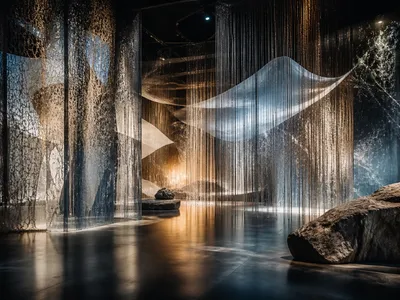
How Does Installation Art Transform Architectural Space?
Installation art fundamentally redefines the relationship between object, space, and observer. It is not a static artifact but a dynamic, experiential construct that architects must comprehend as a spatial discipline. This artistic framework positions the installation not as an applied ornament but as the primary generator of spatial narrative and affect.
The installation functions as a conceptual provocation, challenging conventional architectural syntax of walls, floors, and ceilings.
Theoretical underpinnings from phenomenology and embodied cognition explain this shift. We transition from viewing space as a neutral container to understanding it as a performative and interactive medium. Every design decision, from material choice to light manipulation, becomes a deliberate tool for scripting experience.
The Phenomenology of Immersive Space
At its core, installation design manipulates the phenomenological essence of space—how it is perceived, felt, and lived. It directly engages Merleau-Ponty's concept of the "lived body," where perception is an active, bodily engagement with the world. This immersion transcends visual spectacle to create a holstic sensory reality.
The designer orchestrates phenomena—light, shadow, sound, texture, and scale—to craft specific atmospheres that directly influence emotional and cognitive states. This approach, championed by thinkers like Peter Zumthor, posits atmosphere as the primary architectural product, preceding formal composition.
Consequently, the visitor is no longer a passive spectator but an active participant within a constructed reality. The installation's success is measured by its capacity to induce a state of "being-in" the work, a palpable shift in one's sense of presence and self-awareness within the configured environment.
Interactive Experiences in Contemporary Installation Art
The most profound shift installation design heralds is the reconfiguration of the audience's role from passive recipient to active participant and co-author. This paradigm, rooted in relational aesthetics, posits that the artwork's meaning is not fully realized until completed by the viewer's physical and interpretive engagement. The installation provides a scaffolding for experience, but the final narrative is authored in real-time by the visitor's choices, movements, and reflections.
This co-creation can be physical, as in kinetic installations that respond to touch or presence, or cognitive, where the viewer must complete conceptual gaps. The designer's authority is deliberately decentralized, creating a democratic space where multiple, even contradictory, readings are valid. This process transforms the experience from a static observation into a unique, personal event, different for each individual and each encounter.
This collaborative dynamic fundamentally challenges the traditional author-viewer hierarchy. In this model, the installation is not a finished product but a generative system—a set of rules, materials, and conditions that yield an infinite number of possible experiences. The visitor's presence, behavior, and interpretation become the essential media of the work, making them indispensable to its very existence and ensuring that no two encounters with the space are ever truly identical.
Lasting Imprint on Memory
The ultimate measure of an installation's power lies in its persistent occupation of memory. Unlike the fleeting glance at a painting, a successful spatial intervention creates a cognitive and emotional anchor that resurfaces long after departure. This mnemonic durability is engineered through intense sensory stimuli, novel perceptual challenges, and personal emotional resonance, forging neural connections that are more robust and easily recalled.
Installations often exploit the von Restorff effect—the psychological principle that an item that stands out distinctly from its surroundings is more likely to be remembered. By crafting spaces of radical difference from everyday environments, designers ensure the experience is marked as a salient "event" in autobiographical memory. This memory is not merely visual but embodied and affective, recalling the felt sense of being within the space, the textures underfoot, the enveloping sounds, and the emotions they provoked.
Consequently, the installation transcends its physical and temporal boundaries to become a lasting psychological artifact. It reshapes the visitor's internal landscape, influencing future perceptions of space, material, and even self. The memory of the experience acts as a persistent filter, a lens through which subsequent environments are understood and felt. In this way, installation design achieves its most profound impact: it doesn't just shape a temporary space but permanently alters the cognitive and emotional frameworks of those who pass through it, proving that the most potent spaces are those we carry within us.