The Liveness Factor
The co-presence of performer and spectator creates an unrepeatable ontological event. Each performance breathes differently, shaped by the invisible thread between stage and audience that no recording can capture.
Experimental theater foregrounds this ephemeral chemistry as a core narrative device rather than a mere condition of production. When bodies share air, the fourth wall becomes a permeable membrane through which meaning is not transmitted but negotiated in real time. The unpredictability of live interaction transforms passive viewing into active witnessing.
Scholars examining performance phenomenology argue that liveness generates a distinct cognitive and affective processing mode unavailable in mediated forms. The audience's awareness of their own witnessing presence alters the ontological fabric of the event, creating a feedback loop where performer responses shift imperceptibly based on collective energy. This mutual calibration means that a Tuesday performance differs fundamentally from a Saturday matinee, not merely in quality but in the very narrative substance produced through the co-creative labor of all participants sharing that specific temporal and spatial container.
Why Sensory Overload Becomes New Meaning
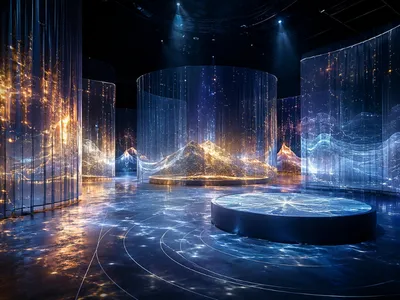
Contemporary experimental works frequently abandon linear logocentric storytelling in favor of immersive sensory environments. The overload itself operates as a deliberate dramaturgy of disorientation that fractures conventional interpretation.
Soundscapes that vibrate through seating structures and lighting that disorients spatial perception force the audience to process experience somatically before intellectually. This pre-cognitive impact bypasses analytical frameworks, allowing meaning to emerge through visceral resonance rather than linguistic decoding.
The dissolution of hierarchical sense-making becomes particularly evident in productions where multiple sensory channels carry conflicting information simultaneously. A performer might whisper a tender monologue while projected imagery displays geological violence, and the scent of damp earth permeates the space. No single element dominates; instead, the phenomenological thickness of the experience generates what performance theorists describe as emergent understanding, a form of knowing that arises not from parsing individual signs but from inhabiting the totality of sensory input. This approach challenges the primacy of text-based narrative, proposing that bodily sensation and emotional texture constitute valid and powerful storytelling modes in their own right.
Audiences trained on passive consumption often resist this multi-sensory bombardment initially, yet surrender to it produces altered states of reception. The inability to focus on a singular narrative thread mimics contemporary lived experience, where information saturation demands new strategies for constructing coherence from chaos.
Audience Agency in Unscripted Moments
The deliberate relinquishment of authorial control invites audiences into the creative process. Shared vulnerability between performer and spectator transforms narrative into a co-authored event.
This participatory dramaturgy dismantles the passive observer model, replacing it with a dynamic where every hesitation and spontaneous choice carries narrative weight. Spectators become witnesses whose reactions alter performance trajectories in palpable ways.
Immersive productions demonstrate how removing predetermined scripts creates fertile ground for emergent dramaturgy. Each individual navigates the performance space constructing a unique diegetic pathway, assembling fragments of action into personal meaning. The absence of a fixed linear sequence multiplies narrative possibility exponentially, decentralizing authorial voice and fundamentally redefining the storytelling act itself.
When audiences step inside the narrative machinery, they become co-authors. The performance unfolds as a series of negotiations between intention and intervention.
- 💬 Spontaneous dialogue becomes script
- 🌀 Movement paths diverge infinitely
- 🎭 Audience decisions shape climax
Embodied Narratives
The performing body operates as a primary narrative vehicle, bypassing linguistic mediation entirely. Kinesthetic empathy allows spectators to feel story through muscular resonance.
Choreographic structures replace dialogue, building dramatic arcs through spatial tension and physical punctuation. Gesture becomes vocabulary.
The intelligence of the somatic archive stores trauma, desire, and memory in tissue and bone. When performers access this embodied knowledge, they externalize interior landscapes without uttering a single word. This corporeal storytelling draws on precognitive pathways that predate language, tapping into shared human experience across cultural boundaries.
Deconstructing Plot Through Fragmented Realities
Narrative fragmentation disrupts temporal logic, offering audiences fragments as building blocks of alternative coherence rather than linear progression.
| Disjointed Time | Chronology collapses | Unsettles narrative certainty |
| Multiple Perspectives | Same event, varied accounts | Truth becomes relative |
| Recursive Loops | Scenes repeat with difference | Accumulation of meaning |
This approach mirrors how memory operates in nonlinear bursts, rejecting smooth exposition for jagged juxtaposition. Audiences assemble scattered pieces, discovering personal resonances that a unified plot would preclude.
The deliberate absence of causal links forces spectators into active meaning-making, a process that mirrors the fragmented nature of digital-age consciousness. A scene of domestic tranquility shatters into abstract movement without transition, leaving the audience to bridge the gap. This fragmented structure refuses the comfort of resolution, instead offering an aesthetic of productive uncertainty where coherence emerges retrospectively through the act of witnessing itself. The resulting narrative lives in the spaces between fragments, demanding a participatory intelligence.
Beyond Language with Physical and Digital Hybrids
The fusion of physical presence with digital augmentation creates a liminal space where language becomes secondary to embodied data streams.
- 🗺️ Projection mapping extends the body's expressive reach
- 🎥 Motion capture translates gesture into visual narrative
- 👻 Augmented reality layers ghostly presences onto live action
- ✋ Haptic feedback makes intangible data felt
This convergence does not diminish the corporeal anchor but amplifies it, extending the performer's nervous system into digital realms. The audience perceives a hybrid entity whose storytelling vocabulary transcends spoken dialogue entirely.
These technologically mediated environments reframe narrative as a sensory architecture rather than a sequence of events. The digital interface becomes an extension of the performer's consciousness, translating internal states into external phenomena visible to all. Sound generated by heartbeat sensors, visuals triggered by breath patterns, and lightscapes reacting to muscle tension all weave a story that bypasses cognitive interpretation. This post-anthropocentric storytelling positions technology as co-creator, challenging the primacy of human-authored narrative.