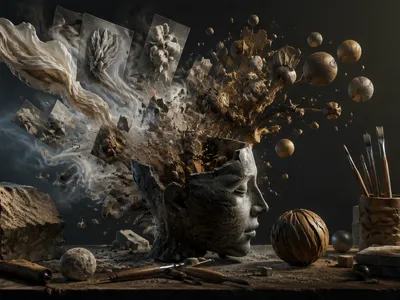
The Genesis of an Idea
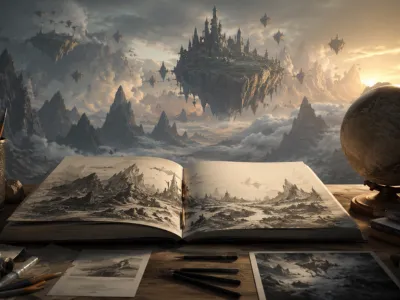
Every visual narrative begins with an embryonic spark that resists immediate articulation. The artist engages in conceptual ideation, a process where mental imagery collides with the physical act of drawing, often yielding unexpected formal mutations.
Before committing to a fixed composition, practitioners navigate a fluid preparational landscape. The following cognitive and material strategies frequently serve as the generative engine for a work's earliest traces.
- ⭐ Nonlinear free association through rapid thumbnail sketching
- ⭐ Phenomenological reduction to essential geometric masses
- ⭐ Temporal annotation of mood and atmospheric tonality
- ⭐ Systematic constraint inversion to provoke formal surprise
Within this emergent phase, gestural mark-making operates as an extension of somatic memory rather than a purely optical enterprise. The hand discovers form before the eye fully apprehends it, collapsing the distance between impulse and inscription on the raw surface.
Sketchbooks become a laboratory where material resistance — the tooth of paper, the drag of graphite — actively shapes visual thinking. This dialogic relationship between medium and mind cultivates a cognitive fluidity that later digital translations must carefully preserve.
Bridging Analog and Digital Realms
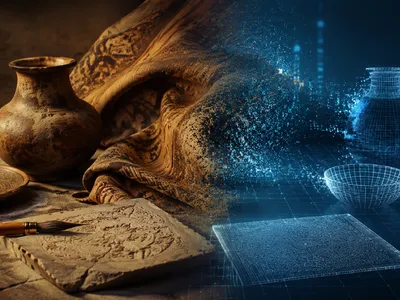
Translating a tangible sketch into a digital environment introduces both liberating possibilities and subtle frictions that shape the final artifact.
| Traditional Medium | Digital Equivalent |
|---|---|
| Charcoal and chalk on toned paper | High-resolution raster brushes with grain engines |
| Dip pen and India ink | Vector-based dynamic stroke stabilization |
| Wet-on-wet watercolor washes | Real-time fluid simulation and pigment dispersion |
| Cut-paper collage | Non-destructive layer masking and smart objects |
Contemporary workflows thrive on preserving gestural authenticity across technological boundaries, where pressure-sensitive styli and texture-aware algorithms reconstruct the haptic intimacy of a pencil. This digitization process is never a neutral transcription but an act of interpretive translation that subtly alters the artwork's ontology.
The power of vectorization lies not in mere conversion but in enabling infinite scalability without sacrificing the organic irregularity of a hand-drawn line. When paired with pressure sensitivity mapping, the artist maintains expressive line weight variation that mirrors traditional crow-quill pens, ensuring the screen does not sterilize the sketch but amplifies its latent energy through controlled procedural augmentation.
Narrative Layers in Visual Storytelling
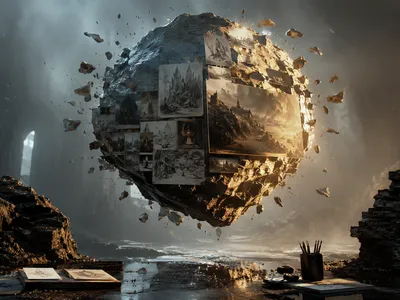
A single static image can compress an entire temporal arc into a dense visual instant. Artists embed narrative substrates within compositional structures, where the viewer instinctively reconstructs preceding events and anticipates forthcoming resolutions through subtle directional cues and symbolic residue, a testament to the importance of mastering mood and atmosphere in digital art.
The psychological mechanism of visual inference transforms passive observation into active co-authorship. When a composition strategically withholds narrative closure, the audience completes the story through personal memory and cultural script, making each encounter a uniquely generative act.
| Narrative Device | Visual Manifestation | Viewer Response |
|---|---|---|
| Implied off-screen space | Cropped figures and directional gaze | Projective world-building |
| Sequential simultaneity | Polyptych panels within single frame | Chronological reconstruction |
| Symbolic object placement | Charged artifacts with allegorical weight | Interpretive depth activation |
| Chromotemporal shifts | Saturation and temperature gradations | Emotional time-mapping |
Contemporary storyboard artists and graphic novelists increasingly deploy transmedia narrative architecture across sequential and static forms, where each frame functions simultaneously as autonomous composition and dependent clause within a larger syntactic flow. This delicate equilibrium between independence and interdependence challenges the long-held hierarchy that privileges moving images over still ones, illustrating precisely how concept art builds visual worlds.
The ethics of visual ellipsis—knowing what to omit—separates didactic illustration from evocative art. Strategic gaps in the narrative sequence invite the viewer into a collaborative dance where interpretive autonomy flourishes, and the work continues evolving long after the initial encounter, shaped by each new audience member who brings their lived experience to bear upon the silent image.
Evolving Tools, Timeless Vision
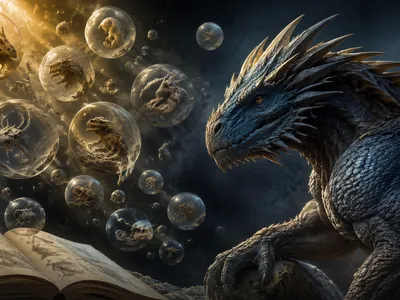
The acceleration of generative artificial intelligence within creative pipelines has reignited fundamental questions about artistic intentionality. These novel instruments do not eliminate the sketch phase but compress the iterative cycle, allowing rapid exploration of compositional permutations that previously demanded exhaustive manual labor while redefining the future of AI in concept art creation.
The artist's core competency shifts from manual dexterity toward a deeper cultivation of curatorial discernment. When a single prompt can yield dozens of sophisticated variations, the creative act resides in recognizing which iteration carries the authentic emotional signature aligned with the original impulse.
- 🧩 Preservation of ambiguous, unresolved qualities that digital perfection often erases
- 🛡️ Resistance against algorithmic homogenization of visual vocabulary
- 🎨 Intentional friction reintroduction through hybrid analog-digital post-processing
- 🧠 Cultivation of a personal visual epistemology beyond dataset aesthetics
- ⚡ Embracing glitch and artifact as expressive rather than defective elements
With every technological leap from silver gelatin to neural rendering, the sovereignty of human perception remains the irreducible core of artistic practice. Tools become transparent when they faithfully serve a vision that predates and transcends them, rendering their sophistication invisible beneath the palpable weight of authentic creative intent.