Dreams on Screen
The Surrealist fascination with the dream state, as a conduit to the unconscious, has found its most direct translation in modern cinema and television. Filmmakers harness dream logic to bypass narrative conventions, creating sequences where time, space, and identity become fluid and mutable.
This approach allows for the visual representation of psychological states, such as trauma, desire, and anxiety, which resist straightforward explanation. David Lynch’s oeuvre, particularly "Mulholland Drive," stands as a primary text, constructing a narrative that operates entirely on oneiric principles.
The plot’s unresolved contradictions and symbolic recurrences—the blue key, the mysterious box—mimic the disjointed yet symbolically charged nature of dreams, demanding a psychoanalytic rather than literal interpretation from the audience. This technique has permeated mainstream media, evident in the shifting realities of "Inception" or the allegorical dreamscapes of "The Sandman," proving the commercial and critical viability of non-linear, introspective storytelling.
Absurdist Storytelling and Social Critique
The systematic injection of absurdity into narrative structures serves as a primary method for deconstructing societal norms and logical frameworks. This strategy, directly inherited from Surrealist theater and literature, employs irrational scenarios to expose the inherent contradictions of modern life.
Works like the Coen Brothers' "Fargo" or Yorgos Lanthimos's "The Lobster" present worlds governed by internally consistent yet fundamentally illogical rules, forcing characters—and by extension, the audience—to navigate a reality where conventional motivation and cause-effect relationships are suspended.
This narrative absurdity often functions as a vehicle for potent social satire and existential inquiry. By placing characters in patently ridiculous situations that they must confront with deadpan seriousness, creators critique bureaucratic rationality, romantic conventions, and the futile search for meaning. The humor derived is not merely comedic but deeply philosophical, challenging viewers to find coherence in chaos and to question the arbitrary nature of their own social contracts and belief systems.
The long-form narrative potential of television has proven exceptionally fertile for this technique. Series like "Atlanta" and "Twilight Zone" revivals utilize absurdist vignettes to explore racial dynamics, consumer culture, and technological anxiety with a sharpness often blunted in more realist dramas. The episodic format allows for sustained, deep exploration of a single absurd premise, achieving a level of thematic resonance that aligns with the Surrealist goal of revolutionizing perception. Ultimately, the embrace of absurdity empowers creators to dismantle hegemonc narratives and propose that truth may reside not in order, but in the deliberate, critical engagement with disorder.
Digital Surrealism in Games and Virtual Worlds
Surrealist visual techniques, such as collage, photomontage, and exquisite corpse, have been radically democratized and transformed by digital tools. Software like Adobe Photoshop and CGI rendering engines act as the new atelier for the unconscious, enabling a seamless hybridization of disparate visual elements that would have required painstaking manual labor in the past.
This digital alchemy allows for the creation of impossible yet photorealistic images, a concept central to Surrealism’s desire to blur the line between the real and the imagined. The influence is pervasive, from the grotesque yet captivating character designs in Guillermo del Toro's films to the dreamlike architectural impossibilities in the works of artists like Beeple.
The very language of visual effects (VFX) is indebted to Surrealist principles, prioritizing emotional resonance and symbolic power over physical realism.
In contemporary video games, this visual alchemy constructs entire worlds that operate on dream logic. Titles like "Control," "Psychonauts 2," and "The Last Guardian" feature environments that shift, breathe, and defy Euclidean geometry, directly engaging the player’s spatial perception and subconscious. These are not mere backdrops but active, psychological landscapes that reflect the narrative’s inner conflicts. The gameplay itself often becomes a process of navigating these surreal spaces, solving puzzles that require abandoning conventional logic in favor of associative or symbolic thinking.
This represents a significant evolution from passive viewing to immersive interaction with Surrealist imagery, deepening the psychological impact.
The legacy of visual alchemy extends into the burgeoning realm of virtual and augmented reality. These technologies offer the ultimate Surrealist canvas: fully immersive, navigable spaces that can be programmed to react to the user’s presence and choices. Artists and developers are crafting experiences where the laws of nature are suspended, and the body’s relationship to space is fundamntally altered. This not only fulfills the Surrealist ambition to revolutionize perception but also raises profound questions about the nature of reality in an increasingly digital age, where the synthesized and the organic become indistinguishable.
The Surrealist Legacy in Interactive Digital Art
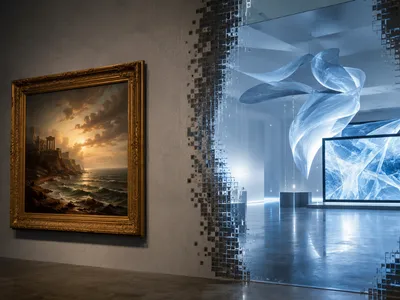
The most profound contemporary evolution of Surrealism may be occurring within interactive and generative digital art, where the viewer becomes an active participant in the co-creation of the unreal. Here, the dream is not presented as a finished tableau but as a responsive system to be explored and manipulated.
This shifts the locus of meaning from artist intention to user experience, aligning with postmodern interpretations of art while deepening the psychological immersion first sought by the original Surrealists.
Platforms like virtual reality (VR) and augmented reality (AR) dissolve the final barrier between the artwork and the observer. Users can physically walk through a Dali-esque landscape, touch impossible objects, or see fantastical creatures anchored in their living room. This embodied experience of the surreal creates a powerful, somatic understanding of disorienttion and wonder that static images cannot replicate. Furthermore, the use of algorithmic art and artificial intelligence introduces a new form of "automatism"—not of the artist's hand, but of the machine's generative logic. Artists train AI on datasets of surrealist art or dream imagery, then curate the uncanny outputs, acting as a guide for the collective unconscious of aggregated data.
This partnership between human curator and machine generator raises compelling questions about authorship, creativity, and the nature of the sublime in the digital age, suggesting that the next frontier for Surrealism lies not in representing dreams, but in providing the tools to collaboratively build and inhabit them in real-time, forever altering our relationship with the boundaries of reality and imagination.