The Shattering of the Mimetic Mirror
The early 20th century witnessed a profound philosophical rupture, as artists deliberately abandoned the centuries-old mandate of mimetic representation. This was not merely a stylistic shift but a radical epistemological break, challenging the very purpose of visual art and its relationship to perceived reality.
Pioneers like Wassily Kandinsky and Piet Mondrian sought to articulate a universal visual language, one that bypassed the external world to communicate pure emotion, spiritual truths, and fundamental structural principles.
This deliberate move away from figuration forced a seismic change in the viewer's role. The passive consumption of a recognizable scene was replaced by an active, participatory hermeneutic engagement. The artwork became a site of intellectual and emotional projection, where meaning was not given but co-created through the interaction between the canvas's formal elements and the viewer's subjective experience.
A Canvas for the Unconscious Mind
Parallel to formalist explorations, abstract art found a powerful theoretical ally in the emerging field of psychoanalysis. The movement provided a potent visual analogue for the inaccessible realms of the psyche, particularly the unconscious as theorized by Freud and Jung.
Surrealist techniques such as automatism—the process of creating art without conscious control—directly channeled this interest. Artists like Joan Miró and André Masson sought to bypass rational thought, allowing marks, shapes, and textures to emerge from a spontaneous, subconscious state.
This psychoanalytic dimension fundamentally altered the cultural perception of creativity. The artist was reconceived not as a skilled craftsman reproducing the visible, but as a medium or conduit for deeper, often irrational, forces. The canvas became a space for psychic archaeology, where automatic gestures and biomorphic forms could reveal latent desires, archetypes, and collective symbols. This legitimized abstraction as a serious investigation into human interiority, granting it an intellectual weight that transcended debates about mere aesthetics and established its significance as a critical tool for mapping the modern self's complex topography.
The Pervasive Abstract Aesthetic in Popular Culture
The visual syntax of abstract art has thoroughly permeated the vernacular of popular culture, moving from the rarefied space of the gallery to become a ubiquitous shorthand for concepts like creativity, innovation, and emotional depth. This diffusion represents one of abstraction's most significant cultural victories.
In cinema and television, abstract visuals are routinely employed in title sequences, dream sequences, and transitional moments to convey psychological states, futuristic settings, or complex ideas without literal representation. The work of designers like Saul Bass in the mid-20th century established this link, using geometric abstraction to create iconic, mood-setting film posters and title animations.
The music and advertising industries have been particularly adept at harnessing abstraction's affective power. Album covers and music videos frequently utilize non-representational imagery to evoke the sonic texture or thematic essence of the music, from the psychedelic art of the 1960s to the digital abstractions of contemporary electronic music visuals.
| Cultural Sphere | Manifestation of Abstract Aesthetic | Primary Function |
|---|---|---|
| Advertising & Branding | Logo design, background visuals, product packaging | Convey modernity, dynamism, and emotional appeal without textual language. |
| Digital & UI Design | Wallpapers, loading animations, interface backgrounds | Create visual interest, signal processing, or establish brand identity in digital spaces. |
| Fashion & Textiles | Pattern design, fabric prints, avant-garde collections | Translate artistic movements into wearable art, signaling sophistication and creativity. |
This adoption is not merely decorative; it is strategic. Advertisers leverage abstract forms to bypass rational critique and create direct, subconscious associations between a brand and feelings of energy, luxury, or forward-thinking modernity. A swirling gradient or a burst of geometric color can communicate more swiftly and universally than a detailed illustration.
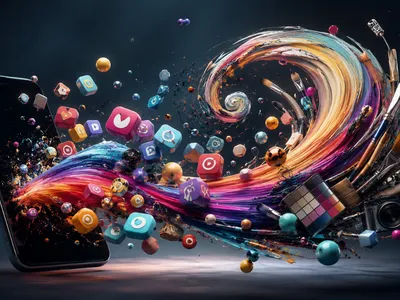
The digital realm has exponentially accelerated this trend. User interface (UI) design, website backgrounds, and app icons often rely on abstract patterns, gradients, and morphing shapes. These elements provide visual texture without cognitive overload, while dynamic, algorithmically-generated abstract art has become a staple of digital entertainment and immersive installations.
The democratization of creation tools has empowered a non-specialist public to engage with abstract aesthetics directly. Social media filters, graphic design software templates, and smartphone photo editing apps often feature abstract effects, allowing users to apply a veneer of avant-garde artistry to their personal content. This has led to a curious cultural phenomenon where the radical, anti-commercial gestures of early abstract pioneers have been seamlessly absorbed into the engine of global consumer culture.
This pervasive presence normalizes an abstract mode of seeing for mass audiences, shaping visual literacy in profound ways. The public now intuitively understands that a splash of color or an asymmetric form can carry meaning, a testment to the deep cultural embedding of abstraction's principles. It signifies a final stage in abstraction's journey: its transformation from a challenging avant-garde language into a foundational, widely understood component of our collective visual vocabulary.
The impact is evident in the expectations placed upon contemporary visual media; a certain level of abstract, non-literal visual flair is often demanded to signal quality and sophistication, whether in a corporate presentation, a tech startup's website, or a blockbuster film's marketing campaign. This demonstrates abstraction's complete assimilation, functioning as both an artistic philosophy and a versatile, powerful tool for contemporary communication.