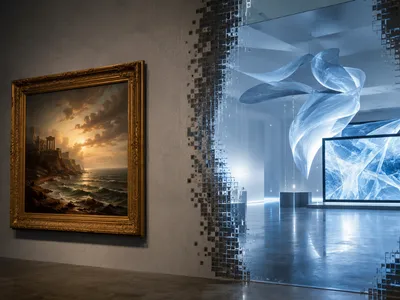
Beyond Words
Art operates as a pre-linguistic and transcendent form of communication, conveying complex internal states that often evade precise verbal description. Its primary function is not to inform but to evoke and share felt experience directly.
This communicative power stems from art's ability to bypass rational cognition and engage our senses and emotions immediately. A melody, a color field, or a sculptural form can communicate nuanced feelings of melancholy, joy, or tension without a single word.
Philosophers like Susanne Langer argue art presents forms of feeling. It objectifies subjective life, giving emotions a visible, audible, or tangible shape that others can perceive and internally recognize, creating a shared experiential field.
| Communicative Mode | Verbal Language | Art as Emotional Language |
|---|---|---|
| Primary Function | Denotation, Information Transfer | Connotation, Affect Transfer |
| Structure | Syntax, Grammar, Lexicon | Composition, Rhythm, Harmony, Texture |
| Interpretation | Strives for Unambiguity | Inherently Polysemous (Multi-meaning) |
| Target Faculty | Rational Intellect | Embodied Perception & Emotion |
The ambiguity of art is not a flaw but its semantic core. Unlike a traffic sign, a painting's meaning is not fixed; it invites personal projection and introspection, making the emotional dialogue between artist and viewer uniquely rich and open-ended.
The Neurological Symphony of Aesthetic Experience
Neuroscientific research provides empirical grounding for art's emotional impact, revealing a distributed neural choreography. The brain does not possess a single "art center"; instead, aesthetic experience emerges from the interplay of multiple specialized systems.
The visual cortex processes formal properties, while the default mode network, associated with self-referential thought and introspection, becomes active during deep aesthetic engagement. This suggests art prompts a profound inward turn, connecting external stimuli to personal emotional memory.
- Mirror Neuron Systems: Facilitate embodied simulation, allowing us to feel the action or emotion depicted in a sculpture or dance internally.
- Limbic System (Amygdala, Hippocampus): The core emotional and memory centers are directly activated by artistic stimuli, creating strong affective responses and personal associations.
- Prefrontal Cortex: Involved in evaluative judgment, conceptual understanding, and the resolution of perceptual ambiguity inherent in complex artworks.
Neuroaesthetics investigates how formal elements like compositional balance, contrast, or curvature trigger predictable emotional and neural responses. For instance, certain visual harmonies may activate reward circuits in the ventral striatum, akin to other primal pleasures.
This biological framework confirms that art's emotional language is not merely metaphorical. It is rooted in the very wiring of our perception and affect systems, facilitating a direct, biologically-mediated form of empathy and understanding that precedes and enriches intellectual analysis.
The encounter with a powerful artwork can thus induce neuroplastic changes, altering our emotional pathways and expanding our capacity for nuanced feeling and empathy, demonstrating its profound role in human cognitive and emotional development.
Cultural Codes and Emotional Translation
The emotional language of art is not a universal lexicon but is profoundly mediated by culturally specific codes and symbols. What evokes sorrow in one tradition may signify transcendence in another, making emotional translation a complx hermeneutic act.
| Cultural Context | Artistic Symbol (Example) | Emotional Valence | Interpretive Key |
|---|---|---|---|
| Classical Greece | Laocoön Statue (Serpents) | Tragic Suffering, Divine Punishment | Mythological Narrative, Hubris |
| Traditional China | Wintry Plum Blossom Painting | Resilience, Hope, Moral Fortitude | Scholar-Official Ideals, Seasonal Cycles |
| Post-WWII Europe | Francis Bacon's Screaming Popes | Existential Angst, Authority in Crisis | Trauma of War, Psychoanalytic Thought |
This cultural encoding means the viewer must engage in a dynamic process of semantic decryption. The emotional payload of an artwork is accessed through familiarity with its historical, religious, and social subtext, which frames the raw sensory data.
Anthropologist Clifford Geertz viewed art as part of a "cultural system," a tangible node in a web of meaning. The emotional response is thus not merely personal but is pre-structured by collective narratives and values that the artist both inherits and challenges.
- Iconography: The study of symbolic, religious, or historical content that must be decoded to access intended emotions.
- Aesthetic Conventions: Culturally agreed-upon rules for composition, color use, or perspective that guide emotional perception.
- Artistic Ritual: The context of creation and reception (e.g., a ritual ceremony, a public gallery) that primes emotional engagement.
Despite this cultural relativity, certain proto-symbolic forms—like the use of verticality for awe, dissonance for unease, or tactile proximity for intimacy—may tap into shared embodied experiences, creating bridges for cross-cultural emotional understanding that bypass purely intellectual translation.
Artistic Mediums as Distinct Dialects
If art is a language, then its various mediums—painting, sculpture, music, literature—constitute unique dialects with their own grammatical rules and affective potentials. The choice of medium is a primary aesthetic decision that fundamentally shapes the emotional message.
The temporal arts, such as music and film, unfold in time, allowing for the development of emotional narratives, suspense, and climax. In contrast, the spatial arts, like painting and architecture, present a total emotional Gestalt meant to be apprehended in a sustained moment of contemplation.
- Painting & Drawing: Dialect of simultaneity, line, and color field. Emotion is condensed into a single, potent visual plane where composition directs feeling.
- Sculpture & Installation: Dialect of presence, volume, and bodily encounter. Emotion is generated through physical scale, texture, and the viewer's kinesthetic engagement with space.
- Music & Sonic Art: Dialect of temporal patterning, frequency, and resonance. Emotion is evoked through melodic contour, harmonic tension, and rhythm, directly altering physiological states.
- Literary Arts: Dialect of metaphor, narrative, and syntactic rhythm. Emotion is constructed through the imaginative gap between verbal sign and evoked imagery or idea.
Each medium possesses inherent affordances and constraints. Music excels at conveying the fluid dynamcs of feeling but struggles with denotative specificity. Literature can articulate complex inner monologues but lacks the immediate sensory impact of a chromatic harmony. The artist's mastery lies in leveraging these specific properties to compress and transmit nuanced emotional states.
The materiality of the medium itself carries emotional weight—the grit of charcoal, the sheen of marble, the glitch of digital video. These material qualities are not neutral carriers but active participants in the emotional discourse, adding layers of meaning about temporality, labor, and cultural value that resonate on a subconscious, tactile level with the perceiver.
Contemporary interdisciplinary practice often seeks to hybridize these dialects, creating immersive, multi-sensory experiences that aim to overwhelm categorical perception and trigger more holistic, and often more profound, emotional and cognitive responses by engaging multiple neural pathways concurrently.
The Dialogic Cycle of Creation and Reception
The emotional language of art is completed not in the studio but in the dynamic dialogic encounter between the artwork and its beholder. This transforms art from a static object into an event of communication, where meaning is perpetually negotiated.
The artist encodes emotional content through formal decisions, yet this encoding is inherently incomplete. It requires the viewer's subjective experience, memories, and cultural background to activate its full semantic and affective potential, creating a unique interpretive fusion for each reception.
Reception theory, notably associated with Hans Robert Jauss, posits that the "horizon of expectations" of the audience actively shapes the emotional and aesthetic impact. An artwork can shock, comfort, or bore based on its relation to these prevailing cultural and personal horizons.
This cycle is not linear but circular. The viewer's interpretation, often manifested in critique, discourse, or even derivative works, feeds back into the cultural milieu, influencing future creators. Thus, the emotional language of art evolves through this continuous feedback loop of expression and response, making it a living, collective discourse.
Ultimately, art as emotional language finds its truest function in this intersubjective space. It does not merely transmit a fixed feeling but provides a sophisticated framework—a set of constraints and possibilities—within which profound emotional exploration and shared understanding between conscious beings can authentically occur.