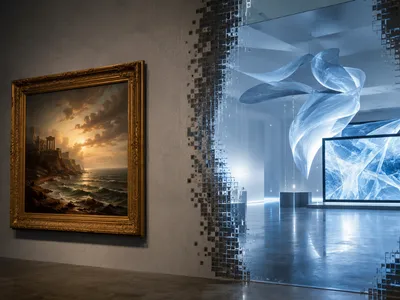
The Symbolist movement in painting emerged as a definitive reaction against the prevailing artistic doctrines of the late 19th century, particularly Realism and Impressionism. While Realism sought to depict the observable world with fidelity and Impressionism focused on the optical effects of light, Symbolism turned inward. It championed the primacy of ideas, emotions, and the spiritual realm over mere visual representation. This was not merely a stylistic shift but a philosophical rebellion, rooted in the broader fin-de-siècle disillusionment with materialism, positivism, and the perceived banality of modern industrial life.
The intellectual and literary foundations of Symbolism are paramount to understanding its visual counterpart. The movement’s name and core principles were crystallized by the French poet Jean Moréas in his 1886 “Symbolist Manifesto” published in Le Figaro. Moréas argued for an art that could express the Ideal through subjective and evocative forms. Symbolist painters found profound inspiration in the works of writers like Charles Baudelaire, whose concept of “correspondences” suggested a mystical link between the sensory and the spiritual, and Stéphane Mallarmé, who pursued the suggestion of ideas rather than their explicit statement. Furthermore, the philosophy of Arthur Schopenhauer, with its emphasis on the world as representtion and the power of art to provide temporary respite from the will’s suffering, provided a crucial metaphysical framework for Symbolist artists.
Key early precursors to Symbolist painting include the visionary works of Gustave Moreau, whose intricate, jewel-encrusted canvases depicting mythological and biblical subjects were laboratories of dream-like imagery. Similarly, the haunting, melancholic scenes of Pierre Puvis de Chavannes, characterized by their simplified forms and muted tonalities, created a timeless, allegorical space that profoundly influenced the generation to come. The Swiss artist Arnold Böcklin further expanded the movement’s emotional range with his enigmatic landscapes, such as the famous “Isle of the Dead,” which evoked universal themes of mortality and mystery. These artists collectively forged a visual language where the symbol became the primary vehicle for conveying complex psychological and spiritual states.
To delineate the movement's evolution, a comparison with its immediate predecessors is instructive.
| Movement | Primary Focus | View of Reality | Symbolist Position |
|---|---|---|---|
| Realism/Impressionism | External, sensory world; optical truth. | Reality is directly observable and empirically verifiable. | Rejected as superficial; sought a deeper, subjective truth behind appearances. |
| Romanticism | Emotion, individualism, sublime nature. | Reality is infused with powerful, often tumultuous, feeling. | Shared the focus on emotion but channeled it through more codified, abstract, and synthetic symbols. |
| Academic Art | Historical/mythological narrative, technical mastery. | Reality is best expressed through idealized forms and didactic stories. | Rejected narrative literalism; used myth and allegory as personal, esoteric metaphors. |
The establishment of Symbolism as a coherent movement was solidified through key exhibitions and publications. The Rose+Croix Salons, organized by Joséphin Péladan from 1892 to 1897, provided a dedicated platform for artists who shared a disdain for naturalism and a fascination with the occult, mysticism, and Catholic idealism. Concurrently, periodicals like La Plume and La Revue Blanche became critical venues for disseminating Symbolist theory and imagery, creating a network of like-minded artists and intellectuals across Europe.
Key Characteristics
The defining feature of Symbolist painting is its resolute anti-mimesis. The objective reproduction of the external world is deliberately abandoned in favor of constructing an image that serves as a conduit for internal states. This results in a visual lexicon built upon specific, recurrent strategies that distinguish Symbolist work from other contemporary styles.
A paramount characteristic is the use of subject matter steeped in allegory, mythology, dream, and literary allusion. Rather than depicting scenes from contemporary life, Symbolists revived ancient myths, biblical tales, and literary narratives, not for their historical accuracy but for their archetypal power. These stories were re-imagined as highly personal metaphors for the artist's own anxieties, desires, and spiritual quests. The figure of the femme fatale, the androgyne, the mystic, and the wanderer became recurring archetypes of psychological complexity.
Formally, Symbolist painting often employs a high degree of stylization and simplification. Drawing inspiration from early Renaissance frescoes, Puvis de Chavannes, and mural painting, artists frequently eschewed rigorous perspective and detailed modeling. Figures and landscapes are rendered with a clarity of line and a flattening of space that creates a sense of timelessness and otherworldliness. This formal approach is not a technical deficiency but a conscious choice to distance the image from mundane reality and elevate it to the level of an icon or a vision.
The Symbolist treatment of color is fundamentally non-naturalistic. Color is used emotively and symbolically, not descriptively. A palette might be dominated by somber, twilight hues to evoke melancholy or introspection, or it might erupt in lurid, unnatural tones to convey passion, ecstasy, or terror. This approach directly facilitates the creation of a unified, suggestive atmosphere that permeates the entire canvas, pulling the viewer into a specific, often unsettling, mood.
| Characteristic | Artistic Manifestation | Primary Function |
|---|---|---|
| Idea over Form | Distorted perspective, ambiguous spaces, synthetic compositions. | To subvert visual realism and prioritize the conceptual or emotional content. |
| Evocation over Description | Muted or exaggerated color, diffuse light sources, blurred contours. | To create an atmosphere that suggests meaning rather than stating it literally. |
| The Subjective Gaze | Dreamscapes, introspective figures, personal symbolism. | To explore the inner world of the psyche, the unconscious, and the spiritual. |
| Synthesis of the Arts | Inspiration from poetry, music, and theater; titles with literary references. | To achieve a "total work of art" (Gesamtkunstwerk) that transcends any single medium. |
Finally, Symbolism is characterized by a profound synesthetic tendency—the desire to express the qualities of one sense (e.g., sound) through the medium of another (e.g., sight). Painters aspired to create the visual equivalent of a poem’s rhythm or a musical composition’s harmony. This drive for synthesis made the movement inherently interdisciplinary, fostering collaborations and mutual influences between painters, poets, composers, and playwrights, all seeking to articulate the ineffable.
Major Artists
While Symbolism was a broad international phenomenon, its core was defined by a constellation of key figures whose work established the movement's diverse aesthetic parameters. Gustave Moreau (1826–1898) stands as a foundational pillar. His studio became a crucible for Symbolist ideas, where mythological subjects like Salomé and Orpheus were transformed into dense, jewel-like visions of psychic ambiguity and decadent splendor. Moreau’s technique, layering paint and varnish to create a luminous, enamel-like surface, was as much a part of his symbolism as his subject matter, suggesting a sacred, otherworldly realm.
Pierre Puvis de Chavannes (1824–1898) represented a contrasting yet equally influential pole. His large-scale murals and paintings, such as "The Poor Fisherman" and "Hope," employed a radically simplified composition, restrained palette, and static, timeless figures. This aesthetic of silence and asceticism evoked a universal, melancholic poetry that deeply affected artists from Seurat to Gauguin. Puvis demonstrated that symbolism could reside not in intricate detail, but in evocative reduction and a profound sense of atmospheric suspension.
Beyond France, Symbolism found powerful and distinct voices. The Swiss painter Arnold Böcklin (1827–1901) infused landscape with a potent, dramatic symbolism. His "Isle of the Dead" (multiple versions, 1880–1886) is a quintessential Symbolist work, where a rocky island, a cypress grove, and a solitary boatman coalesce into an archetypal image of mourning and mystery. In Belgium, Fernand Khnopff (1858–1921) cultivated an art of intimate enigma. His hyper-realistic yet dream-logic compositions, often featuring his sister as a model, explored themes of memory, duality, and inaccessible desire with a fin-de-siècle intensity.
The Norwegian Edvard Munch (1863–1944), though later associated with Expressionism, is inseparable from Symbolism’s core concerns. Works like "The Scream" (1893) and "Madonna" (1894–95) utilize exaggerated color, sinuous line, and psychologically charged compositions to externalize existential angst, love, and death. His work represents Symbolism’s most direct pivot towards the exploration of raw, subjective emotional states, a bridge to the 20th-century avant-garde.
| Artist | Nationality | Key Symbolist Tenets Exemplified | Signature Work |
|---|---|---|---|
| Gustave Moreau | French | Decadent ornamentation, literary/mythological allegory, visionary interiority. | "The Apparition" (c. 1876) |
| Odilon Redon | French | Evocation of the dream world, mastery of suggestive charcoal (Noirs) and pastel, botanical fantasy. | "The Cyclops" (c. 1914) |
| Fernand Khnopff | Belgian | Psychology of desire, symbolism of silence and enclosure, photographic precision. | "The Caress" (1896) |
| Jan Toorop | Dutch | Synthesis of linear rhythm (inspired by Javanese shadow puppets) with spiritual and social themes. | "The Three Brides" (1893) |
Symbolism Versus Other Art Movements
To fully apprehend Symbolism’s unique contribution, a comparative analysis with adjacent and succeeding movements is essential. While sharing a reaction against Realism, Symbolism diverged fundamentally from Impressionism. Where Impressionists like Monet sought to capture the ephemeral effects of light and atmosphere on the retina, Symbolists like Redon sought to depict the landscapes of the mind. Impressionism is an art of the immediate sensory moment; Symbolism is an art of the eternal, internal idea.
The relationship with Post-Impressionism is more nuanced and symbiotic. Artists like Paul Gauguin and Vincent van Gogh are often situated at this intersection. Gauguin’s "Vision After the Sermon" (1888) employs flat planes of color and bold outlines not for decorative effect, but to visualize a spiritual and collective reality, a core Symbolist aim. Van Gogh’s swirling skies and radiant suns are less depictions of nature than externalizations of psychic energy. However, while these artists utilized symbolic form and color, their connection to observed reality—however transformed—remained more tangible than in the purely imaginative constructs of a Moreau or a Khnopff.
The clearest distinction lies with Art Nouveau, a movement with which Symbolism is often contemporaneous and occasionally overlapping. Both movements rejected academic tradition and favored organic, flowing lines. However, Art Nouveau’s primary focus was on aesthetic reform and total design, applying its stylized forms to architecture, furniture, and decortive arts to beautify the everyday environment. Symbolism, in contrast, was inherently content-driven and philosophical, concerned less with surface decoration than with probing profound, often dark, themes of existence. Art Nouveau is an art of elegant life; Symbolism is an art of the soul.
Symbolism’s most direct legacy is to the movements of the early 20th century. It provided the crucial link to Expressionism, which amplified Symbolism’s subjective focus into a more violent distortion of form and color for emotional impact. The Surrealists, particularly the wing led by André Breton, directly claimed descent from Symbolism’s “victory of the irrational and the subconscious.” The Symbolist fascination with dreams, mystery, and the juxtaposition of incongruous elements laid the conceptual groundwork for Surrealist automatism and oneiric imagery.
| Movement (Approx. Period) | Primary Relationship to Symbolism | Key Differentiator |
|---|---|---|
| Romanticism (late 18th–mid 19th c.) | Precursor; shared emphasis on emotion, individualism, and the sublime. | Romanticism often expressed emotion through dramatic natural scenes; Symbolism channeled it through coded, synthetic, and often esoteric personal symbols. |
| Impressionism (1870s–1880s) | Direct antithesis in terms of artistic aim. | Impressionism: Objective recording of visual perception. Symbolism: Subjective expression of ideas and inner vision. |
| Art Nouveau (1890–1910) | Contemporary; shared stylistic motifs (flowing lines) but divergent core purposes. | Art Nouveau sought aesthetic harmony in applied arts; Symbolism sought metaphysical truth in fine art. |
| Expressionism (early 20th c.) | Direct descendant and intensifier. | Symbolism suggested mood and idea, often with a degree of restraint; Expressionism violently externalized raw emotion. |
This comparative framework reveals Symbolism not as an isolated stylistic anomaly, but as a vital nexus in the evolution of modern art. It consciously severed the direct tie to optical reality that had dominated Western art since the Renaissance, thereby creating the intellectual and aesthetic space for the radical abstractions and explorations of the unconscious that would define the century to come. Its stance was fundamentally anti-materialist and idealist, privileging the reality of the mind over the reality of the physical world.

Interpreting Symbols in Painting
The interpretation of symbols within Symbolist painting necessitates a move beyond iconographic literalism—the simple one-to-one decoding of images—towards a more nuanced, contextual, and often polysemous analysis. A symbol, in the Symbolist lexicon, is not an allegorical sign with a fixed meaning (e.g., a dove equals peace), but rather a form charged with suggestive power, capable of evoking a spectrum of associated ideas, emotions, and spiritual states. The meaning is not locked but latent, requiring an active engagement from the viewer to be partially unlocked.
A fundamental methodological approach involves distinguishing between cultural/conventional symbols and private/idiosyncratic symbols. Cultural symbols draw upon a shared reservoir of mythology, religion, literature, and art history. The figure of the Sphinx, the closed garden (hortus conclusus), or the motif of the veil all carry centuries of accumulated meaning that the artist can tap into and personally inflect. In contrast, private symbols are developed by the artist for highly personal reasons and require biographical or contextual knowledge for interpretation. The recurrent use of a specific model (like Khnopff's sister) or a particular animal in an artist's oeuvre often falls into this category.
- Context is Paramount: The meaning of a symbol is never absolute but is derived from its relationship to other elements within the composition—other symbols, color choices, formal arrangements, and the work's title.
- Atmosphere Over Narrative: Symbolist works often prioritize creating a cohesive, immersive mood (e.g., melancholy, ecstasy, dread) over telling a linear story. The symbols collectively generate this atmosphere.
- Embrace of Ambiguity: A definitive, singular interpretation is frequently impossible and may even be contrary to the artist's intent. The power of the symbol often lies in its productive ambiguity, its ability to resonate on multiple levels simultaneously.
- Interdisciplinary Connections: Effective interpretation often requires looking beyond the visual arts to the concurrent Symbolist movements in poetry, music, and theater, as ideas and motifs circulated fluidly among them.
For example, consider the pervasive Symbolist motif of the mirror or reflective surface. On a conventional level, it can symbolize vanity or self-absorption. In a Symbolist context, however, it more profoundly suggests the duality of the self, the threshold between reality and illusion, or the search for an elusive inner truth. In Khnopff's work, mirrors often reflect something differnt from what stands before them, pointing to the hidden psyche. This demonstrates how a common object is transformed into a complex, multi-valent symbol through its specific artistic treatment and placement within a Symbolist aesthetic framework.
Legacy and Influence of Symbolism
The terminus of Symbolism as a coherent, historical movement around the dawn of World War I did not signify its demise but rather its dissemination and metamorphosis into the very fabric of 20th-century modernism. Its most profound legacy was the legitimization of the subjective, interior world as the primary subject of art. By breaking the chain of representational fidelity, Symbolism granted artists the license to distort form, manipulate color, and invent imagery directly from the psyche, a license that would be exploited fully by subsequent avant-garde movements.
This influence is most directly traceable in Expressionism. The German Die Brücke and Der Blaue Reiter groups, and later the Neue Sachlichkeit, inherited Symbolism's emotional intensity and anti-naturalist stance. Artists like Ernst Ludwig Kirchner or Emil Nolle took the internalization of experience to new extremes, using jagged lines and clashing colors not to suggest a mood, as Symbolists might, but to scream a visceral emotional state. The Austrian Oskar Kokoschka and the Norwegian Edvard Munch (a figure straddling both movements) exemplify this direct lineage, where the symbolic becomes the expressionistic.
Perhaps the most explicit acknowledgment of this debt came from Surrealism. André Breton’s First Surrealist Manifesto (1924) hailed Symbolist poets like Rimbaud and Lautréamont as crucial forerunners. In painting, the Surrealist pursuit of the unconscious, the dream, and the marvelous found a direct precedent in the oneiric landscapes of Redon, the enigmatic narratives of de Chirico (an early Surrealist influence himself shaped by Symbolist mystery), and the psychologically charged juxtapositions of Symbolist theatre. The automatic drawing practiced by the Surrealists sought to bypass rational control in a way that paralleled the Symbolist search for a direct, unmediated expression of the idea or vision.
Beyond these direct lineages, Symbolism's echoes can be discerned in the mythic archetypes of Pablo Picasso's neoclassical period, the metaphysical stillness of Giorgio de Chirico's early "Pittura Metafisica," and even in the symbolic color fields of certain Abstract Expressionists like Mark Rothko, who sought to evoke transcendent emotional and spiritual states through non-representational means. In literature, cinema, and graphic arts, the Symbolist preference for mood, suggestion, and archetype over explicit narrative has remained a potent creative strategy.
In conclusion, Symbolism's enduring relevance lies in its successful establishment of an alternative artistic paradigm. It proved that art's highest purpose could be the exploration of the invisible—the realms of dream, spirit, and emotion—using a language of form and symbol. It stands as a critical pivot point in art history, the moment when the gaze turned decisively inward, thereby setting the stage for the pluralistic, psychologically-oriented, and often abstract art of the modern and contemporary era. Its legacy is not a specific style, but a fundamental permission to seek reality beyond appearance.