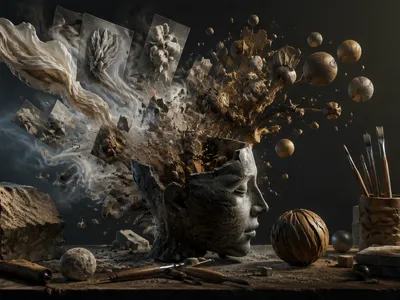
The Psychology Behind Uncanny Creature Design
Creature design often leverages the psychological phenomenon of the uncanny valley, where human-like yet clearly non-human features create unease. This tension between familiarity and strangeness engages viewers more deeply, transforming initial discomfort into sustained curiosity. Neuroscientific research indicates that such ambiguity activates the anterior cingulate cortex, associated with conflict monitoring and error detection, as the brain struggles to categorize hybrid forms, heightening attention and emotional investment.
Anthropomorphism is a foundational tool in creature design, enabling artists to map human psychological frameworks onto non-human entities. By incorporating recognizable emotional expressions or postures, creators foster empathy while maintaining the thrill of otherness. This deliberate balance between the familiar and the alien mirrors evolutionary mechanisms of threat assessment, where exaggerated eyes or unusual proportions trigger instinctual vigilance, yet familiar social cues create compelling cognitive dissonance.
The uncanny mirror does more than evoke fear; it invites observers to navigate the boundaries of self and other. Designers manipulate these perceptual thresholds to craft figures that linger in memory, precisely because they resist straightforward classification and challenge perceptual expectations.
Evolution’s Echo: Why We Fear and Favor
Evolutionary psychology provides a framework for understanding why certain creature features resonate universally. Traits such as sharp teeth, exaggerated limbs, or luminous eyes often engage ancient predator-recognition circuits, eliciting reflexive caution. Conversely, neotenous features—the retention of juvenile characteristics—trigger caregiving instincts. Large eyes and rounded forms, commonly used in friendly creature designs, tap into deep-seated biological impulses to nurture and protect, creating an immediate emotional bond.
The impact of a creature frequently depends on the strategic combination of threat and safety cues. A design may incorporate formidable claws while maintaining a submissive posture, compelling viewers to reconcile conflicting instincts and invest more cognitive effort into interpretation, enhancing engagement and memorability.
To illustrate how designers operationalize these evolutionary triggers, consider the following recurring visual strategies:
- ⭐ Hyperstimuli – Exaggerated versions of natural signals (e.g., oversized eyes, iridescent scales) that amplify instinctual responses.
- ⭐ Mimicry – Borrowing recognizable patterns from dangerous animals (spines, venomous coloration) while subverting them with docile features.
- ⭐ Ambiguous postures – Poses that combine defensive and inviting body language to sustain narrative tension.
This layered approach ensures that a creature resonates on both conscious and subconscious levels. Audiences rarely articulate why a design feels “right,” yet the underlying evolutionary scaffolding reliably guides their emotional response.
By grounding speculative anatomy in real biological principles, creature designers achieve what paleontologists call “functional plausibility.” Even in fantastical contexts, adherence to evolutionary logic lends credibility, allowing the imagination to engage without suspension of disbelief.
Thus the most memorable creatures act as evolutionary echoes, simultaneously awakening ancient fears and ancient affections. They become cultural archetypes precisely because they speak to cognitive tools honed over millennia.
How Does Creature Design Tell a Story?
Every curve, angle, and texture in a creature functions as a narrative device. Silhouette alone can convey morality, with jagged lines suggesting menace while fluid contours imply grace or harmlessness. Materiality enhances this visual language, as choices like sleek chitin, weathered stone, or luminous flesh reflect evolutionary history and environmental pressures. Form follows emotional function, situating the creature within its fictional ecology and reinforcing the storytelling principles that shape character design.
Designers also use proportion hierarchies to guide viewer attention, often exaggerating features that carry narrative significance—such as hands for cunning creatures or jaws for predators. These formal decisions combine into a visual biography that establishes character traits even before a single action unfolds, reinforcing storytelling through design alone.
Mechanical Logic in Fantastical Creature Design
While biological plausibility grounds a creature, mechanical and architectural principles often elevate it into the realm of the sublime. Structural engineering concepts like tension, load distribution, and joint articulation lend credibility to impossible anatomies.
The integration of non-biological materials—metallic alloys, crystalline structures, or woven composites—expands the designer’s palette beyond evolutionary constraints. Such choices imply alternative histories where technology and biology converge, prompting speculation about the creature’s origin and purpose.
A few recurring mechanical strategies demonstrate how designers construct wonder through functional logic:
- Biomechanical integration – Organic forms fused with articulated machinery, suggesting self-repair or adaptive weaponry.
- Modularity – Bodies composed of interchangeable units, allowing for transformation or regeneration.
- Exoskeletal frameworks – Visible internal structures that double as armor, balancing vulnerability with resilience.
These mechanical motifs invite the audience to reverse-engineer the creature’s capabilities. Function becomes a puzzle, and wonder arises from the elegant solution embedded in the design itself.
How Will AI Shape the Future of Creature Design?
Generative artificial intelligence is transforming creature design by producing thousands of anatomical variants in seconds, shifting the designer’s role from constructor to curator, though questions of authorship remain unresolved. This transformation is directly influencing the future of AI in concept art creation. Interactive environments further demand creatures that respond to player psychology, requiring procedural animation systems that simulate emotional states through real-time skeletal adjustments, moving design from static sculpture toward dynamic behavioral architecture. Virtual reality adds complexity by placing observers inside the creature’s scale and environment, compelling designers to account for proprioceptive impact alongside visual appeal.
As speculative biology converges with computational ecology, future creatures will increasingly emerge from simulated evolutionary pressures rather than purely artistic intuition. These algorithmically evolved forms challenge conventional ideas of intentionality while offering an unprecedented diversity of plausible life, expanding the boundaries of imaginative design.
| Technological Frontier | Transformation in Creature Design |
|---|---|
| Generative adversarial networks | Massive exploration of morphological space; designer shifts to curator. |
| Real‑time ray tracing | Subsurface scattering and bioluminescence become computationally trivial, enabling hyper‑realistic organic materials. |
| Neural motion synthesis | Creatures learn locomotion from reference video, producing unpredictable yet anatomically convincing gaits. |
| Volumetric capture | Physical puppetry merges with digital iteration, preserving tactile authenticity while allowing infinite revision. |
These converging technologies do not replace the designer but elevate the role to that of an evolutionary director. The future of imaginary beings lies in systems that learn, adapt, and surprise—yet always under the guiding hand of human intentionality.