The Visual Hook
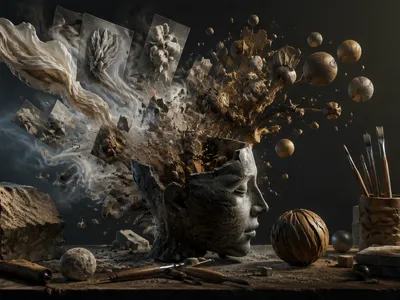
A compelling concept art piece captures attention through an immediate visual hook such as an unusual silhouette, striking contrast, or compositional disruption. These elements engage pre-attentive processing, where the brain prioritizes novelty, while Gestalt principles ensure coherence through closure, continuity, and figure-ground separation.
Silhouette legibility guarantees clarity even at a distance, while hierarchical lighting directs focus toward key elements. Combined with color temperature to reinforce emotional tone, these techniques transform a simple design into a memorable and impactful image.
Narrative Seeds Within an Image
A single frame of concept art must imply a larger story through visual cues. The arrangement of characters, environmental details, and expressive gestures suggests relationships, conflicts, or moments just before or after a key event.
Micro-narratives emerge from carefully placed props, wear patterns on surfaces, or subtle interactions between figures. These elements invite viewers to construct their own interpretations, transforming passive observation into active engagement.
Expressive anatomy serves as a primary vehicle for narrative, where posture and muscle tension communicate psychological states. A warrior’s slumped shoulders after battle speak to exhaustion and loss without a single line of dialogue. Environmental storytelling embeds history into the setting, using decay, adaptation, or incongruous objects to imply past events.
Color symbolism operates as a silent narrator, with specific hues carrying cultural or archetypal meanings that reinforce thematic undertones. Designers often encode character allegiance or moral ambiguity through controlled palettes, ensuring the narrative remains legible while mastering mood and atmosphere in digital art.
The following table outlines key narrative techniques frequently embedded in concept art to enhance memorability and depth.
| Narrative Device | Function in Concept Art |
|---|---|
| Expressive Anatomy | Conveys psychological state and unspoken emotion through posture, tension, and gesture. |
| Environmental Storytelling | Implies history, use, and change through weathering, spatial arrangement, and contextual props. |
| Color Symbolism | Reinforces allegiance, mood, or moral alignment via controlled, culturally resonant palettes. |
Technique, Texture, and Tangibility
Material studies enhance concept art by anchoring imaginative designs in tactile realism, where surfaces like leather, metal, or silk are rendered with attention to reflectivity, roughness, and subsurface scattering. Artists rely on real-world references and controlled lighting to translate physical properties into convincing visual cues.
Digital brush economy emphasizes efficient, intentional strokes that convey both texture and form, while layered compositing blends photorealistic and painted elements into a cohesive whole. Techniques like atmospheric perspective and edge control guide depth and focus, where precision meets expressive freedom in the final composition.
Concept artists often employ a structured workflow to maintain consistency across complex designs. The following table summarizes key technical approaches and their impact on memorability.
| Technique | Primary Function | Memorability Factor |
|---|---|---|
| Material Studies | Establishes tactile realism and physical believability | Creates sensory resonance |
| Brush Economy | Conveys texture and form with minimal strokes | Encodes authorial confidence |
| Layered Compositing | Blends photographic and painted elements | Generates hybrid realism |
What Distinguishes the Iconic from the Merely Competent?
Iconic concept art goes beyond technical skill by combining conceptual clarity with a distinctive visual language, a core principle of designing worlds and concept art mastery. Through deliberate use of visual hierarchy, artists emphasize core ideas over secondary detail, ensuring lasting recognizability. Emotional authenticity and cultural specificity further strengthen impact, as psychologically nuanced designs and research-driven elements create deeper, more enduring connections with audiences.
The factors that consistently appear in critically acclaimed concept art can be summarized as follows.
- 📌 Conceptual clarity over decorative complexity
- 📌 Intentional restraint in color and detail
- 📌 Psychological depth embedded in form and gesture
- 📌 Research-driven cultural authenticity