Art as Social Commentary
Contemporary art has evolved beyond aesthetic contemplation to become a primary vehicle for social commentary, directly engaging with the fractures and complexities of modern life. Artists now routinely dissect issues of power, inequality, and identity, transforming galleries into spaces of civic discourse.
This shift represents a fundamental change in the perceived role of the artist, from an isolated creator to a public intellectual or witness to their era. The artwork becomes an argument, a provocation, or a documented testimony, often leveraging shock, satire, or forensic aesthetics to challenge audience complacency.
Thematic focus has decisively turned toward systemic critique. Financial inequality, institutional racism, and gendered violence are no longer merely subjects but central premises for artistic investigation.
Artists employ symbolic gestures and material choices to make abstract injustices tangibly felt. For instance, the use of mundane or oppressive materials can poetically mirror the burdens of socio-economic struggle, creating a visceral connection between the viewer's physical experience and a broader political reality.
This methodology often bypasses traditional narrative for a more potent, emotive narrative built from juxtaposition and metaphor, asking viewers to engage in critical deduction rather than passive consumption.
The gallery thus transforms into a forum where the politics of the street and the intimacy of personal testimony converge for collective examination. This practice does not offer simple solutions but insists on the uncomfortable necessity of sustained attention to societal wounds.
Participatory Art Forms
A defining feature of socially engaged art is the move toward participatory models that dismantle the traditional barrier between artist, artwork, and audience. These practices reconfigure the artistic event as a collaborative social process, where the outcome is co-created by participants.
The authority of the singular artistic genius is deliberately decentralized in favor of community dialogue and shared authorship. This paradigm asserts that the aesthetic experience is rooted in the dynamics of human interaction and the forging of temporary collectives.
Theoretical underpinnings for this shift draw from relational aesthetics and dialogical art, where the core artistic material is the space of encounter itself. Success is measured not in object quality but in the depth of interpersonal exchange and the generation of social capital.
The following table categorizes primary modes of participatory art, highlighting their distinct mechanisms and intended social effects.
| Participatory Mode | Primary Mechanism | Intended Social Effect |
|---|---|---|
| Dialogical and Conversational | Structured conversations, shared meals, storytelling circles | To build empathy, facilitate understanding across difference, and create discursive communities |
| Performative and Activated | Guided group actions, protests, communal rituals or tasks | To embody solidarity, practice new social models, and create visible collective gestures |
| Co-Creative and Generative | Collaborative making, community murals, collective writing or archiving | To democratize creative agency, produce shared cultural assets, and validate communal narratives |
Ethical considerations are paramount in these collaborative frameworks. Artists must navigate issues of consent, representation, and the potential for exploitation when engaging communities, especially marginalized ones.
The goal is to avoid instrumentalizing participants for artistic gain and instead ensure the process offers genuine value and agency to all involved. This requires long-term commitment and a willingness for the artist to become a facilitator rather than a director.
Key characteristics defining ethical participatory art include several core principles that guide its practice and evaluation.
- A foundation of mutual consent and transparent communication between all parties.
- A design that ensures participant agency shapes the process and outcomes.
- A commitment to sustained engagement beyond a single project or event.
- A focus on generating reciprocal benefit for both the artist and the community.
- Critical reflexivity where the artist continuously examines their own position and power.
Digital Activism
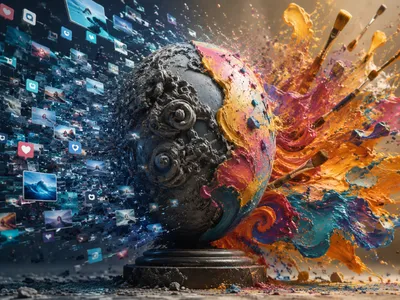
The digital sphere has emerged as a dominant arena for artistic activism, where tools of virality and network effects are harnessed for social critique. Online platforms enable artists to bypass traditional institutional gatekeepers, engaging global audiences directly and instantaneously with politically charged work.
This environment fosters new aesthetic languages, including hashtag aesthetics, data visualization, and digital guerrilla tactics that respond to current events in real time. The meme format, with its rapid mutation and participatory nature, has become a potent vehicle for political satire and counter-narrative.
Artists leverage these formats to challenge state and corporate power, often highlighting surveillance capitalism or algorithmic bias. The very architecture of social media becomes both medium and subject of critique.
A significant development is the creation of complex, immersive projects that exist primarily online. These can include alternative reality games that critique labor practices, virtual environments simulating climate displacement, or crowdsourced archives documenting state violence. Such projects use interactivity not for entertainment but to foster empathetic understanding and systemic awareness, translating vast, abstract issues into personalized, navigable experiences.
The ephemeral and distributed nature of digital activism redefines artistic impact, valuing widespread dissemination and community mobilization over the creation of a permanent physical object. This shift presents new challenges for preservation and historiography, as the most influential works may be campaigns or platforms rather than discrete images or sculptures.
Curatorial Strategies for Social Justice
Curators have adopted an increasingly activist role, moving beyond collection display to become critical editors of cultural discourse. They construct narratives that deliberately center marginalized voices and challenge entrenched historical canons, treating the exhibition as a form of argument.
This practice involves meticulous research and community partnership to present historically excluded perspectives with authenticity and depth.
Exhibition design itself becomes a political tool, using spatial arrangement, signage, and multimedia to guide visitors through a critical perspective. A curator might juxtapose colonial-era artifacts with contemporary Indigenous art to expose ongoing legacies of extraction, or use audio testimonies to personalize statistical data on migration. The goal is to create an embodied, affective learning environment that moves beyond text panels to foster a deeper, more confrontational engagement with the subject matter.
Curatorial methodologies for advancing social justice are diverse, often combining scholarly rigor with community-based practices to achieve specific critical aims.
| Curatorial Mode | Primary Mechanism | Critical Aim |
|---|---|---|
| Counter-Historiography | Re-examining archives, centering subaltern narratives, highlighting erasure | To challenge official histories and demonstrate the constructed nature of cultural memory |
| Institutional Critique | Intervening in museum spaces, exposing collection histories, debating restitution | To reform institutional policies and transparently address legacies of colonial acquisition |
| Platform for Agency | Ceding curatorial authority, facilitating community-led exhibitions | To transform the museum from a presenting authority to a hosting platform for community voice |
This strategic curation does not seek neutrality but actively models a more equitable and critically aware framework for public cultural engagement. It positions the museum not as a temple for finished masterpieces but as a contested public square where history and its meanings are actively negotiated.
Environmental Consciousness in Artistic Practice
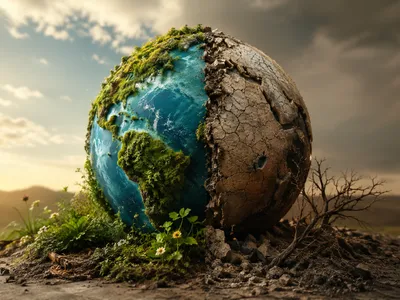
Artistic engagement with ecological crisis has moved beyond romantic landscape depiction to confront the material and philosophical realities of the Anthropocene. This shift marks a transition from representing nature to interrogating the entangled systems of ecology, politics, and economics that drive environmental degradation.
Contemporary practitioners critically examine the material ethics of art production itself, questioning the environmental footprint of traditional mediums and industrial art logistics.
A prominent strand of this work involves using data as both medium and subject, transforming complex scientific information on species extinction, carbon emissions, or ocean acidification into visceral sensory experiences. These projects make the imperceptible scale of planetary change palpable, bridging the gap between abstract data and embodied understanding. Another approach involves biomimicry or collaboration with living systems, creating works that exist in dialogue with biological growth, decay, and adaptation.
This practice fundamentally redefines artistic value, prioritizing sustainable processes, inter-species empathy, and long-term ecological thinking over the creation of permanent objects.
Artists employ diverse strategies to translate ecological urgency into compelling aesthetic experiences, each with distinct methodologies and focal points.
| Artistic Strategy | Methodological Focus | Primary Objective |
|---|---|---|
| Forensic Ecology | Fieldwork, soil/water sampling, mapping environmental violence | To document and evidence ecological damage, often for legal or activist contexts |
| Speculative Fabulation | Creating post-human narratives, imagining future ecologies | To overcome "imagination failure" and envision paths beyond catastrophic thinking |
| Restorative Practice | Phytoremediation, habitat creation, rewilding projects | To actively heal damaged sites and integrate art directly into ecosystem repair |
The philosophical underpinnings of ecological art are reflected in several core principles that guide its creation and critique.
- An unwavering commitment to interdisciplinary collaboration with scientists, activists, and local communities.
- A critique of anthropocentrism, seeking to decentre the human and acknowledge non-human agency.
- An emphasis on process and systems over finite, commodifiable objects.
- The use of renewable, biodegradable, or repurposed materials to minimize environmental impact.
- A pedagogical drive to foster ecological literacy and inspire responsible action in audiences.
Reclaiming Marginalized Histories
A potent function of contemporary art is the critical excavation and imaginative reclaiming of histories that have been suppressed, erased, or misrepresented by dominant narratives. This practice operates as a form of counter-memory, challenging the authority of official archives and national myths.
Artists engage in meticulous research to resurrect subaltern voices, often employing speculative methods to fill archival silences where documentary evidence has been destroyed or never recorded.
This work is deeply informed by postcolonial and decolonial theories, seeking to dismantle the enduring epistemic violence of colonialism. It questions whose knowledge is valued and how history is constructed, frequently turning to oral traditions, familial archives, and embodied cultural practices as legitimate repositories of knowledge.
The artistic output manifests as alternative monuments, counter-archives, or immersive installations that invite viewers to experience history from a marginalized vantage point, fostering a critical reassessment of the present through a reclaimed past.