AI as a Creative Partner in Contemporary Art
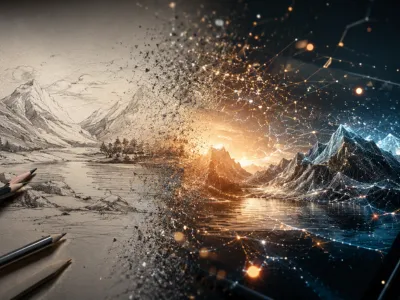
The evolution of generative adversarial networks and diffusion models has fundamentally altered the creative landscape, pushing artificial intelligence beyond mere automation. These systems no longer simply execute commands but actively propose novel visual solutions, functioning as sophisticated collaborators rather than passive instruments.
This transition is evident in how contemporary artists engage with machine learning algorithms. The artist's role shifts from direct manipulation to high-level guidance, curating and refining the vast output generated by the AI. This new dynamic fosters a recursive loop of suggestion and selection, deeply integrating the technology into the ideation phase of art creation.
| Creative Role | Traditional Tool Function | AI Partner Function |
|---|---|---|
| Ideation | Executes a specific sketch | Generates multiple, divergent concepts |
| Exploration | Applies a predefined filter | Remixes styles and elements unpredictably |
| Refinement | Manually corrects details | Intelligently inpaints or upscales based on context |
| Output | Produces a static file | Offers a latent space for continuous iteration |
Examining this partnership reveals a form of co-creativity where the machine's stochastic processes meet human intentionality. The artist prompts, the model interprets and generates, and the artist selects, creating a feedback loop that neither party could achieve alone. This interplay challenges the very definition of authorship in the digital age.
- 💡 Augmented Divergence: AI breaks creative fixation by offering unexpected combinations.
- ⚡ Rapid Prototyping: Concepts can be visualized and discarded in minutes, accelerating iteration.
- 🔎 Bias Exploration: Artists can study and critique the biases embedded in training data.
- ✏️ Semantic Manipulation: Directly editing images through natural language descriptions.
Contemporary research increasingly frames this relationship as a hybrid intelligence system. By embedding AI within the creative process, artists are not replaced but rather empowered to navigate a vastly expanded solution space. The technology serves as a catalyst, augmenting human creativity with a scale of variation previously unimaginable.
This new paradigm necessitates a critical examination of the tools themselves. Understanding the underlying architecture of models like DALL-E 3 or Stable Diffusion becomes essential for artists seeking to push beyond surface-level aesthetics. Mastery now involves a deep comprehension of prompt engineering and latent space navigation.
Redefining the Artist's Workflow
The integration of generative AI into professional pipelines is not merely an addition of a new tool but a fundamental reconfiguration of the creative workflow. Traditional linear processes are giving way to iterative, non-destructive cycles where AI handles technical bottlenecks, freeing artists for higher-level conceptual work.
This restructuring is particularly pronounced in the early stages of production. Concept artists can now generate hundreds of variations on a theme in minutes, a task that would have taken weeks manually. The following comparison illustrates the shift from a purely manual process to an AI-augmented one.
| Workflow Stage | Traditional Approach | AI-Augmented Approach |
|---|---|---|
| Research & Reference | Manual image sourcing | AI-assisted mood board generation |
| Ideation & Sketching | Thumbnail sketches by hand | Text-to-image concept seeding |
| Iteration & Refinement | Redrawing based on feedback | Inpainting and style transfer adjustments |
| Final Polish | Manual detailing and compositing | AI upscaling and intelligent detail synthesis |
The efficiency gains are substantial, but the deeper impact lies in the changed nature of exploration. Artists are no longer constrained by the time cost of each iteration, enabling a more divergent and experimental approach. This shift allows for a greater focus on narrative and emotional resonance rather than purely technical execution. The artist becomes a director, guiding an ensemble of generative processes.
This emerging workflow requires a redefined skill set, where traditional digital painting abilities are complemented by expertise in curating AI-generated outputs and integrating multiple iterations into a unified final composition. Artists cultivate a discerning awareness of the artifacts and stylistic tendencies characteristic of specific models, intentionally leveraging these traits as expressive tools. At the same time, the creative cycle increasingly incorporates the model as an active prticipant: a prompt may be refined, new variations generated, selected elements composited, and the resulting image processed again through another model for additional transformation. This recursive and non-linear methodology produces a distinctive artistic imprint shaped by both human judgment and machine computation, ultimately reshaping the material qualities of digital artwork.
New Aesthetics and Visual Languages
Generative models do not merely replicate existing styles; they forge entirely new visual lexicons rooted in their training data's statistical patterns. This emergent aesthetic, often characterized by surreal hallucinations and coherent incoherence, challenges established notions of composition and form in digital art.
One prominent phenomenon is the rise of in-betweening, where the model interpolates between concepts to create images that exist in a never-before-seen categorical space. These outputs possess a dreamlike quality, blending textures and objects in ways a human artist might not conceive, thus expanding the expressive vocabulary available to creators.
This algorithmic visual language is not without its recognizable signatures. The specific artifacts of diffusion models, such as the characteristic rendering of hands or text, have become aesthetic signifiers in their own right. Contemporary artists now deliberately invoke these machine hallucinations as stylistic devices, turning previous technical limitations into expressive strengths.
The proliferation of these AI-native aesthetics prompts a critical reevaluation of artistic value. As unique stylistic fingerprints emerge from latent space, the discourse shifts from imitation to innovation. Scholars examine how these synthetic images influence human perception, creating a feedback loop where digital art continuously reinvents itself through model collapse and subsequent creative repurposing, fundamentally altering the trajectory of visual culture.
Can AI Replicate Artistic Intuition?
The question of whether generative models can truly replicate artistic intuition strikes at the heart of creative cognition. Artistic intuition involves subconscious pattern recognition, emotional resonance, and years of embodied experience, elements that are fundamentally different from statistical prediction.
Current architectures operate through high-dimensional probability distributions, predicting the next most likely pixel or token based on training data. While this can produce aesthetically pleasing results, it lacks the intentionality and affective grounding that characterizes human creative decision-making. The machine does not feel the emotion it visualizes.
To better understand the divergence between human intuition and machine generation, the following comparison outlines key cognitive dimensions. This framework helps clarify where AI succeeds in mimicry and where it fundamentally falls short of replicating the nuanced processes underlying artistic creation.
| Cognitive Dimension | Human Artistic Intuition | AI Generation Process |
|---|---|---|
| Intentionality | Driven by conceptual goals and emotional states | Optimizes for coherence with prompt and training distribution |
| Experience Integration | Synthesizes lived experience and cultural context | Statistical recombination of existing image patterns |
| Error Recognition | Identifies semantic or emotional misalignment | Detects statistical anomalies or artifacts |
| Novelty Generation | Purposeful deviation from convention | Interpolation within latent space boundaries |
| Temporal Awareness | Understands artistic movements and historical context | Lacks genuine temporal consciousness of style evolution |
The distinction becomes particularly evident when examining the creative process under constraints. Human artists make intuitive leaps based on personal narrative and cultural memory, often arriving at solutions that defy statistical probability. AI, by contrast, remains tethered to the latent space constructed from its training data, unable to truly transcend its algorithmic foundations.
Some scholars contend that this comparison fundamentally misinterprets the issue, suggesting that instead of framing AI as a tool of replication, it should be understood as providing a complementary mode of synthetic intuition. Although this computational intuition functions through distinct processes, it can still stimulate human creativity by generating unexpected juxtapositions and unfamiliar visual arrangements that trigger authentic artistic insight. The evolving dynamic between human and machine therefore rests on acknowldging the distinct strengths each brings: artists contribute embodied awareness, emotional nuance, and cultural context, whereas AI offers expansive combinatorial capacity and the ability to navigate vast stylistic territories with remarkable speed. In combination, these capacities establish a collaborative creative paradigm that exceeds the constraints of either operating independently.
The question may not be whether AI can replicate human intuition, but rather how this new form of computational creativity reshapes our understanding of intuition itself. As the technology evolves, the boundary between learned statistical patterns and genuine creative insight becomes increasingly complex and worthy of continued philosophical inquiry.