Visual Language Genesis

Concept art serves as the foundational lexicon from which a game's entire visual identity is constructed. It is the primary medium for establishing the aesthetic pillars of a project, long before a single line of code is written or a 3D model is sculpted.

Through mood boards, character sheets, and environment paintings, artists translate abstract themes—such as "bio-punk decay" or "solar-punk utopia"—into tangible visual guidelines. This process is not merely artistic but deeply analytical, involving research into architecture, fashion, and ecology to build believable worlds.

These initial visual decisions create a crucial reference framework for all subsequent departments, ensuring a cohesive artistic direction.

The genesis phase is where core artistic constraints are defined, deliberately limiting the palette of shapes, colors, and materials to foster a unique and recognizable style.

This foundational stage prevents visual anarchy in later production. By solving fundamental design problems early, concept art mitigates the risk of costly revisions during modeling, texturing, and animation stages, establishing a clear visual target for the entire team.

Beyond Aesthetics A Communication Pipeline

The function of concept art extends far beyond its aesthetic value, operating as a critical, non-verbal communication pipeline within a multidisciplinary development team. It acts as a universal visual language that bridges the gap between creative vision and technical execution.

For game designers, a concept illustration of a scene implicitly communicates level design intent, potential gameplay routes, and the intended player emotional journey. For narrative designers, character concepts embed backstory and personality into posture, attire, and equipment.

This visual communication is paramount for technical artists and engineers. Detailed orthographic views and material callouts in concept sheets provide exact specifications for 3D modeling, ensuring the final asset adheres to the artistic vision.

The pipeline transforms subjective ideas into objective production briefs, drastically reducing ambiguity. A single, well-crafted environment painting can align the efforts of dozens of specialists, from lighting artists to sound designers who derive acoustic expectations from the visual space.

Effective concept art must therefore be created with its audience in mind; it is as much a technical document as it is a piece of artwork. The iterative feedback loop between the concept artist and other departments refines the visual language, ensuring it remains both inspiring and technically feasible.

This collaborative dialogue, facilitated by the concept artwork, is essential for maintaining project cohesion and preventing misaligned interpretations of the game's world, which could lead to disjointed player experiences and inefficient resource allocation.

Economic Viability and Investor Pitch Asset

In the competitive arena of game development, concept art transcends its creative role to become a critical economic asset. It functions as a tangible proof-of-concept that can secure essential funding and stakeholder buy-in during a project's nascent stages.

High-fidelity concept paintings and a cohesive art bible demonstrate a team's vision, capability, and commitment, translating abstract ideas into compelling visuals that resonate with publishers and investors. This visual material is indispensable for crafting persuasive pitch decks and marketing trailers, effectively de-risking the project in the eyes of financiers by showcasing a clear, marketable direction.

A strong visual identity directly influences marketability and projected ROI. The table below outlines key economic functions of concept art in the pre-production and pitching phases.

Function Economic Impact Stakeholder Addressed
Visual Proof of Concept Reduces perceived risk, increases likelihood of funding. Investors, Publishers
Brand & Identity Establishment Creates early market buzz, aids in audience building. Marketing, Future Players
Production Blueprint Prevents costly mid-production art direction changes. Project Managers, Finance

By defining scope and style early, concept art establishes a financial framework, preventing budget overruns from ambiguous artistic direction and enabling more accurate resource planning.

The Iterative Dialogue Between Art and Technology

Concept art is not a static deliverable but the opening statement in a continuous, iterative dialogue between artistic ambition and technological constraints. This negotiation is fundamental to achieving a feasible yet visionary final product.

Early sketches may depict fantastical architectures or intricate creatures that push the boundaries of real-time rendering. Through collaboration with technical artists and engineers, these concepts are analyzed for polygon budgets, shader complexity, and animation rig feasibility. The artwork is then refined, balancing aesthetic impact with performance requirements.

This cycle of proposal, technical review, and revision ensures that the game's vision is not compromised by later unforeseen technical hurdles. The dialogue often sparks innovative solutions, such as bespoke rendering techniques or optimized mesh construction, born from the challenge of realizing a specific concept.

The relationship is symbiotic, not restrictive. Technological advancements can also inspire new artistic directions, with concept artists exploring the aesthetic possibilities of new engines, lighting models, or hardware capabilities. This iterative loop is where creative vision is tempered into shippable reality.
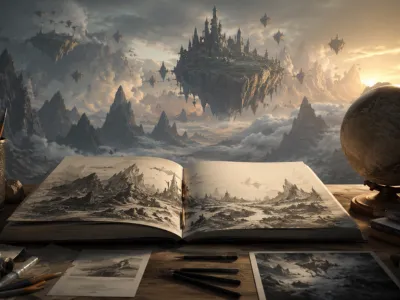
The table below exemplifies stages in this critical dialogue, while the list group outlines its primary benefits to the development ecosystem.

Phase Artistic Input Technological Feedback
Initial Vision High-detail painting establishing mood and scale. Assessment of target platform limitations (draw calls, VRAM).
Technical Art Review Orthographic views, material breakdowns. Specification of LOD requirements, shader instructions.
Iterative Refinement Simplified geometry, optimized texture proposals. Prototype implementation and performance profiling.
  • Risk Mitigation: Identifies technical overreach early in pre-production, preventing costly asset reworks.
  • Innovation Driver: Pushing artistic boundaries forces the development of new technical solutions and tools.
  • Team Alignment: Creates a shared understanding of goals and constraints between artistic and programming disciplines.
  • Quality Assurance: Ensures the final in-game assets maintain the core aesthetic intent under technical limits.

The Unseen Hands of the Concept Artist

The role of the concept artist is often misunderstood, perceived solely as that of an illustrator tasked with creating beautiful standalone images. In reality, their work is deeply embedded in a complex nexus of research, problem-solving, and interdisciplinary translation.

They operate as visual philosophers, deconstructing narrative themes and design mechanics into core visual principles. This involves extensve historical, scientific, and cultural research to inject authenticity and depth into every design choice, ensuring the world feels lived-in and logically consistent.

Their sketches serve as the first line of defense against design incoherence.

Beyond generating initial ideas, the concept artist acts as a visual gatekeeper throughout production. They provide constant feedback on 3D models, textures, and lighting to ensure the final assets remain faithful to the established visual language and artistic intent, maintaining stylistic cohesion across hundreds of individual components.

A critical, often unheralded skill is that of designing for function. A character's armor must not only look iconic but also accommodate a rigged skeleton for animation. An environment must be visually striking while facilitating level design metrics and gameplay flow. This requires a mind that balances aesthetics with engineering constraints.

The following list group encapsulates the multifaceted, non-illustrative responsibilities that define the modern concept artist's critical contribution to the development pipeline, responsibilities that extend far beyond the canvas and into the very architecture of the game's reality.

  • Visual Systems Architect: Establishes scalable rules for color, shape, and material that can be applied consistently by an entire art team.
  • Technical Liaison: Translates artistic vision into actionable briefs for 3D, VFX, and technical art departments, often creating detailed turnaround sheets and material maps.
  • Narrative Archaeologist: Embeds story and lore into environmental details, character wear-and-tear, and object design, enriching the world without explicit exposition.
  • Problem Solver: Addresses specific production challenges, such as designing a creature that can be both intimidating and animateable within polygon limits, or a vista that optimizes draw calls.

Cultural Imprint

Concept art is the primary vessel for embedding a game's cultural and thematic DNA. It consciously or subconsciously weaves real-world cultural references, philosophical ideologies, and social commentaries into the visual fabric of the game world, transforming it from a mere setting into a statement.

This process goes beyond superficial aesthetic appropriation. It involves a deep synthesis of influences to create something new yet resonant. A dystopian cityscape might visually critique hyper-capitalism through oppressive architecture and neon-lit advertisements, while a fantasy race's societal structure could be expressed through hierarchical clothing and communal living spaces.

The visual language becomes a tool for storytelling and player reflection.

Through deliberate iconography, color symbolism, and architectural styles, concept artists build worlds that challenge player perceptions and evoke specific emotional and intellectual responses. The derelict ruins of an advanced civilization can evoke themes of ecological hubris, while the fusion of organic and mechanical elements in a design can question the boundary between nature and technology.

This cultural imprint is what grants a game lasting relevance and depth, elevating it to a form of interactive cultural discourse. The work of the concept artist, therefore, is not just to depict a world, but to imbue it with a soul—a coherent set of values, history, and tensions that players can explore, question, and ultimately carry with them after the game is over. This complex layering of meaning ensures the game's visual world resonates on a level far deeper than the immediate gratifiction of its graphical fidelity, securing its place in the broader cultural conversation surrounding interactive media.

Future Trajectories in an AI-Driven Landscape

The advent of sophisticated generative AI is fundamentally reshaping the conceptual phase, transitioning the artist's role from sole originator to curatorial director of a hybrid creative process.

These tools offer unprecedented rapid iteration, generating vast arrays of visual options based on text prompts, thereby accelerating the initial ideation and mood-boarding stages. However, this necessitates a critical evolution in the concept artist's skill set, focusing on advanced prompt engineering, iterative refinement, and the crucial synthesis of AI-generated elements into a coherent, intentional visual language that aligns with core narrative and design pillars, ensuring the output transcends mere algorithmic novelty.