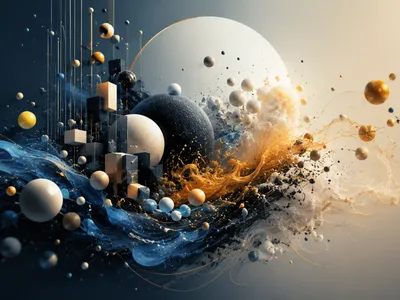
Abstract Thinking in Art and Visual Expression
Abstract thinking in art represents a fundamental departure from representing the visible world, engaging instead with concepts, emotions, and formal relationships. It operates through a language of form, color, line, and texture to convey ideas that are not tied to figurative depiction.
This cognitive mode prioritizes internal experience over external imitation, seeking to articulate the intangible. The artist's process becomes one of translation, converting non-visual phenomena into a visual syntax that can evoke complex responses.
At its heart, abstraction is not merely the absence of recognizable subjects but the active creation of a new visual paradigm based on principles like harmony, contrast, rhythm, and spatial tension. It challenges the viewer to participate in meaning-making rather than passively receiving a narrated scene, establishing a direct dialogue between the artwork's material presence and the observer's perception.
Theoretical frameworks position abstraction as a form of epistemic tool, a way of knowing and understanding that is distinct from, but complementary to, figurative representation. It functions on a spectrum, from works that distill essential qualities from observed reality to those concerned solely with non-objective, self-referential systems. This intellectual shift redefines art's purpose from narration to investigation, where the artwork becomes a site for exploring the very foundations of visual thought and sensory experience.
How Does Abstract Art Influence the Brain?
The creation and reception of abstract art engage distinct cognitive systems compared to figurative art. Artists utilize abstraction as a tool for perceptual mechanics, manipulating visual cues to trigger specific psychological or emotional states in the viewer.
This process often involves a deliberate bypassing of the brain's rapid object recognition pathways. By withholding familiar referents, the artist forces a slower, more contemplative mode of seeing that engages higher-order thinking.
Research into neuroaesthetics suggests that abstract art can activate neural networks associated with gestalt principles of organization, such as closure, continuity, and figure-ground relationships. The brain works to find structure and coherence within the composition, deriving pleasure from resolving visual tensions or appreciating balanced formal relationships. This search for order in non-representational patterns is a fundamental cognitive drive, making abstract art a potent stimulus for exploring how the mind constructs meaning from sensory input. The artistic strategy thus becomes one of designing a visual experience that guides this interpretive process without dictating a singular narrative outcome.
The artist's own cognitive process involves a sophisticated translation of non-visual concepts into material form. This requires moving beyond semantic meaning tied to objects and developing a personal vocabulary of marks, colors, and textures that correlate with internal states or ideas. The studio practice becomes a form of visual thinking, where decisions are made based on formal logic and intuitive feeling rather than descriptive accurcy. This mode of operation cultivates a unique inner lexicon of forms, where a specific type of line might embody tension and a particular color combination might evoke a sense of transcendence. The resulting artwork serves as both a record of this cognitive process and an instrument to provoke a analogous, though not identical, process within the viewer, creating a shared but subjective experiential space.
The Viewer's Active Engagement
Abstract art fundamentally reconfigures the role of the viewer from passive observer to active participant and co-creator of meaning. Without a prescribed subject, the individual must draw upon their own memories, emotions, and associations to engage with the work.
This engagement transforms the viewer into an interpreter, whose personal and cultural context becomes the primary lens for understanding. The artwork functions as an open system, its significance generated dynamically in the space between the artifact and the observer's consciousness.
The experience is best described as a phenomenological encounter with the artwork's physical presence—its scale, texture, and materiality. This direct, pre-conceptual engagement can evoke somatic responses that precede intellectual analysis.
This paradigm shift places immense importance on the hermeneutic gap—the space of interpretation between the artist's intent and the viewer's perception. This gap is not a deficiency but the essential core of abstract art's function, allowing for a multiplicity of valid readings. The artwork's success often hinges on its ability to sustain this generative ambiguity, inviting repeated viewings that yield new insights. This theoretical framework positions the abstract work not as a statement to be decoded but as an horizon of expectations that is continually renegotiated, making each encounter uniquely personal and temporally situated.
The dynamics of this interaction can be categorized to understand the different levels at which a viewer might connect with a non-representational piece. These categories are not hierarchical but represent different entry points into the work, often operating simultaneously. The following table outlines primary modes of engagement, illustrating how abstract art catalyzes diverse psychological and perceptual responses, moving beyond mere aesthetic appreciation to become a catalyst for introspection and cognitive reflection.
| Mode of Engagement | Cognitive Focus | Potential Outcome |
|---|---|---|
| Formal Analysis | Relationships of color, shape, line, composition | Appreciation of internal harmony, balance, or dynamic tension. |
| Affective Resonance | Emotional and somatic response to visual stimuli | Elicitation of mood, feeling, or physiological reaction. |
| Associative Projection | Personal memory and symbolic association | The work becomes a screen for the viewer's own narratives and metaphors. |
| Conceptual Contemplation | Consideration of ideas suggested by form or title | Reflection on broad themes like chaos, order, energy, or stillness. |