The Material Illusion

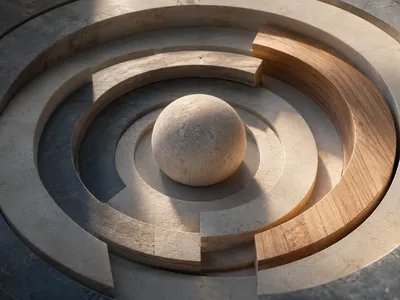
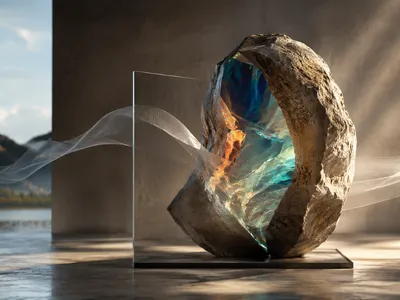
In visual composition, texture refers to the perceived surface quality of a work, a potent illusion that suggests tactile experience through purely visual means. This element operates on a dual level, engaging both the objective materiality and the subjective impression of a surface.

Artists and designers manipulate texture to evoke sensory memories, compelling the viewer to imagine the feel of roughness, smoothness, or grain. The visual suggestion of a material's character can profoundly influence the emotional and psychological response to an image, building a bridge between sight and touch.

This perceptual phenomenon relies on our brain's innate ability to interpret visual cues as physical properties. Pattern, light, and shadow converge to create convincing representations of depth and tactility on a flat plane, deceiving the eye into sensing dimension.

The strategic application of texture guides compositional hierarchy, directing attention and establishing contrast between elements. It functions as a critical tool for adding informational complexity and visual weight, distinguishing foreground from background and defining spatial relationships within the frame. This layer of information moves beyond shape and color to communicate environmental context and narrative detail.

Categories of Visual Texture

Textures in visual media are systematically categorized by their origin and method of application. Tactile texture is physically tangible, created through the actual manipulation of material, as seen in impasto paint or collaged elements. In contrast, visual texture is an implied, simulated quality, a photograph of bark or a digital rendering of fabric.

A further distinction exists between invented and simulated textures. Invented textures are non-representational patterns that originate from the artist's creativity, serving decorative or expressive purposes without mimicking a known source.

Simulated textures, however, are meticulously crafted to replicate the appearance of specific real-world materials, achieving a degree of photorealism that anchors the image in a believable reality. The choice between these categories dictates the artwork's stylistic language, from abstract expressionism to hyperrealism. Design software now offers extensive libraries of procedurally generated textures, allowing for infinite variation and precision in creating surface appearances that can be seamlessly applied and modified across digital canvases, revolutionizing traditional texturing workflows.

The following table delineates the primary categories of visual texture and their defining characteristics, providing a framework for analysis.

Category Definition Primary Application
Tactile (Actual) Physically exists on the surface; can be felt by touch. Painting, sculpture, mixed media, printmaking.
Visual (Implied) Illusion of surface quality created through visual cues. Photography, digital art, illustration, graphic design.
Invented Decorative or abstract patterns not based on real-world references. Abstract art, graphic patterns, textile design.
Simulated Realistic imitation of a specific material's surface. Hyperrealism, 3D rendering, architectural visualization.

Texture and Perceptual Psychology

The human visual system processes textural information through dedicated neural mechanisms, parsing gradients and patterns to infer object properties and spatial orientation. This rapid, pre-conscious analysis is a fundamental aspect of perceptual organization, allowing us to segment a scene into discrete elements.

Cognitive studies demonstrate that rough or irregular textures often signal potential hazard or natural decay, triggering instinctive caution. Conversely, smooth and uniform surfaces are typically associated with safety, modernity, and human-made precision, illustrating texture's deep semantic encoding.

The psychophysical response to texture is not merely aesthetic but functional, enabling material recognition and distance judgment without physical contact. Our brains leverage textural gradients—the gradual change in a texture's size and density—as a primary monocular depth cue, constructing a three-dimensional understanding ffrom a two-dimensional image. This automatic interpretation is why a photograph of a gravel path appears to recede into the distance.

Artists exploit these ingrained perceptual rules by manipulating texture to create compelling illusions of space and substance. The visual weight of a textured area can anchor a composition or create dynamic tension, directly influencing where a viewer's gaze is held longest. Furthermore, the perceived emotional temperature of an image is frequently modulated by its textural quality; coarse, chaotic textures may evoke anxiety or raw energy, while fine, orderly patterns suggest calm and control. This psychological dimension makes texture a powerful, often subliminal, channel for non-verbal communication within visual rhetoric, shaping narrative and mood beyond the capacities of form and color alone.

Tactility in the Digital Age

Digital media has fundamentally transformed the creation and experience of texture, divorcing surface quality from physical substance. Algorithmic texturing allows for the generation of infinitely complex, repeatable patterns through mathematical functions, enabling unprecedented control and variation.

The pursuit of hyperrealistic digital materiality drives advances in rendering engines, which simulate light interaction with virtual surfaces down to sub-surface scattering and micro-geometry. This computational mimicry seeks to evoke a tangible response to an intangible pixel array.

Paradoxically, the digital realm has also seen a resurgence of simulated analog texture—noise, grain, brush strokes, and paper imperfections—deliberately added to confer a sense of warmth, authenticity, or historical context. This practice, known as digital skeuomorphism, leverages texture to bridge the familiarity of the physical world with the abstraction of the digital interface, mitigating sterility and fostering emotional connection.

Interactive and haptic technologies are pushing the boundaries further by attempting to reunite the visual with the tactile. While true haptic feedback for visual textures remains limited, visual designers use texture to suggest interactivity, making buttons appear pressable or surfaces seem draggable through careful shading and highlight cues. The evolution of texture is thus central to the phenomenology of digital experience, constantly negotiating between the desire for flawless simulation and the human yearning for material trace and imperfection. This tension defines much of contemporary visual culture, where texture serves as a primary signifier of both technological advancement and a nostalgic longing for the physically authentic.

A Fundamental Design Tool

Beyond its aesthetic role, texture functions as a critical structural component in visual composition. Designers deploy texture strategically to establish a clear visual hierarchy, using coarse or detailed areas to attract primary attention and smoother zones to provide necessary rest. This manipulation guides the viewer's eye along a predetermined path through the work.

Texture is indispensable for creating convincing spatial relationships and defining the limits of forms. In the absence of overt lines, a shift in textural pattern can articulate the edge of an object or the boundary between two planes. This technique is vital for achieving depth in two-dimensional media.

The communicative power of texture extends to conveying specific material properties, environmental conditions, and temporal states such as aging or erosion. A designer's textural choices carry substantial cultural and symbolic weight, where certain patterns or materials can evoke tradition, luxury, or technological advancement. This symbolic layer adds a connotative dimension to the direct visual experience.

In practical application, texture interacts synergistically with other core design principles. It is a primary vehicle for creating contrast, whether through the juxtaposition of rough and smooth or patterned and plain. It also establishes rhythm through the repetition of textural motifs and contributes to overall unity when a consistent textural theme is maintained. The deliberate absence of texture, utilizing flat color and clean gradients, remains an equally powerful statement within minimalist and modern design paradigms, proving that its strategic omission is as significant as its application.

Effective use of texture in composition can be broken down into several key strategic functions:

  • Creation of Depth and Space: Textural gradients and diminishing detail suggest atmospheric perspective and distance.
  • Definition of Form: Highlights and shadows within a texture reveal the contours and volume of a shape.
  • Direction of Visual Flow: Leading lines within a pattern or areas of high textural contrast guide the viewer's gaze.
  • Establishment of Mood and Tone: The emotional resonance of an image is heavily influenced by its surface qualities.
  • Enhancement of Visual Interest: Texture prevents monotony by adding complex, engaging detail to areas of a composition.
Transgressing Surface Boundaries

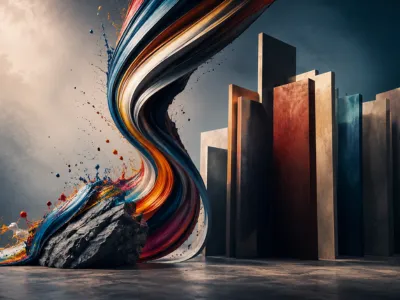
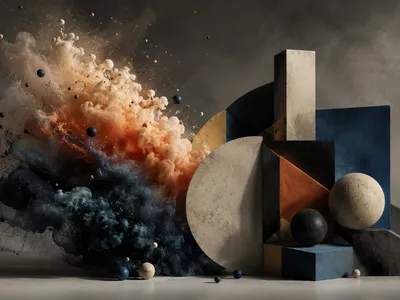
Contemporary art and design frequently challenge the conventional role of texture, pushing it beyond mere representation into the realms of conceptual and experiential practice. Artists manipulate texture not just to depict but to question materiality itself, often creating works where the visual and the tactile are intentionally misaligned.

This conceptual approach sees texture employed as a metaphor for social, psychological, or environmental conditions. A fractured, decaying surface might comment on urban neglect, while a densely layered, oppressive texture could symbolize information overload. In these contexts, the material illusion becomes a carrier for critical discourse, its aesthetic qualities inseparable from its thematic message. The texture is the content.

Advanced fabrication technologies like 3D printing and digital milling further blur the lines between texture and form, allowing for the creation of objects where surface pattern is integral to the structure. In such works, texture is not applied but generated, emerging from the algorithmic logic of the design process. This represents a fundamental shift from texture as a superficial application to texture as a systemic property, deeply embedded in the object's genesis and function.

The exploration of texture has expanded into immersive and multi-sensory installations, where visual texture is coupled with sound, smell, or actual tactile feedback. These experiences dismantle the traditional boundaries between sensory modalities, proposing a more holistic model of perception. The future of texture in visual composition lies in its continued dematerializtion and re-materialization, oscillating between pixel and particle, always serving as a crucial interface between the viewer, the work, and the ideas it embodies. This evolution underscores texture's enduring capacity to adapt and retain its foundational role as a bridge between the seen and the felt, even as the definitions of both are perpetually redefined.

The following table contrasts traditional and contemporary approaches to texture, highlighting the evolution of its application and conceptual significance.

Aspect Traditional Approach Contemporary/Conceptual Approach
Primary Function Mimetic representation, decorative enhancement, spatial cueing. Conceptual metaphor, experiential trigger, structural integration.
Relationship to Form Applied to the surface of a pre-established form. Generative; form and texture emerge from the same process.
Sensory Engagement Primarily visual, with implied tactility. Multi-sensory, often combining visual with auditory, haptic, or olfactory elements.
Technological Basis Physical craft (brushwork, carving, printing) or analog photography. Digital algorithms, parametric design, and hybrid digital-physical fabrication.
End Goal To master illusion and achieve aesthetic harmony or realism. To provoke inquiry, challenge perception, and materialize abstract ideas.