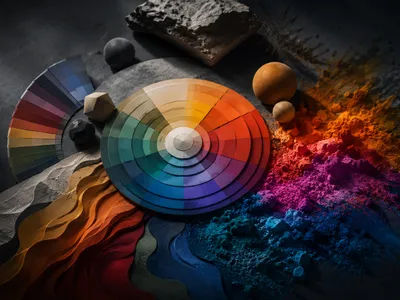
Can Digital Art Replicate the Tactility of Analog Art?
Analog art privileges the haptic encounter, where the physical interaction between hand, tool, and substrate produces an indexical trace of the artist’s gesture. This unmediated contact embeds a temporal narrative within the work, one that digital processes often seek to emulate but cannot fully replicate.
Contemporary discourse increasingly recognizes that digital tools are not devoid of tactility; rather, they generate what theorists term a simulated sensory field. Pressure-sensitive styluses and haptic feedback devices translate physical force into parametric variation, forging a new category of mediated materiality.
This convergence challenges the traditional dichotomy between the authentic, imperfect surface of analog media and the sterile perfection of the digital. Artists now exploit the friction between these domains, deliberately introducing glitches, rendering artifacts, and algorithmic noise to evoke the unpredictability of handmade marks.
The Algorithmic Hand
Code-based creation redefines artistic agency by embedding procedural logic directly into the mark-making process. Generative algorithms function as a collaborative agent, producing forms that emerge from rule sets rather than direct manipulation, yet the artist’s curation of parameters remains a distinctly authored act.
The concept of computational materiality has gained traction, framing software not as an immaterial medium but as a structured environment with its own resistances and affordances. Just as a lithographer respects the grain of the stone, the digital artist learns to work with the constraints of the compiler.
To illustrate how these algorithmic constraints manifest across different creative platforms, the following table outlines key technical parameters that define texture generation in contemporary digital art practice. Each entry highlights the interplay between user input and system behavior.
| Platform / Environment | Texture Parameter | Algorithmic Constraint |
|---|---|---|
| Procedural generation (Houdini) | Noise functions, attribute noise | VEX expressions limit randomness range |
| Neural style transfer (PyTorch/TensorFlow) | Gram matrix, feature maps | Pretrained model biases texture synthesis |
| Creative coding (p5.js, openFrameworks) | Pixel shaders, particle systems | GPU memory & frame‑rate bottlenecks |
Such technical parameters reveal that algorithmic tools do not eliminate the physical; instead they substitute one form of resistance for another. The artist’s fluency in navigating these computational limits becomes a contemporary analog to traditional craft knowledge.
Materiality in the Digital Realm
The notion of digital materiality reorients critical discourse away from ephemerality toward the tangible constraints embedded in hardware and software. Physical substrates such as graphics cards, memory architectures, and network latencies impose limits that artists harness as expressive resources rather than mere technical obstacles.
This perspective reframes the studio as a distributed system where code, silicon, and gesture intersect. A glitch in a rendering pipeline or a deliberate buffer overflow becomes a contemporary analogue to the accidental crack in a ceramic glaze—both are embraced for their capacity to reveal underlying structures, much like how abstract art influences graphic design through structural experimentation.
Scholars now categorize digital materiality across several axes, each influencing how texture is conceived and perceived. The following list outlines key dimensions that define the material behavior of computational media, moving beyond surface appearance to structural properties.
- Computational grain – the inherent resolution, bit depth, and algorithmic limits of a given environment
- Input resistance – the tactile feedback and latency introduced by stylus, mouse, or haptic devices
- Procedural viscosity – the “weight” of code execution, from real-time interaction to non-linear rendering times
- Archival decay – the gradual obsolescence of file formats, drivers, and hardware platforms
These categories demonstrate that digital creation is never purely dematerialized. Instead, it operates within a layered materiality that demands a craft‑based sensitivity to non‑human actors. Artists who treat algorithms as pliable substances rather than rigid instructions produce works of unexpected depth.
How Do Artists Combine Analog and Digital Techniques?
Hybrid methodologies deliberately blur the boundaries between analog and digital, creating artworks where physical substrates are augmented by computational processes or where digital outputs are re‑embedded into tangible media. Such practices often begin with a traditional mark—a brushstroke, a print—that is then scanned, algorithmically transformed, and finally returned to a physical surface through CNC milling or large‑format printing.
Artists employing hybrid techniques frequently cite the concept of material translation as central to their process. This process closely aligns with what is mixed media exploration, involving not merely converting file formats but negotiating the distinct affordances and resistances each medium offers, allowing imperfections from one realm to enrich the other.
A prominent strategy involves using digital tools to generate data that directly controls analog fabrication devices, creating a feedback loop between virtual design and physical execution. The table below contrasts three common hybrid workflows, illustrating how each redefines artistic authorship and texture production.
| Workflow Type | Analog Input | Digital Process | Analog Output |
|---|---|---|---|
| Scan‑manipulate‑print | Hand‑drawn textures, found objects | Photoshop layering, generative neural networks | Archival pigment print on textured paper |
| Parametric fabrication | Physical mold or clay model | 3D scanning, parametric deformation in CAD | CNC‑routed wood or ceramic extrusion |
| Analog‑digital loop | Intuitive brushwork on canvas | Real‑time projection mapping, live video feedback | Modified surface with projected digital textures |
Each hybrid workflow foregrounds a distinct form of material dialogue. In the first, the digital layer amplifies the granularity of the original analog gesture; in the second, computation introduces structural complexity that would be impossible to achieve by hand alone. The third approach preserves the immediacy of painting while overlaying ephemeral digital textures that shift with viewer interaction.
This integration of analog craft and digital precision challenges the notion that technology alienates makers from physical materials. Instead, hybrid practitioners cultivate a bimodal literacy—fluency in both the logic of code and the behavior of canvas, stone, or wood—that expands the vocabulary of contemporary art. Their works serve as sites where the supposed opposition between the handmade and the programmed dissolves into a continuous creative spectrum.
How Do Digital Images Simulate Tactile Experience?
Digital screens produce a uniform visual field that reduces texture to pixels, yet viewers can still infer tactile qualities through visual cues, mentally reconstructing sensations like roughness or softness. Neuroscience explains this through haptic imagery, where observing textures activates touch-related brain regions, allowing digital images to evoke responses similar to physical interaction.
Extended screen exposure has reshaped aesthetic expectations, favoring highly detailed and realistic textures that mimic physical materials. Artists use this to blur the boundary between simulation and reality, revealing how perception itself is shaped by interpretation, where sensory experience and aesthetic judgment depend as much on the observer as on the medium.